

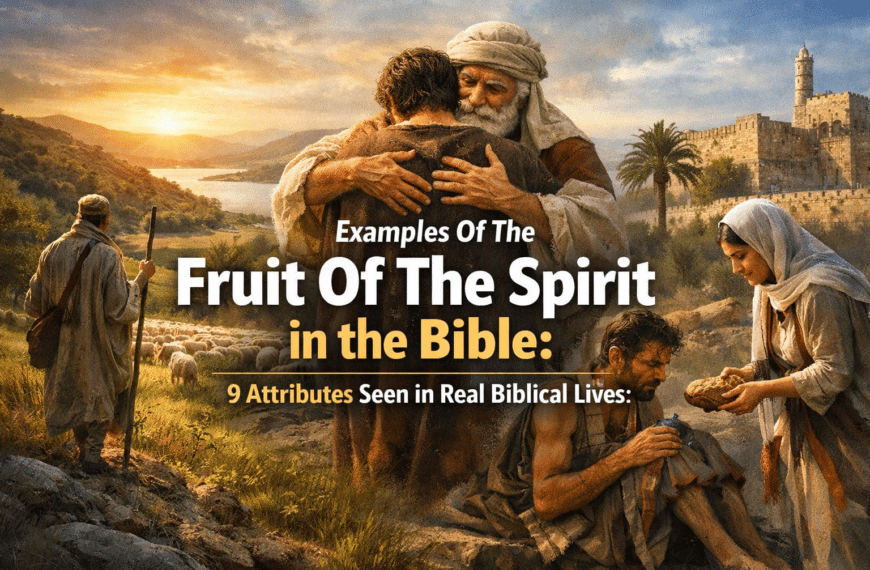
A single verse in Galatians has shaped how millions of Christians understand spiritual maturity for nearly two thousand years. That verse, Galatians 5:22-23, lists nine qualities that the Holy Spirit grows in the life of every believer. But here is what I find luminous about this passage: Paul did not invent these traits out of thin air. They show up all through Scripture, lived out by real people in real, messy situations. When we look at examples of the Fruit of the Spirit in the Bible, we discover that these qualities are not abstract ideas. They are Christ-like responses that God’s Spirit has been cultivating in His people since the beginning.
As a pastor, I have watched believers struggle to “produce” spiritual fruit through sheer effort. It never works. The fruit is not something you manufacture. It is something the Holy Spirit grows in you as you stay connected to the Vine [3]. Think of it like an apple on a branch. Cut the branch from the tree, and the apple withers. Stay connected, and the fruit comes naturally.
Let’s walk through each of the nine attributes and find concrete examples of the Fruit of the Spirit in the Bible that bring these qualities to life.
Key Takeaways
- The Fruit of the Spirit is one fruit with nine expressions: Love, joy, peace, patience, kindness, goodness, faithfulness, gentleness, and self-control (Galatians 5:22-23) [1].
- These qualities come from the Holy Spirit, not human effort. You cannot grit your teeth hard enough to produce them on your own [6].
- Every attribute has clear biblical examples in both the Old and New Testaments, proving God has always been shaping His people this way.
- Paul contrasted these traits with the “works of the flesh” to show believers the difference between a Spirit-led life and a self-led life [2].
- “Against such things there is no law” means these virtues represent the highest moral standard anyone could live by [3].

What Is the Fruit of the Spirit? A Quick Foundation
Before we dig into specific examples of the Fruit of the Spirit in the Bible, let’s set the foundation.
The Apostle Paul wrote to the churches in Galatia:
“But the fruit of the Spirit is love, joy, peace, longsuffering, kindness, goodness, faithfulness, gentleness, self-control. Against such there is no law.” — Galatians 5:22-23 (NKJV)
Notice Paul says “fruit,” not “fruits.” That is intentional. These nine qualities are one unified harvest that the Holy Spirit produces in a believer’s life [4]. You do not get to pick three and skip the rest. As you grow in Christ, all nine begin to emerge.
Paul wrote this passage to contrast the works of the flesh with the fruit of the Spirit [1][2]. The works of the flesh are things like hatred, jealousy, outbursts of anger, and selfish ambition. The fruit of the Spirit is the opposite. It is what your life looks like when God’s Spirit is genuinely in control.
This teaching also fulfills a promise God made centuries earlier through the prophet Ezekiel: “I will put My Spirit within you and cause you to walk in My statutes” (Ezekiel 36:27, NKJV) [3]. The Fruit of the Spirit is not a New Testament novelty. It is the fulfillment of God’s ancient plan to transform His people from the inside out.
If you are on a spiritual growth journey, understanding these nine attributes is essential.
Examples of Love, Joy, and Peace in the Bible

Love: Ruth’s Devotion to Naomi
Love tops the list for a reason. It is the bedrock of every other attribute. And one of the most resplendent examples of love in Scripture is Ruth.
When Naomi lost her husband and both sons, she told her daughters-in-law to go back to their families. Orpah left. Ruth refused. She said:
“Wherever you go, I will go; and wherever you lodge, I will lodge; your people shall be my people, and your God, my God.” — Ruth 1:16 (NKJV)
Ruth gave up her homeland, her culture, and her security for the sake of a grieving mother-in-law. That is not obligation. That is Spirit-level, sacrificial love.
How to apply this: Love is not just a feeling. It is a decision to stay when leaving would be easier. Ask God to show you one person this week who needs your steadfast presence.
Joy: Paul and Silas Singing in Prison
Joy is not happiness. Happiness depends on circumstances. Joy comes from knowing God is in control even when your circumstances are terrible.
In Acts 16:25, Paul and Silas had been beaten and thrown into prison. Their feet were locked in stocks. And what did they do? They sang hymns to God at midnight. The other prisoners listened. Then God sent an earthquake that opened every door.
Joy in the Spirit does not wait for things to get better. It worships in the dark.
Peace: Jesus Sleeping in the Storm
In Mark 4:38, a violent storm raged over the Sea of Galilee. The disciples panicked. Jesus? He was asleep on a pillow in the back of the boat.
That is peace. Not the absence of storms, but the presence of trust. Jesus knew His Father was sovereign. When He woke, He simply said, “Peace, be still!” and the wind obeyed.
If anxiety is something you wrestle with, take a look at the biblical antidote for anxiety. God’s peace is available to you right now.
Examples of Patience, Kindness, and Goodness in Scripture

Patience (Longsuffering): Joseph’s Long Wait
Joseph was sold into slavery by his brothers at age 17. He was falsely accused by Potiphar’s wife. He spent years in prison for a crime he did not commit. He did not see vindication until he was 30 years old.
Thirteen years. That is a long time to wait for God’s promise.
Yet Joseph never grew bitter. When he finally stood before his brothers, he said: “You meant evil against me; but God meant it for good” (Genesis 50:20, NKJV).
Patience is not passive waiting. It is active trust that God is working even when you cannot see it. If you feel like God has forgotten His promise to you, Joseph’s story says otherwise.
Kindness: The Good Samaritan
Jesus told the parable of the Good Samaritan in Luke 10:30-37. A man was beaten and left for dead. A priest walked by. A Levite walked by. But a Samaritan, someone despised by the Jewish community, stopped. He bandaged the man’s wounds, put him on his own donkey, and paid for his care at an inn.
Kindness crosses social barriers. It does not ask, “Does this person deserve my help?” It simply helps.
Goodness: Dorcas (Tabitha) and Her Generous Life
In Acts 9:36, we meet a disciple named Dorcas who was “full of good works and charitable deeds.” She made clothing for widows. She served her community tirelessly. When she died, the widows stood weeping, holding up the tunics she had made for them.
Goodness is love in action. It is tangible. It leaves evidence. For more on this topic, explore these examples of goodness in the Bible.
Examples of Faithfulness, Gentleness, and Self-Control in the Bible
Faithfulness: Daniel’s Unwavering Commitment
Daniel served in a foreign government for decades. Kings rose and fell around him. Political enemies tried to destroy him. Yet Daniel never compromised his devotion to God.
When a law was passed forbidding prayer to anyone but the king, Daniel “knelt down on his knees three times that day, and prayed and gave thanks before his God, as was his custom since early days” (Daniel 6:10, NKJV).
Faithfulness is not flashy. It is showing up day after day, doing what God has called you to do, whether anyone notices or not. Daniel’s story is one of the most compelling examples of conquering fear with faith in all of Scripture.
Gentleness: Jesus with the Children
The disciples tried to shoo the children away from Jesus. They thought He was too important, too busy. But Jesus rebuked His own disciples and said:
“Let the little children come to Me, and do not forbid them; for of such is the kingdom of God.” — Mark 10:14 (NKJV)
Then He took them in His arms and blessed them. Gentleness is strength under control. Jesus had all authority in heaven and earth, yet He knelt down to hold a child.
Self-Control: Jesus Before Pilate
Perhaps the most staggering example of self-control in the Bible is Jesus standing before Pontius Pilate. He had the power to call down twelve legions of angels (Matthew 26:53). He could have destroyed every person in that courtroom with a word.
Instead, He remained silent. “He was led as a lamb to the slaughter, and as a sheep before its shearers is silent, so He opened not His mouth” (Isaiah 53:7, NKJV).
Self-control is not weakness. It is the most formidable kind of strength. It is choosing God’s plan over your own impulse. For more on temperance and restraint, see these examples of temperance in the Bible.
How to Cultivate the Fruit of the Spirit in Your Daily Life

Knowing examples of the Fruit of the Spirit in the Bible is valuable. But knowledge without application is just trivia. Here is how to actually grow this fruit in your life:
🌱 5 Practical Steps to Grow Spiritual Fruit
| Step | Action | Scripture Anchor |
|---|---|---|
| 1. Stay connected to Jesus | Spend daily time in prayer and the Word | John 15:5 — “Without Me you can do nothing” |
| 2. Surrender to the Spirit | Stop trying to produce fruit by willpower | Galatians 5:16 — “Walk in the Spirit” |
| 3. Identify your weak areas | Which fruit is hardest for you? Focus there | Philippians 2:13 — God works in you |
| 4. Practice in small moments | Choose patience in traffic. Choose kindness online | Luke 16:10 — Faithful in little things |
| 5. Stay in community | Spiritual fruit grows best around other believers | Hebrews 10:24-25 — Stir one another up |
The key truth is this: you cannot grow spiritual fruit apart from the Holy Spirit [6]. An apple does not strain to grow on a branch. It simply stays attached to the tree, and the tree does the work [3]. Your job is to abide. God’s job is to produce.
If you want to go deeper, I recommend exploring the Holy Spirit’s power in your life and learning what it means to pray in the Spirit.
Common Mistakes to Avoid
- Trying harder instead of surrendering more. The flesh cannot produce spiritual fruit [2].
- Comparing your growth to others. Fruit ripens at different rates. Be patient with yourself.
- Neglecting one attribute for another. You might be great at kindness but struggle with self-control. The Spirit wants to develop all nine.
- Forgetting that pruning is part of the process. God sometimes allows difficult seasons to produce greater fruit (John 15:2).
If you are carrying old wounds or baggage that hinder your growth, consider letting go of spiritual baggage so the Spirit can work freely in your heart.
Conclusion: Let the Spirit Do the Growing
The examples of the Fruit of the Spirit in the Bible are not just ancient stories. They are blueprints for how God wants to shape your life in 2026 and beyond. Ruth showed us love. Paul and Silas showed us joy. Jesus showed us peace, gentleness, and self-control at the highest level imaginable.
Here is what I want you to walk away with today:
- Pick one fruit that you struggle with most. Be honest with yourself.
- Study the biblical example connected to that attribute. Let it sink deep.
- Ask the Holy Spirit each morning this week to grow that specific fruit in you.
- Look for one small opportunity each day to practice it.
You do not have to be perfect. You just have to stay connected to the Vine. The Spirit will handle the rest.
“He who has begun a good work in you will complete it until the day of Jesus Christ.” — Philippians 1:6 (NKJV)
God is not finished with you. The best fruit is still ahead.
References
[1] Fruit Of The Spirit – https://www.compassion.com/blog/fruit-of-the-spirit/
[2] The Acts Of The Flesh Vs The Fruit Of The Spirit Galatians Sermon 22 Of 26 – https://twojourneys.org/sermons/series/galatians/the-acts-of-the-flesh-vs-the-fruit-of-the-spirit-galatians-sermon-22-of-26/
[3] A Fresh Look At The Fruit Of The Spirit – https://ourdailybread.org/a-fresh-look-at-the-fruit-of-the-spirit/
[4] Fruits Spirit And Their Meanings Bible – https://bibleproject.com/articles/fruits-spirit-and-their-meanings-bible/
[6] What The Fruit Of The Spirit Looks Like In Your Daily Life – https://maninthemirror.org/what-the-fruit-of-the-spirit-looks-like-in-your-daily-life/
Share On Pinterest



Pastor Duke has been preaching and teaching the Bible since 1988. He has shared his knowledge online since 2011.








 By
By