
For centuries, burial has been the predominant practice for Christians, rooted in deep tradition and theological conviction. Yet as cremation now accounts for over 63% of all U.S. dispositions [1], many sincere believers are wrestling with a genuinely important question: Does the choice between burial and cremation actually matter to God?
This is not a trivial question. It touches the resurrection, the sanctity of the body, and how Christians bear witness even in death. The conversation around Christian burial vs. cremation is one that deserves a careful, Scripture-anchored answer, and that is exactly what this article aims to provide.
Key Takeaways
- The Bible does not explicitly forbid cremation, but Christian tradition has strongly favored burial as a theological statement about resurrection.
- Most Protestant denominations permit cremation, while the Catholic Church allows it with specific conditions about how remains must be treated.
- Practical factors like cost and environmental concern are driving more Christians toward cremation in 2026.
- What matters most is the heart behind the choice, not the method itself.
- Believers should make this decision prayerfully, in community, and with Scripture as their guide.
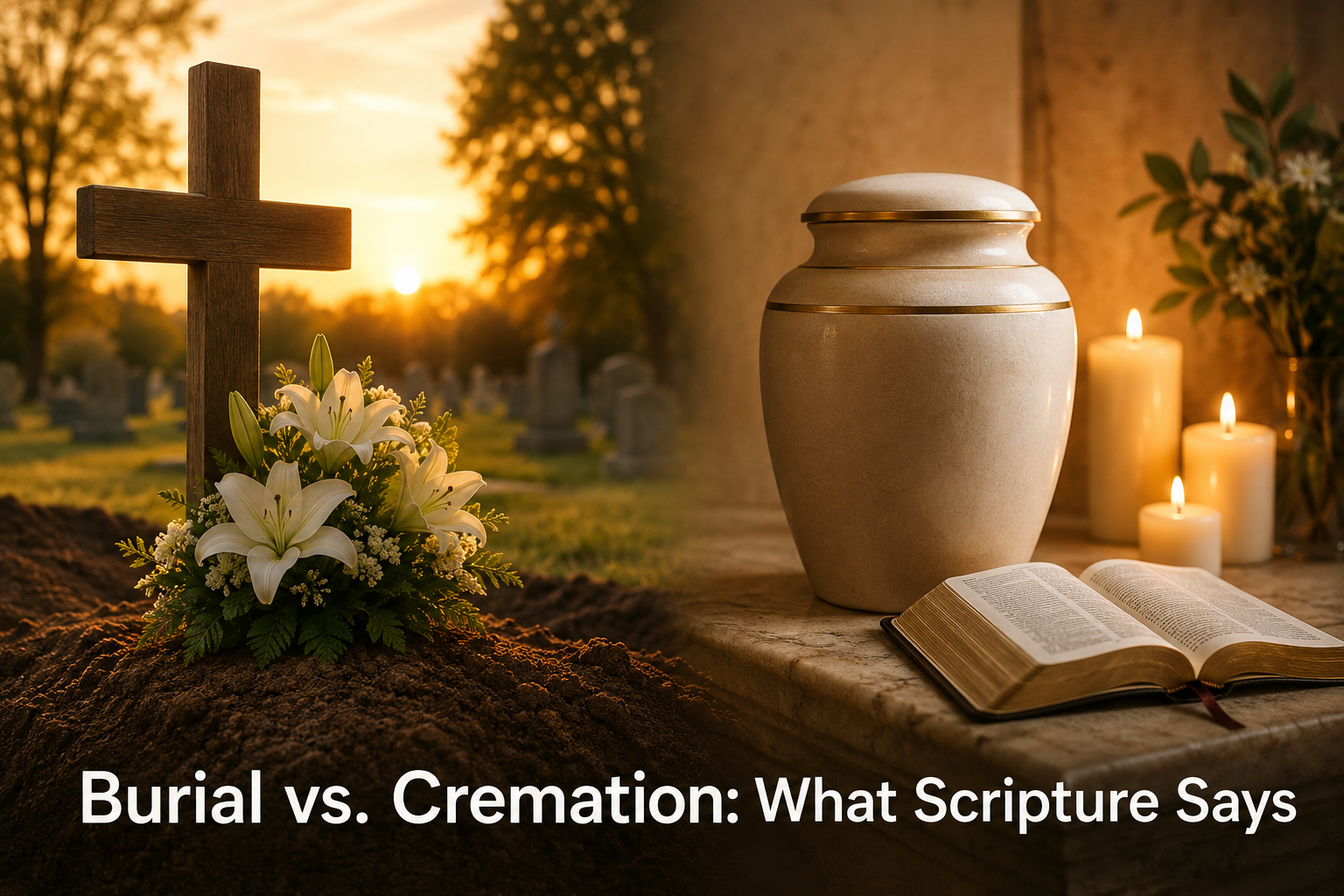
What Does the Bible Actually Say?
Scripture never directly commands burial or prohibits cremation. That is an important starting point. However, the Bible does establish a high view of the human body that shapes how Christians have historically approached death.
Genesis 3:19 says, “For dust you are, and to dust you shall return” (NKJV). This verse is often cited in both directions: some say it supports cremation as a faster return to dust, while others argue it describes a natural process that should not be artificially accelerated.
More significantly, the New Testament frames the body as a temple of the Holy Spirit. 1 Corinthians 6:19-20 declares, “Do you not know that your body is the temple of the Holy Spirit who is in you, whom you have from God, and you are not your own? For you were bought at a price; therefore glorify God in your body and in your spirit, which are God’s” (NKJV). This does not settle the burial-versus-cremation debate, but it does establish that the body carries dignity and deserves reverence.
The resurrection of Jesus is also central. His body was buried, not burned. John 19:40 records that His body was wrapped and placed in a tomb according to Jewish burial customs. Early Christians, living in the shadow of the resurrection, followed suit. Burial became a profound act of faith, a way of saying, “We believe this body will rise again.”
Historical Christian Burial Practices and Their Meaning
For most of church history, cremation was associated with pagan practice. Early Christians deliberately chose burial as a counter-cultural statement. They believed the body mattered, not because it could not be resurrected from ashes, but because burial was a visible, communal act of hope.
The early church father Tertullian wrote against cremation in the second century, not because God could not raise a cremated body, but because burial better expressed the Christian hope of resurrection. This tradition held firm across Catholic, Orthodox, and Protestant communities for well over a thousand years.
The Catholic Church formally prohibited cremation until 1963, when the Second Vatican Council lifted the ban. Even today, the Church permits cremation but strongly prefers burial and requires that cremated remains be treated with the same reverence as a body. They must be buried or entombed, not scattered or kept in a home. [3] [7]
This history matters because it reveals the theological instinct behind Christian burial: the body is not a shell to be discarded. It is part of the person God created, redeemed, and will one day raise.
What Different Denominations Teach Today
The landscape of Christian burial vs. cremation looks different depending on where you worship.
| Denomination | Position on Cremation |
|---|---|
| Roman Catholic | Permitted; remains must be buried or entombed [3] |
| Eastern Orthodox | Generally discouraged; burial strongly preferred |
| Most Protestant | Permitted; left to individual conscience |
| Southern Baptist | No official prohibition; burial culturally preferred |
| Anglican/Episcopal | Permitted; burial of remains encouraged |
For most Protestant believers in 2026, cremation is a matter of personal and family choice. What most traditions agree on is this: the method of disposition does not affect God’s ability to resurrect the body. Romans 8:11 assures us, “But if the Spirit of Him who raised Jesus from the dead dwells in you, He who raised Christ from the dead will also give life to your mortal bodies through His Spirit who dwells in you” (NKJV). God is not limited by whether a body was buried whole or reduced to ash.
Studying the character of God in Scripture helps believers anchor this truth: God’s sovereignty over creation means no physical state is beyond His resurrecting power.
Modern Trends Shaping Christian Choices in 2026
Several real-world factors are influencing how Christians approach end-of-life decisions right now.
Cost is a major driver. The median cost of a casketed burial with viewing and ceremony was $8,300 in 2023, compared to just $2,750 for direct cremation. [2] For many families, especially those in financial hardship, cremation is simply the more viable option. Being a good steward of resources is itself a biblical value.
Environmental concern is growing. Over half of Americans surveyed would consider a green burial, reflecting a broader cultural shift toward environmental stewardship. [5] Some Christians see caring for creation as an extension of their faith, pointing to passages like Genesis 2:15 about tending the earth.
Generational shifts are surprising. Interestingly, a recent survey found a resurgence of interest in traditional casket burials among Generation Z, suggesting that younger believers may be rediscovering the theological weight of burial. [5]
Declining religious affiliation also plays a role. With the Christian share of the U.S. adult population now between 60% and 64% [4], fewer families are making end-of-life decisions within a faith framework at all. This makes it even more important for believers to think through these choices intentionally.
Leaning on Bible verses for family can help ground these conversations in love and shared faith when families gather to make these decisions together.
What Actually Matters to Believers
So what should a Christian prioritize when making this decision? Here are five practical considerations:
- Honor the body. Whatever method is chosen, the body should be treated with dignity and respect. This is non-negotiable for believers.
- Affirm the resurrection. The funeral or memorial service should clearly proclaim the hope of resurrection. The method of disposition is secondary to this witness.
- Respect denominational guidance. If you are Catholic or Orthodox, follow your church’s teaching. If you are Protestant, bring the question to prayer and wise counsel.
- Consider your family. Grief is real. The way remains are handled can deeply affect how loved ones process loss. Bible verses about comfort when stressed can help families navigate this tender season.
- Do not let cost or culture decide alone. Financial reality is a legitimate factor, but it should not be the only voice in the room.
The apostle Paul wrote in 1 Thessalonians 4:13-14, “But I do not want you to be ignorant, brethren, concerning those who have fallen asleep, lest you sorrow as others who have no hope. For if we believe that Jesus died and rose again, even so God will bring with Him those who sleep in Jesus” (NKJV). That hope is the foundation of every Christian funeral, regardless of what happens to the body.
For those walking through grief right now, the Bible quotes on healing found in Scripture are a genuine source of strength.
Conclusion: Let Faith Lead the Way
The question of Christian burial vs. cremation does not have a single, binding answer for most believers. What Scripture demands is not a specific method, but a posture of reverence, hope, and faith. The body matters. The resurrection matters. How the community gathers to grieve and celebrate matters.
If you are navigating this decision for yourself or a loved one, bring it before God. Talk with your pastor. Search the Scriptures. And remember that the God who knit you together in your mother’s womb (Psalm 139:13) is more than able to raise you on the last day, whatever your earthly remains may look like.
For those wanting to deepen their understanding of who God is and what He promises, a solid Bible study on who God is can build the theological confidence needed to face even the hardest questions with peace.
Actionable next steps:
- Pray and discuss your wishes with family before a crisis moment arrives.
- Consult your pastor or church leadership for denominational guidance.
- Write down your end-of-life preferences and share them with trusted loved ones.
- Ground every decision in the hope of resurrection, not just cultural convenience.
References
[1] Americans Choosing Cremation At Historic Rates Nfda Report Finds – https://nfda.org/news/media-center/nfda-news-releases/id/9772/americans-choosing-cremation-at-historic-rates-nfda-report-finds?utm_source=openai
[2] Funeral Cremation Burial Options – https://www.axios.com/2026/01/25/funeral-cremation-burial-options?utm_source=openai
[3] Cremation And Funerals – https://www.usccb.org/prayer-and-worship/sacraments-and-sacramentals/bereavement-and-funerals/cremation-and-funerals?utm_source=openai
[4] Religious Landscape Study Religious Identity – https://www.pewresearch.org/religion/2025/02/26/religious-landscape-study-religious-identity/?utm_source=openai
[5] Death Care Survey – https://law.wfu.edu/2026/02/death-care-survey/?utm_source=openai
[6] 2022 Us Cremation Rate – https://us-funerals.com/2022-us-cremation-rate/?utm_source=openai
[7] Cremation – https://www.catholicnh.org/parishes/parish-life/catholic-cemeteries/cremation/?utm_source=openai
[8] The Case For Christian Burial – https://americanreformer.org/2025/06/the-case-for-christian-burial/?utm_source=openai
Test Your Knowledge!
Answer all 10 questions, then submit to see your score.
Related Posts
Evangelicals and LDS Church: Why the 'Cult' Label Persists in June 2026
Last updated: June 2026 A June 2026 decision by the U.S. Department of Defense to remove the "Christian" label from its official religious classifications reignited a…
 Jun 15, 2026
Why Is Faith So Important in Christianity?
Last updated: May 2026 Discover why faith is the foundation of the Christian life — how it connects you to salvation, shapes how you see the world, and transforms your relationship with God every day.
May 18, 2026
How to Choose the Right Bible Study on Love (What to Look For)
Last updated: May 2026 Not all Bible studies on love are created equal. Learn what to look for — theological depth, serious Scripture, and application that actually changes how you love.
May 21, 2026
Encouraging Trends in Global Christianity: June 2026 Update
Last updated: June 2026 While headlines often focus on challenges facing Christianity, new reports highlight encouraging trends in global Christian adherence and engagement. The global Christian…
Jun 10, 2026


 By
By


