

Have you ever felt like your past mistakes disqualify you from God’s calling? I’ve been there. But when I dive into a Bible character study about Peter, I’m reminded that God doesn’t call the qualified—He qualifies the called. Peter’s story is one of the most compelling transformation narratives in all of Scripture, showing us that our failures don’t define us; God’s grace does.
Peter wasn’t a polished religious leader. He was a rough-around-the-edges fisherman who spoke before he thought, made bold promises he couldn’t keep, and denied Jesus at His darkest hour. Yet Jesus chose this impulsive, passionate man to become the rock upon which He would build His church. That’s the beauty of God’s redemptive power—He takes our mess and transforms it into a message.
In this comprehensive Bible character study about Peter, we’ll walk through his journey from the shores of Galilee to the foundation of the early church. Whether you’re leading a small group, preparing a sermon, or seeking personal spiritual growth, Peter’s life offers practical lessons we can apply today.
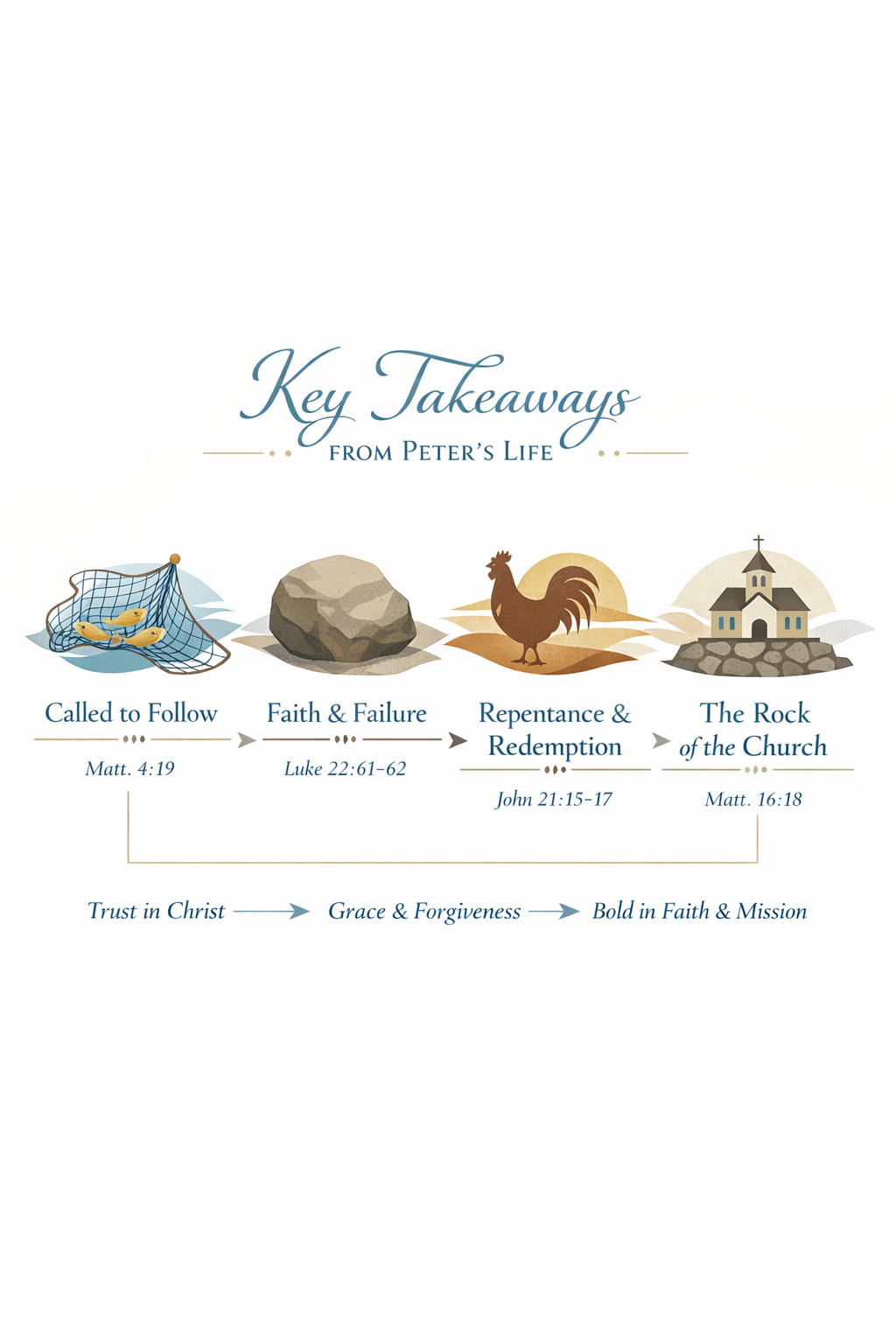
Key Takeaways
- Peter’s transformation from impulsive fisherman to foundational church leader demonstrates God’s power to redeem and restore anyone willing to follow Him
- Bold faith and spectacular failure both marked Peter’s journey, showing us that stumbling doesn’t disqualify us from God’s calling
- Jesus’s restoration of Peter after his denial reveals the depth of God’s grace and His commitment to complete the work He starts in us
- Peter’s leadership model emphasizes servant-hearted humility, resilience through failure, and unwavering commitment to Christ’s mission
- Practical application of Peter’s life helps us embrace our own transformation journey with hope and confidence in God’s faithfulness
Who Was Peter? Understanding His Background and Calling
The Fisherman from Bethsaida
Before Peter ever met Jesus, he was Simon, son of Jonah, a fisherman from Bethsaida who worked the waters of the Sea of Galilee[1]. This wasn’t some romantic, peaceful occupation. Fishermen in first-century Galilee were characteristically strong, decisive, courageous, and often used coarse language[3]. They worked brutal hours, hauled heavy nets, and battled unpredictable weather.
Peter and his brother Andrew ran a fishing business, likely in partnership with James and John, the sons of Zebedee. This was hard, physical labor that shaped Peter’s personality—he was a doer, a man of action who made quick decisions and wasn’t afraid of a challenge.
When we understand Peter’s background, we see why Jesus called him. God doesn’t waste our experiences. The same qualities that made Peter a successful fisherman—boldness, leadership, resilience—would later make him a powerful apostle. Jesus saw past the rough exterior to the rock underneath.
The Moment Everything Changed
Peter’s calling came in a dramatic encounter recorded in Luke 5:1-11. After a frustrating night of catching nothing, Jesus told Peter to let down his nets one more time. Peter’s response reveals his character: “Master, we have toiled all night and caught nothing; nevertheless at Your word I will let down the net” (Luke 5:5, NKJV).
That “nevertheless” is powerful. Peter was tired, skeptical, and probably thought Jesus—a carpenter—didn’t know much about fishing. But he obeyed anyway. The result? A catch so massive it nearly sank two boats.
Peter’s immediate response shows his spiritual sensitivity: “Depart from me, for I am a sinful man, O Lord!” (Luke 5:8, NKJV). He recognized he was in the presence of holiness. But Jesus had different plans: “Do not be afraid. From now on you will catch men” (Luke 5:10, NKJV).
Peter left everything—his boats, his business, his security—to follow Jesus. That’s the kind of all-in commitment Jesus still calls us to today. If you’re exploring how to do a Bible character study, Peter’s calling is a perfect starting point for understanding radical obedience.
Three Names, One Journey
Throughout Scripture, we see Peter referred to by three different names, each representing a stage in his spiritual journey:
- Simon – His birth name, representing his old identity as a fisherman
- Peter (Greek) / Cephas (Aramaic) – Both meaning “rock,” given by Jesus to represent his future role
- Simon Peter – A combination showing the tension between his old nature and new calling
Jesus renamed Simon “Peter” in Matthew 16:18, declaring, “You are Peter, and on this rock I will build My church” (NKJV). This wasn’t just a nickname—it was a prophetic declaration. Jesus saw what Peter would become, not just what he was.
I love this about God. He calls us by our future, not our past. When God looks at you, He doesn’t see your failures—He sees your potential in Christ.
Peter’s Character: Bold, Impulsive, and Passionate
The Unofficial Spokesman
Peter was consistently the disciples’ unofficial leader and spokesperson[5]. In the Gospels, Peter speaks more than all the other disciples combined. He was the one who asked the questions everyone else was thinking, made the declarations others were too timid to voice, and stepped out when others held back.
This boldness was both Peter’s greatest strength and his biggest weakness. He was the disciple who:
- Walked on water toward Jesus (Matthew 14:28-29)
- Confessed Jesus as the Christ, the Son of the living God (Matthew 16:16)
- Rebuked Jesus for talking about His death (Matthew 16:22)
- Cut off a soldier’s ear defending Jesus in the garden (John 18:10)
- Denied Jesus three times out of fear (Luke 22:54-62)
Peter’s impulsiveness meant he experienced both spectacular victories and devastating failures. But here’s what I’ve learned from Peter: God can work with passionate people who make mistakes more easily than passive people who never step out.
A Man of Extremes
Peter lived life at full volume. He didn’t do anything halfway. When Jesus asked who He was, Peter didn’t hesitate: “You are the Christ, the Son of the living God” (Matthew 16:16, NKJV). Jesus commended this revelation, but moments later, Peter was rebuking Jesus for predicting His death, earning the sharp correction: “Get behind Me, Satan!” (Matthew 16:23, NKJV).
Talk about emotional whiplash! Peter went from being blessed to being called Satan in the span of a few verses. This pattern repeated throughout his life:
- Bold declaration: “Even if all fall away, I never will!” (Mark 14:29)
- Spectacular failure: Denying Jesus three times before the rooster crowed
Peter’s extremes teach us an important lesson: spiritual maturity isn’t about never failing; it’s about getting back up when we do. For more examples of faith through trials, check out these examples of overcomers in the Bible.
The Inner Circle
Jesus chose Peter, James, and John to be His closest companions, inviting them into moments the other disciples didn’t witness[5]. They were present at:
- The Transfiguration (Matthew 17:1-9)
- The raising of Jairus’s daughter (Mark 5:37-43)
- Jesus’s agony in Gethsemane (Matthew 26:37-46)
Being in Jesus’s inner circle didn’t mean Peter had it easier—it meant he had greater responsibility. With greater revelation comes greater accountability. Peter saw Jesus’s glory on the mountain and His agony in the garden. He witnessed both the divine power and the human suffering of Christ.
This proximity to Jesus shaped Peter profoundly. He didn’t just learn about Jesus; he lived with Him, watched Him, and absorbed His teaching through daily interaction. That’s the model for discipleship—not just information transfer, but life transformation through relationship.
Key Moments in Peter’s Life: A Bible Character Study About Peter’s Journey

Walking on Water: Faith and Fear
One of the most famous stories in Peter’s life is his attempt to walk on water (Matthew 14:22-33). While the other disciples stayed in the boat during a storm, Peter asked Jesus, “Lord, if it is You, command me to come to You on the water” (Matthew 14:28, NKJV).
Jesus said one word: “Come.” And Peter stepped out of the boat.
Let that sink in. While eleven disciples watched from the safety of the boat, Peter took the risk. He actually walked on water! But then he saw the wind, became afraid, and started to sink. Jesus immediately reached out and caught him, saying, “O you of little faith, why did you doubt?” (Matthew 14:31, NKJV).
Here’s what I love about this story: Peter is the only disciple besides Jesus who ever walked on water. Yes, he sank. But he also stepped out. The other disciples stayed dry and safe—and missed the miracle entirely.
This moment perfectly captures Peter’s character and offers us a powerful lesson: Faith means taking the first step even when we can’t see the whole path. Want to explore this story deeper? Check out this faith Bible study on Peter’s walk on water.
The Great Confession at Caesarea Philippi
In Matthew 16:13-20, Jesus asked His disciples, “Who do men say that I, the Son of Man, am?” They gave various answers—John the Baptist, Elijah, Jeremiah. Then Jesus made it personal: “But who do you say that I am?”
Peter answered boldly: “You are the Christ, the Son of the living God” (Matthew 16:16, NKJV).
This wasn’t just a good guess. Jesus explained that this revelation came from the Father. Then He made an extraordinary promise: “I also say to you that you are Peter, and on this rock I will build My church, and the gates of Hades shall not prevail against it” (Matthew 16:18, NKJV).
Jesus gave Peter “the keys of the kingdom of heaven”—symbolic of his role in opening the door of faith to both Jews (Acts 2) and Gentiles (Acts 10). This moment marked Peter’s commissioning as a foundational leader in the church.
But here’s the crucial point: The rock wasn’t Peter’s personality or strength—it was his confession of faith in Christ. The church is built on the truth that Jesus is the Christ, the Son of the living God. Peter would be instrumental in laying that foundation, but Christ Himself remains the cornerstone.
The Denial: Peter’s Darkest Hour
Despite his bold promises, Peter denied Jesus three times on the night of His arrest (Luke 22:54-62). This wasn’t a momentary lapse—it was a repeated, emphatic rejection:
- First denial: “Woman, I do not know Him” (Luke 22:57)
- Second denial: “Man, I am not!” (Luke 22:58)
- Third denial: “Man, I do not know what you are saying!” (Luke 22:60)
The third time, Peter even began to curse and swear, insisting he didn’t know Jesus (Mark 14:71). Then the rooster crowed, Jesus turned and looked at Peter, and Peter remembered Jesus’s prediction. He went out and wept bitterly[1].
I can’t imagine the weight of that moment. The man who had walked on water, confessed Jesus as Christ, and promised to die for Him had just denied knowing Him three times. Peter’s failure was complete and public.
But here’s the hope: God’s plan doesn’t end with our failure. Peter’s denial wasn’t the end of his story—it was the beginning of his transformation. Sometimes we have to hit rock bottom before we can be rebuilt on the Rock.
The Restoration: Breakfast on the Beach
After the resurrection, Jesus orchestrated a beautiful restoration scene with Peter (John 21:15-19). On a beach by the Sea of Galilee—the same waters where Peter had first been called—Jesus asked Peter three times, “Do you love Me?”
Three denials. Three affirmations. Jesus gave Peter the opportunity to replace each denial with a declaration of love[1].
Each time Peter said “Yes, Lord, You know that I love You,” Jesus responded with a command:
- “Feed My lambs”
- “Tend My sheep”
- “Feed My sheep”
Jesus was recommissioning Peter for ministry. The failure wasn’t final. The denial didn’t disqualify him. Instead, Jesus restored Peter and gave him a clear mission: care for God’s people.
This restoration reveals Jesus’s heart for all of us who have failed. He doesn’t shame us or reject us—He restores us and gives us purpose. If you’ve experienced failure, Peter’s story offers profound hope. God specializes in second chances.
Peter’s Transformation: From Fisherman to Foundation
The Day of Pentecost: A New Peter Emerges
Fifty days after Jesus’s resurrection, Peter stood before a crowd in Jerusalem and preached the first evangelistic sermon of the church age (Acts 2:14-41). This is the same man who had denied Jesus out of fear. Now, filled with the Holy Spirit, he boldly proclaimed:
“Therefore let all the house of Israel know assuredly that God has made this Jesus, whom you crucified, both Lord and Christ” (Acts 2:36, NKJV).
The result? Three thousand people were saved and baptized that day.
What changed? Peter received the Holy Spirit. The transformation from an impulsive fisherman to a foundational church leader wasn’t accomplished through willpower or self-improvement—it came through the power of God’s Spirit[1][6].
This is crucial for us to understand: We can’t transform ourselves. Real, lasting change comes when we surrender to the Holy Spirit’s work in our lives. Peter’s boldness at Pentecost wasn’t the same as his impulsive declarations before—it was Spirit-empowered courage rooted in truth.
From Ambitious to Humble
Early in his walk with Jesus, Peter was ambitious and self-focused. He wanted to know what reward the disciples would get for following Jesus (Matthew 19:27). He argued with the other disciples about who was greatest (Mark 9:33-34). He was confident in his own strength and commitment.
But after his denial and restoration, Peter’s leadership took on a different character. He became a model of servant leadership, exhibiting humility and resilience[2]. In his first epistle, Peter wrote:
“Shepherd the flock of God which is among you, serving as overseers, not by compulsion but willingly, not for dishonest gain but eagerly; nor as being lords over those entrusted to you, but being examples to the flock” (1 Peter 5:2-3, NKJV).
These words came from hard-won experience. Peter learned that true leadership isn’t about position or power—it’s about serving others. He learned it through failure, restoration, and the patient mentoring of Jesus.
Courageous in the Face of Opposition
The Book of Acts shows us a Peter who was unshakable in his commitment to Christ. When the religious leaders commanded him to stop preaching about Jesus, Peter responded:
“Whether it is right in the sight of God to listen to you more than to God, you judge. For we cannot but speak the things which we have seen and heard” (Acts 4:19-20, NKJV).
This is the same man who had denied Jesus to save his skin. Now he was willing to face imprisonment, beatings, and death rather than stop proclaiming Christ. According to tradition, Peter was eventually crucified upside down in Rome, considering himself unworthy to die in the same manner as his Lord.
That’s transformation. From denying Jesus before a servant girl to dying for Him before the Roman Empire. That’s the power of God’s grace to completely remake a person from the inside out.
Opening Doors for Jews and Gentiles
Peter played a pivotal role in the expansion of the early church. He was the one who:
- Preached to the Jews at Pentecost (Acts 2)
- Healed the lame beggar at the temple gate (Acts 3)
- Confronted Simon the sorcerer in Samaria (Acts 8)
- Raised Dorcas from the dead in Joppa (Acts 9)
- Brought the Gospel to the Gentiles through Cornelius (Acts 10)
That last point is especially significant. Peter, a devout Jew, had to overcome centuries of cultural and religious barriers to accept that God’s salvation extended to Gentiles. Through a vision and the Holy Spirit’s leading, Peter entered Cornelius’s house and declared:
“In truth I perceive that God shows no partiality. But in every nation whoever fears Him and works righteousness is accepted by Him” (Acts 10:34-35, NKJV).
Peter used the “keys of the kingdom” Jesus had given him to unlock the door of faith for both Jews and Gentiles. He was instrumental in establishing the truth that salvation is for all people, not just one ethnic group.
Practical Lessons from Peter’s Life for Today

1. God Uses Imperfect People
Peter’s story demolishes the myth that God only uses perfect people. Peter was flawed, impulsive, and prone to failure—and Jesus chose him anyway[1]. If you feel disqualified because of your past or your personality, Peter’s life says otherwise.
God doesn’t call us because we’re perfect. He calls us because He’s committed to perfecting us. Your weaknesses don’t surprise God—they’re opportunities for His strength to be displayed.
Application: Stop waiting until you feel “ready” or “qualified” to serve God. Step out in obedience where you are, with what you have. God will equip you along the way.
2. Failure Isn’t Final
Peter’s denial could have been the end of his story, but it wasn’t. Jesus restored him, recommissioned him, and used him powerfully[1]. Your failures—no matter how spectacular—don’t have to define you.
The difference between Peter and Judas is instructive. Both betrayed Jesus. Judas despaired and took his own life. Peter repented and received restoration. The key isn’t avoiding failure—it’s how we respond when we fail.
Application: If you’ve failed, don’t run from Jesus—run to Him. Confession and repentance open the door to restoration. God’s grace is greater than your worst mistake. For more on this, explore these Bible stories that illustrate unwavering faith even after failure.
3. Transformation Takes Time
Peter didn’t become a mature leader overnight. His journey from calling to Pentecost took about three years of daily walking with Jesus, plus the crucifixion, resurrection, and empowerment of the Holy Spirit. Spiritual growth is a process, not an event[2].
We often want instant maturity, but God is more interested in deep, lasting transformation. Peter had to learn through experience—both successes and failures—what it meant to follow Jesus.
Application: Be patient with yourself and others in the discipleship process. Celebrate progress, not just perfection. Keep showing up, keep learning, and trust that God is faithful to complete the work He started in you (Philippians 1:6).
4. Bold Faith Requires Stepping Out
Peter is the only disciple who walked on water because he was the only one willing to get out of the boat. Yes, he sank. But he also experienced a miracle the others only watched.
Playing it safe might keep you comfortable, but it won’t lead to spiritual breakthrough. God often calls us to step out in faith before we see the provision or understand the plan.
Application: What is God calling you to step out in faith toward? A ministry opportunity? A difficult conversation? A financial commitment? Don’t let fear of failure keep you in the boat. Step out and trust Jesus to meet you on the water.
5. Servant Leadership Is the Model
Peter learned through hard experience that true leadership is about serving, not being served[2]. After Jesus washed the disciples’ feet, after Peter’s restoration, after years of ministry, Peter wrote about shepherding God’s flock with humility and willing service.
The world’s leadership model is about climbing the ladder, gaining power, and being served. Jesus’s model—the one Peter eventually embraced—is about descending in humility, empowering others, and serving sacrificially.
Application: Whether you’re leading a small group, a ministry team, or your family, ask yourself: Am I serving or being served? Am I empowering others or building my own kingdom? Model your leadership after Jesus, not the world. You might find inspiration in these 12 biblical heroes who showed unwavering obedience.
6. The Holy Spirit Makes the Difference
The difference between pre-Pentecost Peter and post-Pentecost Peter is the empowerment of the Holy Spirit. Peter’s own strength led to denial. The Spirit’s power led to bold proclamation and thousands of conversions.
We can’t live the Christian life in our own strength. We need the same Holy Spirit who empowered Peter to empower us. It’s not about trying harder—it’s about surrendering more fully to God’s Spirit.
Application: Are you trying to live the Christian life in your own strength? Invite the Holy Spirit to fill you, empower you, and transform you. Spend time in prayer, asking God to work in you what you cannot accomplish on your own. Consider deepening your prayer life with these 20 Bible verses about prayer.
Using This Bible Character Study About Peter in Your Ministry
For Small Group Leaders
Peter’s life offers rich material for small group discussion. Here are some questions to facilitate meaningful conversation:
- Which aspect of Peter’s personality do you most relate to? His boldness? His impulsiveness? His passion?
- When have you experienced a “get out of the boat” moment? What happened when you stepped out in faith?
- How does Peter’s denial and restoration encourage you in your own failures?
- What does Peter’s transformation teach us about the Holy Spirit’s role in our lives?
- How can we practice servant leadership in our daily contexts?
Consider pairing this character study with a Bible study dinner party format to create a relaxed, engaging environment for discussion.
For Sunday School Teachers
When teaching about Peter to different age groups, consider these approaches:
For Children: Focus on the action-packed stories—walking on water, the miraculous catch of fish, Peter’s bold confession. Emphasize that God can use anyone, even people who make mistakes.
For Teens: Explore Peter’s struggles with peer pressure (denying Jesus), his desire to be the best (arguing about greatness), and his journey to authentic faith. Teens will relate to Peter’s authenticity and struggles. Check out these engaging Bible study ideas for teens for creative teaching methods.
For Adults: Dive deeper into the theological implications of Peter’s confession, his role in the early church, and the leadership principles we can extract from his life.
For Personal Study
If you’re studying Peter on your own, I recommend this approach:
- Read through the Gospels and Acts, highlighting every mention of Peter
- Create a timeline of Peter’s major life events
- Journal your reflections on how Peter’s experiences relate to your own journey
- Memorize key verses from Peter’s story (Matthew 16:16, John 21:17, Acts 4:19-20)
- Read 1 and 2 Peter to see Peter’s mature theology and pastoral heart
For a comprehensive approach to character studies, review this Bible character study guide that will help you unlock deep spiritual growth.
Conclusion: The Rock That Christ Built His Church Upon
Peter’s journey from an impulsive fisherman to the foundation of the early church is one of the most encouraging stories in Scripture. It reminds us that God doesn’t need our perfection—He needs our willingness.
When I look at Peter’s life, I see myself. I see the bold declarations followed by spectacular failures. I see the desire to serve Jesus mixed with the fear of what that might cost. I see the tension between who I am and who God is calling me to become.
But I also see hope. If God could transform Peter—the man who denied Jesus three times—into the bold apostle who preached at Pentecost and died as a martyr, then He can transform you and me too.
The same Jesus who looked at Simon and saw Peter—the rock—looks at you and sees your potential in Him. Your past doesn’t define you. Your failures don’t disqualify you. Your weaknesses don’t surprise Him.
Your Next Steps
Here’s how you can apply this Bible character study about Peter to your life today:
- Identify one area where God is calling you to “get out of the boat” in faith
- Confess any failures that you’ve been holding onto, and receive Jesus’s restoration
- Ask the Holy Spirit to empower you for the work God has called you to do
- Look for opportunities to practice servant leadership in your daily life
- Share Peter’s story with someone who needs to hear that God specializes in second chances
Remember, the Christian life isn’t about perfection—it’s about progression. It’s not about never falling—it’s about getting back up when we do. It’s not about our strength—it’s about God’s power working through our weakness.
Peter’s life proves that God can take a rough fisherman and make him a foundation stone for His church. What might He do with you if you surrender fully to His transforming work?
Let’s pray: “Lord Jesus, thank You for Peter’s story. Thank You that You don’t give up on us when we fail. Fill us with Your Holy Spirit, transform us from the inside out, and use us for Your glory. Help us to step out in faith, to serve with humility, and to proclaim You boldly. We surrender our weaknesses to You, trusting that Your strength is made perfect in them. In Jesus’s name, Amen.”
References
[1] A Bible Character Study Of Peter The Bold And Redeemed Disciple – https://ldsmum.com/2025/01/22/a-bible-character-study-of-peter-the-bold-and-redeemed-disciple/
[2] Peter As Model For Servant Leadership – https://www.regent.edu/journal/inner-resources-for-leaders/peter-as-model-for-servant-leadership/
[3] Bible Character Studies Peter Pt 1 – https://www.openedscripturesbiblestudies.com/2020/01/bible-character-studies-peter-pt-1.html
[4] What Do We Know About The Apostle Peter – https://www.biblestudytools.com/bible-study/topical-studies/what-do-we-know-about-the-apostle-peter.html
[5] The Apostle Peter A Case Study In Character – https://www.kenboa.org/the-apostle-peter-a-case-study-in-character/
[6] Character Study Of Peter Simon Cephas Rev Samuel Arimoro Sermon On Character Study 289123 – https://sermoncentral.com/sermons/character-study-of-peter-simon-cephas-rev-samuel-arimoro-sermon-on-character-study-289123
Share On Pinterest


Related Posts

Best Bible Studies About Faith: A Comprehensive Buyer's Guide
Last updated: May 2026 Discover the 5 best Bible studies about faith for individuals and groups. Compare prices, formats, and features to find the perfect study for your spiritual growth.
 May 12, 2026
What You'll Learn in a Complete Bible Study on Faith
Last updated: May 2026 Discover what a complete Bible study on faith really covers — from the true biblical definition of faith, to doubt, healing, grace, and how faith grows. Grounded in Scripture, practical for everyday life.
May 13, 2026
Why Most People Study the Bible Wrong — And How a Structured Study Changes Everything
Last updated: May 2026 Most Christians read the Bible but never truly study it. Discover the common mistakes that keep believers spiritually stuck — and how a structured Bible study changes everything.
May 26, 2026
Why Casual Bible Reading Isn't Enough — The Case for Structured Bible Study
Last updated: May 2026 Casual Bible reading is a good start — but it's not enough for real spiritual growth. Discover why structured Bible study transforms your faith in ways surface reading never can.
May 21, 2026


 By
By


