
By Duke Taber
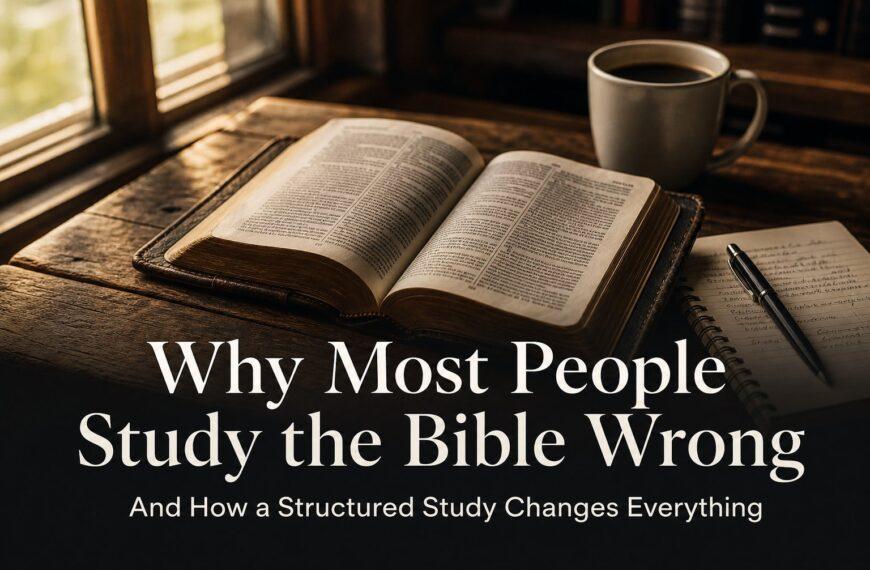
If you have owned a Bible for years, have sat in church most of your life, and still feel like you barely know what is in it — you are not alone, and it is not your fault. The problem is not your intelligence, your commitment, or even your schedule. The problem is almost certainly the way you have been approaching Scripture.
Most Christians were never taught how to study the Bible. They were told to read it, maybe given a devotional, handed a reading plan in January, and sent on their way. And while any time in God’s Word is better than none, there is a significant difference between reading the Bible and actually studying it. One leaves you with a vague sense of inspiration. The other changes the way you think, feel, and live.
This article is for the Christian who senses that gap — who knows something is missing but hasn’t been able to name it. Let’s name it.

The Real State of Bible Engagement
Before we talk about solutions, it helps to understand the scope of what we are dealing with.
Among self-identified Christians in America, about 50 percent report reading the Bible weekly — the highest level in over a decade, according to Barna Group data from 2025. That sounds encouraging until you realize it means half of all Christians are not even opening their Bibles once a week. And reading once a week, as researchers discovered, produces almost no measurable spiritual growth.
The Center for Bible Engagement conducted a sweeping study of 40,000 people ranging in age from 8 to 80. Researchers found that engaging the Bible four or more days a week is the single most powerful predictor of spiritual growth — a finding now widely known as “The Power of 4.” Crucially, the study measured this against prayer, fasting, church attendance, small groups, and more than a dozen other spiritual practices. None predicted spiritual growth the way consistent Bible engagement does.
Here is what makes that finding even more striking: when people engaged with Scripture just one, two, or even three times a week, there was negligible effect on key areas of their lives. The transformative difference appeared only when engagement reached at least four times per week.
So frequency matters. But frequency alone is not the whole picture. How you engage with Scripture matters just as much.
The Problem with Reading the Bible Like a Novel

Most people, when they do open their Bibles, read it the same way they would a magazine — front to back, looking for something interesting, hoping it “speaks to them.” When it doesn’t, they close it and feel vaguely guilty.
“All Scripture is given by inspiration of God, and is profitable for doctrine, for reproof, for correction, for instruction in righteousness, that the man of God may be complete, thoroughly equipped for every good work.” — 2 Timothy 3:16-17 (NKJV)
Notice what Paul says Scripture is for: doctrine, reproof, correction, instruction. These are not passive experiences. They require engagement, attention, and a method. You do not arrive at doctrine by skimming. You do not receive reproof from a text you do not understand in its context. You do not get instruction in righteousness from a five-minute daily devotional that tells you to be kind and have a nice day.
I’ve spent over thirty years studying and teaching Scripture, and the single most common thing I hear from Christians who feel stuck in their faith is this: “I read my Bible, but I feel like I’m not getting anything out of it.” When I ask how they study, the answer is almost always some version of random reading — open to a passage, read a few verses, close it up. There is no observation, no interpretation, no application. There is no structure at all.
The Bible is not meant to be consumed. It is meant to be wrestled with.
What “Studying It Wrong” Actually Looks Like

Let’s be specific, because there are several common patterns that feel like Bible study but produce very little fruit.
The Highlight-and-Move-On Method
You read a passage, a verse catches your eye, you underline it, maybe write it on a sticky note — and then you move on without asking what the verse actually means in its original context. This is how Christians end up misquoting Jeremiah 29:11 as a personal promise of prosperity when it was addressed to exiles in Babylon. Without context, even beautiful verses can mislead us.
The Devotional-Only Approach
Devotionals have their place. They are warm, accessible, and a good way to start a day. But a devotional is someone else’s interpretation of Scripture filtered through someone else’s application. Consuming only devotionals is like only ever eating food someone else has pre-chewed. It can sustain you at a low level, but it cannot build real strength.
If you want to go deeper on this distinction, the difference between reading about Scripture and actually studying it is a gap that most Christians never close — and it shows in their spiritual lives.
The Random-Reading Plan
Accountability-free Bible reading plans — the kind you start in January and abandon by February — fail not because the reader lacks discipline, but because they lack a framework for what they are doing. Reading Leviticus without understanding its place in the redemptive story, or jumping from Matthew to Revelation without any guidance, leaves people more confused than when they started.
The Verse-of-the-Day Trap
Social media has given us a culture of decontextualized Bible verses. A pretty graphic, a comforting phrase, a few seconds of good feeling — and then we scroll on. This is not Bible study. It is spiritual fast food. It fills the moment but leaves you undernourished.
What a Structured Study Actually Does

A structured Bible study is not about making the Bible feel like homework. It is about bringing intentionality to the text — approaching it with questions, staying long enough to hear answers, and walking away with something that shapes the way you live.
“This Book of the Law shall not depart from your mouth, but you shall meditate in it day and night, that you may observe to do according to all that is written in it. For then you will make your way prosperous, and then you will have good success.” — Joshua 1:8 (NKJV)
The Hebrew word translated “meditate” here — hagah — carries the picture of a low, sustained murmur, like a person repeating something to themselves, turning it over. This is not a glance. It is a sustained, deliberate engagement. God told Joshua that this was the key to everything that followed — the battles, the inheritance, the leadership of a nation. The Word was not incidental to Joshua’s life. It was the foundation of it.
A structured study brings that kind of sustained attention back to your time in Scripture. Here is what it changes in practice:
You Learn to Observe Before You Interpret
One of the most powerful shifts in Bible study comes from learning to ask, “What does this passage actually say?” before asking, “What does it mean to me?” The inductive Bible study method — one of the most proven approaches available — trains you to observe the text carefully, interpret it in its context, and only then apply it to your life. This sequence protects you from reading your own assumptions into Scripture.
You Begin to See the Story, Not Just the Verses
The Bible is one continuous story of redemption — a story of a God who pursues a broken people across thousands of years. When you study with structure, you begin to see how Paul’s letter to the Romans connects to Genesis. You see how the tabernacle foreshadows Christ. You understand why Paul says we are “complete” in Jesus, and what that completeness actually means. Isolated verses become windows into a coherent, magnificent whole.
You Build Doctrinal Roots
A Ligonier survey found that 53 percent of American adults agreed that “the Bible, like all sacred writings, contains helpful accounts of ancient myths but is not literally true.” Critically, this confusion was not limited to secular Americans — it extended into professing Christians and even evangelicals. Christians who do not study systematically are vulnerable to theological drift because they have no framework to push back against the culture’s reinterpretation of Scripture. Deep, structured study builds that framework.
You Encounter the Author, Not Just the Text
“Your word is a lamp to my feet and a light to my path.” — Psalm 119:105 (NKJV)
A lamp does not just illuminate the words on a page — it illuminates the path ahead. Structured Bible study does something that passive reading rarely accomplishes: it creates the conditions for genuine encounter. When you come to the text with questions, with time, with a method and a journal and a willingness to sit with what you find, the Holy Spirit has room to move. The role of prayer in Bible study is not decorative. Prayer opens the spiritual ear so that what is read becomes what is received.
The Fruit That Follows

This is not theoretical. The data bears it out.
Christians who engage Scripture at least four times a week are more bold in sharing their faith, less vulnerable to false teachings, and more likely to have a profound impact on those around them. Their lives become what researchers describe as “viral in their faith.”
And the fruit is not only outward. It is deeply inward. 87 percent of regular Bible readers report feeling encouraged after reading Scripture. There is something that happens in consistent, structured engagement with God’s Word that devotionals alone and Sunday sermons alone cannot replicate. You begin to think differently. You worry less. Your decisions become more grounded. Your relationships change.
This is exactly what Paul described:
“And do not be conformed to this world, but be transformed by the renewing of your mind, that you may prove what is that good and acceptable and perfect will of God.” — Romans 12:2 (NKJV)
The transformation comes through the renewing of the mind — a process, not a moment. And structured study is how that process is sustained. What actually happens when you study the Bible consistently is not just spiritual insight — it is a gradual reshaping of the person doing the studying.
How to Make the Shift

The transition from casual Bible reading to structured study does not require a seminary degree or three free hours every morning. It requires three things: a method, a commitment, and a starting point.
Choose a Method That Fits You
There is no single correct way to study the Bible, but there are proven frameworks. The SOAP method — Scripture, Observation, Application, Prayer — is one of the most accessible for beginners and faithful practitioners alike. Inductive Bible study goes deeper. Topical studies trace a single theme — grace, faith, healing, prayer — through the whole of Scripture and can be life-changing when done with rigor. Bible study journaling gives your study a record and helps you see growth over time.
The method matters less than the consistency. Pick one and stay with it long enough for it to form a habit.
Give It More Than One Day a Week
This bears repeating: the research is clear that once a week produces negligible spiritual fruit. If you can carve out time four days a week — even 20 to 30 minutes — you will begin to see the kind of change that Sunday services alone simply cannot produce. Building a consistent Bible study routine is one of the most important spiritual investments you can make.
Start with a Guided Study
One of the most effective on-ramps for structured study is a well-designed guided curriculum. A guided study carries you through a book of the Bible or a biblical theme with questions that prompt observation, historical context, and personal application. It removes the paralysis of not knowing where to start and the drift that comes from undirected reading.
I have personally developed over a dozen structured Bible study series — covering books of the Bible, doctrinal themes, and topics like faith, prayer, healing, and grace — specifically because I have seen what happens when ordinary believers go from surface reading to deep engagement. The transformation is not dramatic all at once. It is steady. It is real. And it tends to be permanent.
A Word to the Discouraged

If you have tried to develop a consistent Bible study practice and failed, I want to say something clearly: that failure is not a reflection of your spiritual condition. It is almost always a structural problem, not a character problem. You were not given the right tools. You were not shown the right methods. You were handed a book and told to figure it out.
“Then He said to them, ‘Therefore every scribe instructed concerning the kingdom of heaven is like a householder who brings out of his treasure things new and old.'” — Matthew 13:52 (NKJV)
The scribe who is “instructed concerning the kingdom” — the one who has been taught — has a treasure to draw from. Instruction matters. Structure matters. You were not designed to do this alone, and the church has a long tradition of catechesis, apprenticeship, and guided formation for exactly this reason.
Start small if you need to. One book. One method. Fifteen minutes. But start with intention, and let that intention grow.
A Call to Action

If you are ready to move from passive reading to genuine study, here is a simple starting place:
- Pick one book of the Bible and commit to studying it chapter by chapter for the next eight to twelve weeks.
- Use a structured method — SOAP, inductive, or a guided study curriculum.
- Engage with Scripture at least four days a week, even briefly.
- Keep a journal of what you observe, what you learn, and how it applies to your life.
- Find one other person to study alongside, even informally.
The resources below will help you go further.
Resources
- American Bible Society — State of the Bible 2025
- Center for Bible Engagement — The Power of 4
- Lifeway Research — 9 Tangible Benefits of Bible Reading
- Barna Group — Bible Reading Trends 2025
- Ligonier Ministries — Are We More Biblically Illiterate than Ever?
- AnsweredFaith.com — How to Study the Bible for Yourself
— Duke Taber

Pastor Duke has been preaching and teaching the Bible since 1988. He has shared his knowledge online since 2011.

 By
By