
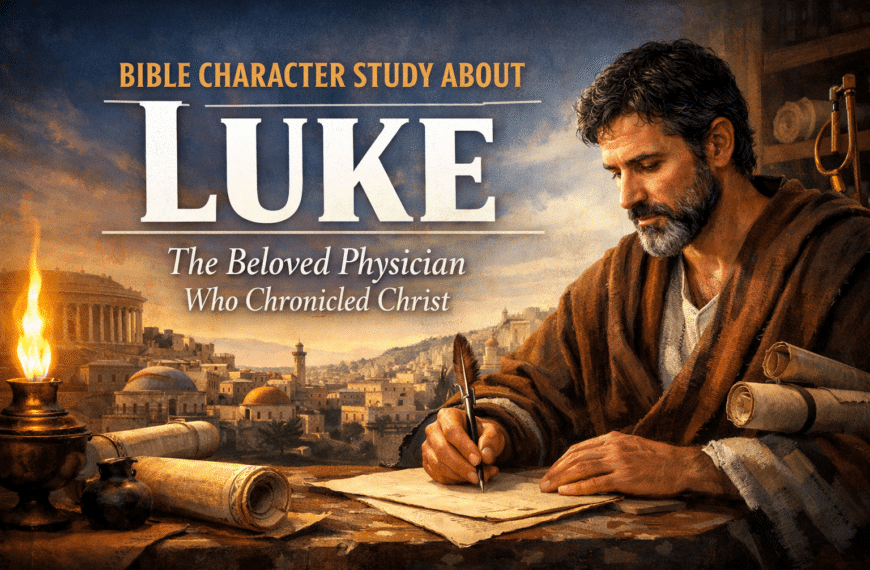
Have you ever wondered who wrote the most detailed account of Jesus’ birth? Or who traveled with Paul through his most dangerous missionary journeys, never abandoning him even when everyone else did? That person was Luke—a Gentile physician who became one of the most influential writers in Christian history. This Bible character study about Luke reveals a man whose medical precision, unwavering loyalty, and compassionate heart shaped how we understand Jesus’ ministry to all people.
Key Takeaways
- Luke was a Gentile physician who brought medical precision and historical accuracy to documenting Jesus’ life and the early church
- He demonstrated unwavering loyalty to Paul, remaining with him when others abandoned the apostle during imprisonment
- Luke emphasized Jesus as Savior for all people, highlighting Christ’s compassion for the marginalized, sick, and social outciders
- His diligent research and attention to detail provide us with the most comprehensive Gospel account and the only record of the early church’s history
- Luke’s humility and servant heart made him an effective witness who pointed others to Christ rather than himself

Who Was Luke? Understanding the Man Behind the Gospel
Luke’s Background and Profession
Luke stands out among the Gospel writers as the only Gentile author in the New Testament. Paul affectionately called him “the beloved physician” in Colossians 4:14[1], revealing both his profession and the deep friendship they shared.
As a physician in the first century, Luke possessed education and training uncommon for his time. His medical background shaped how he observed and recorded events—with careful attention to detail and a compassionate eye toward human suffering.
What made Luke’s perspective unique:
- He wrote as an outsider to Judaism, making his testimony about Jesus’ redemptive plan for all nations particularly powerful[2]
- His medical training gave him analytical skills that enhanced the historical accuracy of his writings
- His Gentile background helped him communicate the gospel effectively to non-Jewish audiences
Luke’s profession wasn’t just a career—it was preparation for his calling. God used his medical knowledge to make him sensitive to the physical and spiritual needs of people, which becomes evident throughout his Gospel account.
Luke’s Relationship with Paul
The bond between Luke and Paul represents one of the most beautiful friendships in Scripture. Luke served as Paul’s traveling companion, fellow worker, and loyal friend through some of the apostle’s most challenging seasons[1].
When you read Acts carefully, you’ll notice something remarkable. Luke occasionally switches from “they” to “we” in his narrative, indicating he was present for those events. These “we passages” show Luke accompanied Paul on several missionary journeys, witnessing firsthand the power of the gospel transforming lives across the Mediterranean world.
“Only Luke is with me.” – 2 Timothy 4:11
This simple statement from Paul’s final letter carries profound weight. When Paul faced execution in a Roman prison, when other companions had left for various reasons, Luke remained[1]. That’s the kind of friend we all need—and the kind of friend we should strive to be.
Through his relationship with Paul, Luke gained something invaluable: access to firsthand testimonies from all the Apostles about Jesus’ life and ministry[2]. This network of eyewitness accounts became the foundation for his meticulously researched Gospel.
For practical guidance on studying biblical characters like Luke, check out our Bible Character Study Guide: Unlock Deep Spiritual Growth.
The Character Traits That Defined Luke’s Ministry
Diligence and Attention to Detail
Luke opens his Gospel with a statement that reveals his methodology:
“Inasmuch as many have taken in hand to set in order a narrative of those things which have been fulfilled among us, just as those who from the beginning were eyewitnesses and ministers of the word delivered them to us, it seemed good to me also, having had perfect understanding of all things from the very first, to write to you an orderly account, most excellent Theophilus, that you may know the certainty of those things in which you were instructed.” – Luke 1:1-4
Notice what Luke is saying here. He didn’t just write down stories he heard. He investigated everything carefully. He interviewed eyewitnesses. He organized his material systematically. He wanted Theophilus—and all of us—to have certainty about Jesus[1].
This diligence shows throughout both Luke and Acts:
- Precise chronological markers that help us date events accurately
- Detailed descriptions of places, people, and circumstances
- Medical terminology that reflects his professional background
- Historical references that have been confirmed by archaeological discoveries
Luke’s attention to detail wasn’t about showing off his research skills. It was about honoring the truth and providing a reliable foundation for faith.
Humility and Servant Leadership
Here’s something that always strikes me about Luke: despite being an eyewitness to many incredible events through his travels with Paul, he rarely mentions himself in his narratives[1].
Think about that. Luke witnessed:
- Miraculous healings
- Dramatic conversions
- Supernatural prison breaks
- Shipwrecks and survival stories
- The explosive growth of the early church
Yet he consistently points the spotlight away from himself and toward Jesus and the work of the Holy Spirit.
This humility made Luke an effective witness. People who are humble don’t need to be the hero of every story. They can celebrate what God is doing through others. They can serve behind the scenes without recognition.
How Luke’s humility shaped his ministry:
✝️ He documented others’ testimonies without inserting his own agenda
✝️ He gave credit to eyewitnesses rather than claiming authority for himself
✝️ He focused on Jesus’ character and mission rather than his own experiences
✝️ He served Paul faithfully without demanding his own platform
Compassion for the Marginalized
Luke’s Gospel has been called “the Gospel of the underdog” because of its unique emphasis on Jesus’ compassion for society’s outcasts[1]. This wasn’t accidental—it reflected Luke’s own heart.
As a physician, Luke had seen suffering up close. He understood pain, disease, and the desperation of those society rejected. His Gospel highlights Jesus’ interactions with:
- The sick and diseased whom others avoided
- Women in a culture that marginalized them
- The poor who had no social standing
- Tax collectors and sinners whom religious people despised
- Gentiles who were considered outsiders to God’s covenant
Luke emphasized that Jesus came as “Savior for all people—both Jews and Gentiles”[1][2]. This wasn’t just theology for Luke—it was personal. As a Gentile himself, he understood what it meant to be an outsider welcomed into God’s family.
I’ve found that the most effective ministers are often those who remember what it felt like to be on the outside looking in. Luke never forgot, and it shaped everything he wrote.
Unwavering Loyalty and Faithfulness
Loyalty is tested not when everything is going well, but when the cost of staying becomes high. Luke passed that test with flying colors.
When Paul wrote his final letter from a Roman prison, facing execution, he noted that Demas had deserted him, Crescens had gone to Galatia, and Titus to Dalmatia. Then he added: “Only Luke is with me” (2 Timothy 4:11)[1].
Picture that scene. Paul, the great apostle who had planted churches across the Roman Empire, sat in a cold prison cell awaiting death. Most of his companions had legitimate reasons to be elsewhere—ministry assignments, family obligations, or simply the danger of being associated with a condemned prisoner.
But Luke stayed.
What Luke’s loyalty teaches us:
- True friendship doesn’t evaporate when circumstances get difficult
- Ministry isn’t just about the exciting moments—it’s about faithful presence
- Our character is revealed by who we stand with when everyone else walks away
- Loyalty to God’s servants honors God Himself
This kind of faithfulness didn’t happen by accident. It grew from Luke’s deep relationship with Christ and his understanding that serving Paul meant serving the gospel itself.
Luke’s Contribution to Scripture: Two Books, One Message

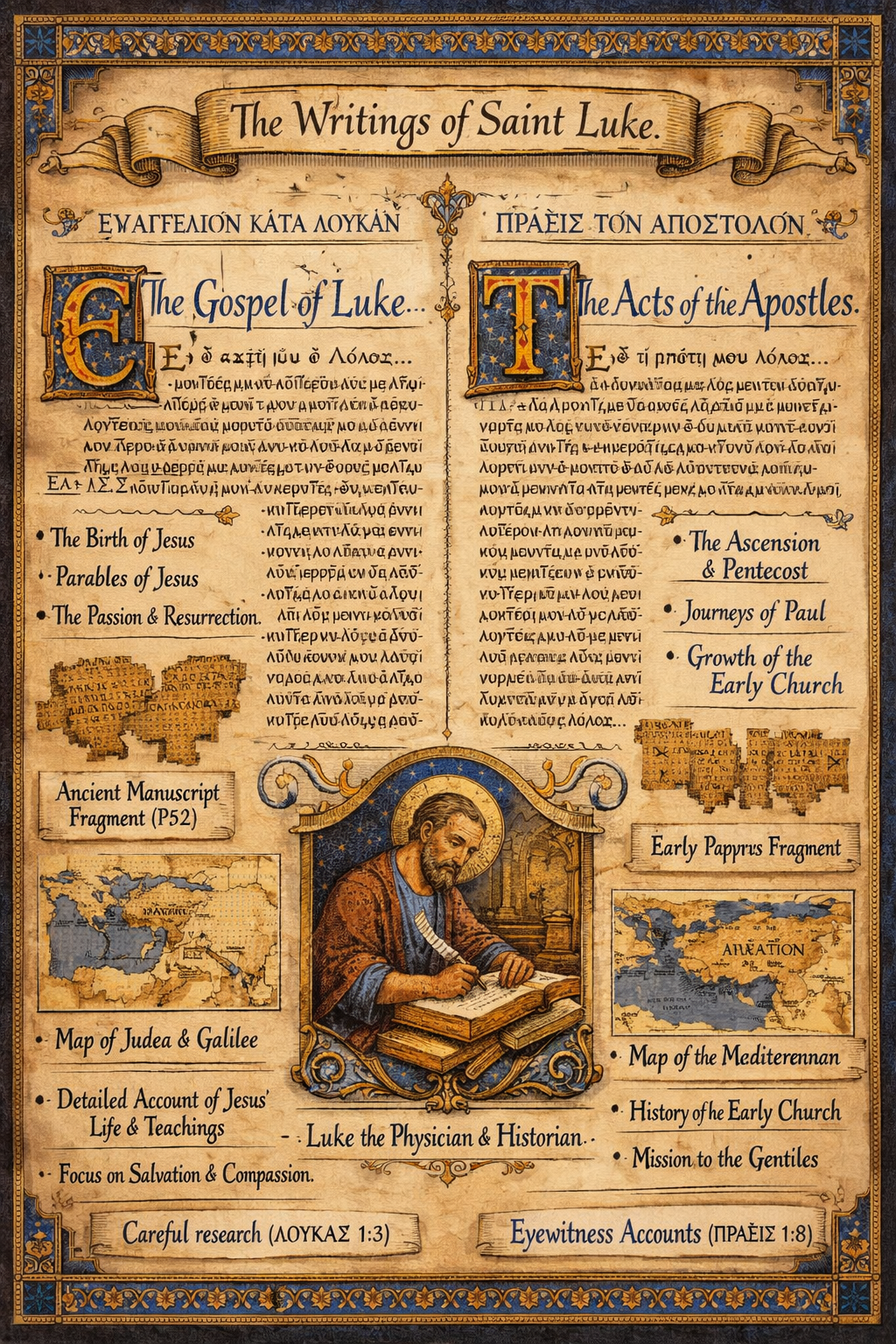
The Gospel of Luke: Jesus as Savior of All People
Luke’s Gospel is the longest of the four Gospels and provides the most comprehensive account of Jesus’ life. But length isn’t what makes it special—perspective is.
Luke presented Jesus as a new Moses, leading a renewed Israel into freedom from sin and evil[3]. He carefully documented Jesus’ birth, ministry, death, and resurrection with an eye toward showing that God’s salvation extends to everyone.
Unique features of Luke’s Gospel:
📖 The most detailed account of Jesus’ birth and childhood
📖 Parables found nowhere else (Good Samaritan, Prodigal Son, Rich Man and Lazarus)
📖 Special emphasis on prayer—Luke records nine prayers of Jesus not found in other Gospels
📖 Prominent role for women in Jesus’ ministry
📖 Focus on Jesus’ compassion for sinners and outcasts
Luke wanted his readers to understand that Jesus didn’t come just for the religious elite or the ethnically privileged. He came for everyone willing to receive Him.
When Luke recorded the angels’ announcement to the shepherds, he emphasized: “I bring you good news that will cause great joy for all the people” (Luke 2:10-11)[1][2]. That phrase—”all the people”—captures Luke’s central message.
For more insights on biblical narratives that demonstrate God’s inclusive love, explore our collection of Bible Stories That Illustrate Unwavering Faith.
The Book of Acts: The Holy Spirit’s Work Through the Church
If Luke’s Gospel answers the question “What did Jesus do?” then Acts answers “What is Jesus still doing through His Spirit and His church?”
Acts is the only historical record we have of the early church’s first three decades. Without Luke’s careful documentation, we would know almost nothing about:
- The Day of Pentecost and the birth of the church
- The conversion of Paul
- The Jerusalem Council’s decision about Gentile believers
- Paul’s missionary journeys
- The spread of the gospel from Jerusalem to Rome
Luke demonstrated exceptional historical accuracy in Acts[1]. He correctly identified:
- Political titles that varied by region and time period
- Geographic details of Mediterranean cities
- Cultural practices of different people groups
- Historical figures and events
Archaeologists and historians have repeatedly confirmed Luke’s reliability. Sir William Ramsay, a skeptical scholar who set out to disprove Acts, ended up concluding that Luke was “a historian of the first rank.”
The central theme of Acts:
The Holy Spirit empowers ordinary people to be Jesus’ witnesses “in Jerusalem, and in all Judea and Samaria, and to the ends of the earth” (Acts 1:8). Luke showed this wasn’t just theory—it was reality. He documented how the Spirit transformed fishermen into preachers, persecutors into apostles, and a small Jewish sect into a world-changing movement.
Applying Luke’s Example to Your Life Today
Cultivate Diligence in Your Spiritual Life
Luke’s careful research and attention to detail challenge us to approach our faith with similar intentionality. We live in an age of spiritual shortcuts and superficial engagement with Scripture. Luke models something different.
Practical ways to develop Luke-like diligence:
- Study Scripture systematically rather than randomly jumping around
- Take notes during sermons and personal Bible study
- Research context for passages you’re studying—who wrote it, to whom, and why
- Ask questions and seek answers rather than settling for surface-level understanding
- Apply what you learn through specific, measurable actions
I’ve found that keeping a Bible study journal transforms my spiritual life. Like Luke documenting the gospel story, writing down what God is teaching me creates a record I can return to and share with others.
If you’re looking for structured approaches to deepen your study, our Bible Character Study Guide offers practical frameworks you can use immediately.
Practice Faithful Presence
Luke’s loyalty to Paul reminds us that ministry often happens in unsexy, unglamorous moments. It’s easy to serve when the crowds are cheering. It’s harder when you’re sitting in a prison cell with someone the world has rejected.
Questions to consider:
- Who in my life needs faithful presence right now?
- Am I willing to stand with people when it costs me something?
- Do I disappear when ministry becomes inconvenient or uncomfortable?
- How can I demonstrate Christ-like loyalty in my relationships?
Faithful presence might look like:
- Visiting someone in the hospital week after week
- Supporting a friend going through a difficult season
- Staying committed to your church even when it’s going through challenges
- Mentoring someone long-term, not just when it’s convenient
The world is full of fair-weather friends. The church needs people like Luke who stay.
Extend Compassion to the Marginalized
Luke’s Gospel challenges us to see people the way Jesus sees them. Who are the marginalized in your community? Who gets overlooked, avoided, or dismissed?
In 2026, the marginalized might include:
- The homeless person you pass on your way to church
- The immigrant family struggling to learn English
- The single parent working two jobs to make ends meet
- The elderly person in your congregation who sits alone
- The person battling addiction who everyone gossips about
Action steps for compassionate ministry:
💙 Identify one marginalized group in your community
💙 Learn about their specific challenges and needs
💙 Find a practical way to serve them this month
💙 Invite someone from that group into relationship, not just charity
💙 Advocate for justice and dignity for those without a voice
Luke didn’t just write about Jesus’ compassion—he embodied it in his own ministry. We’re called to do the same.
For additional inspiration on living out your faith practically, explore our article on Examples of Spiritual Growth.
Develop Your Unique Gifts for Kingdom Purposes
God didn’t waste Luke’s medical training—He repurposed it for kingdom work. Luke’s analytical mind, attention to detail, and compassionate heart all became tools for documenting the gospel and building the church.
What unique gifts, experiences, or training has God given you? How might He want to use those for His purposes?
Your background matters:
- Business skills can help churches operate more effectively
- Teaching experience equips you to lead Bible studies
- Counseling training prepares you to care for hurting people
- Creative abilities can communicate truth in compelling ways
- Technical knowledge can extend ministry reach through digital platforms
I’ve watched God use a retired accountant to bring financial stability to struggling ministries, a former addict to lead recovery groups, and a graphic designer to create resources that help people engage with Scripture. Like Luke, they offered what they had, and God multiplied it.
Don’t despise your “secular” skills. In God’s economy, nothing is wasted. Everything can be consecrated for His glory.
The Legacy of Luke: Why His Example Still Matters

A Model of Excellence in Ministry
Luke set a standard for ministry excellence that still challenges us today. He didn’t settle for “good enough.” He pursued accuracy, clarity, and comprehensiveness in documenting the gospel story[1].
This matters because sloppy ministry dishonors God. When we’re careless with truth, lazy in preparation, or indifferent to quality, we suggest that God’s work doesn’t deserve our best effort.
Luke reminds us that excellence and humility aren’t opposites—they’re partners. We can pursue excellence not to glorify ourselves but to honor God and serve others effectively.
A Bridge Between Cultures
As a Gentile writing about a Jewish Messiah for a diverse audience, Luke built bridges between cultures. He helped Jewish believers understand God’s heart for the nations. He helped Gentile believers understand their connection to Israel’s story[2].
In our increasingly diverse world, we need more bridge-builders like Luke—people who can translate truth across cultural boundaries without compromising it, who can honor different perspectives while pointing everyone to the same Savior.
Luke’s bridge-building teaches us to:
- Listen to perspectives different from our own
- Communicate truth in culturally relevant ways
- Celebrate diversity as part of God’s design
- Find common ground without sacrificing conviction
- Build relationships across ethnic, economic, and social divides
A Witness to God’s Faithfulness
Ultimately, Luke’s writings testify to God’s faithfulness. Through his Gospel and Acts, we see God keeping His promises, extending His mercy, and building His church despite opposition.
Luke documented:
- God’s faithfulness to send the promised Messiah
- God’s faithfulness to pour out His Spirit
- God’s faithfulness to include Gentiles in His family
- God’s faithfulness to sustain His servants through trials
- God’s faithfulness to spread the gospel despite persecution
When I’m discouraged about the state of the church or the world, I return to Luke’s writings. They remind me that God has always been faithful, and He always will be.
If you’re struggling to trust God’s timing in your life, our article Trusting the Process: Bible Quotes on God’s Timing & Plan offers encouragement.
Conclusion: Becoming Like Luke in Your Generation
This Bible character study about Luke reveals a man who combined professional excellence with spiritual devotion, cultural sensitivity with theological clarity, and personal humility with historical significance. He wasn’t an apostle who walked with Jesus during His earthly ministry. He wasn’t a dramatic convert like Paul. He was a faithful physician who used his gifts to serve God’s purposes.
That’s encouraging, isn’t it? God doesn’t just use the superstars. He uses ordinary people who make themselves available—people who stay faithful when others leave, who pursue excellence in their calling, who extend compassion to the overlooked, and who document God’s work for future generations.
Your next steps:
- Choose one of Luke’s character traits to focus on this month—diligence, loyalty, compassion, or humility
- Read through Luke’s Gospel with fresh eyes, noticing how his unique perspective shapes the narrative
- Identify someone who needs your faithful presence and commit to being there for them
- Use your unique gifts in service to your church or community this week
- Document God’s faithfulness in your own life through journaling or testimony
Luke’s legacy continues every time someone reads his Gospel and encounters Jesus. Every time a new believer reads Acts and discovers the Holy Spirit’s power. Every time a marginalized person finds hope in the Savior who came for “all people.”
What legacy will you leave? How will you use your gifts, your experiences, and your opportunities to point others to Christ?
The world needs more people like Luke—faithful, excellent, compassionate, and humble servants who make Jesus known. By God’s grace, you can be one of them.
References
[1] Character Study Of Luke Rev Samuel Arimoro Sermon On Character Study 289163 – https://sermoncentral.com/sermons/character-study-of-luke-rev-samuel-arimoro-sermon-on-character-study-289163
[2] Book Overview Luke %e2%80%a2 01 11 26 – https://www.harvestdesmoines.org/episode/book-overview-luke-%E2%80%A2-01-11-26/
[3] Book Of Luke – https://bibleproject.com/guides/book-of-luke/
Share On Pinterest



Pastor Duke has been preaching and teaching the Bible since 1988. He has shared his knowledge online since 2011.







 By
By