
Eve’s story in the Bible is both compelling and mysterious. As the first woman, wife, and mother, she holds a unique place in human history. Her name appears only four times in Scripture yet her impact is monumental.
Even though her pivotal role, much about Eve remains untold. This scarcity of details invites us to ponder God’s reasons for keeping her story concise. Eve’s journey from creation to the fall carries lessons that resonate deeply with our own experiences of guilt and hope.
Eve’s Origin and Creation
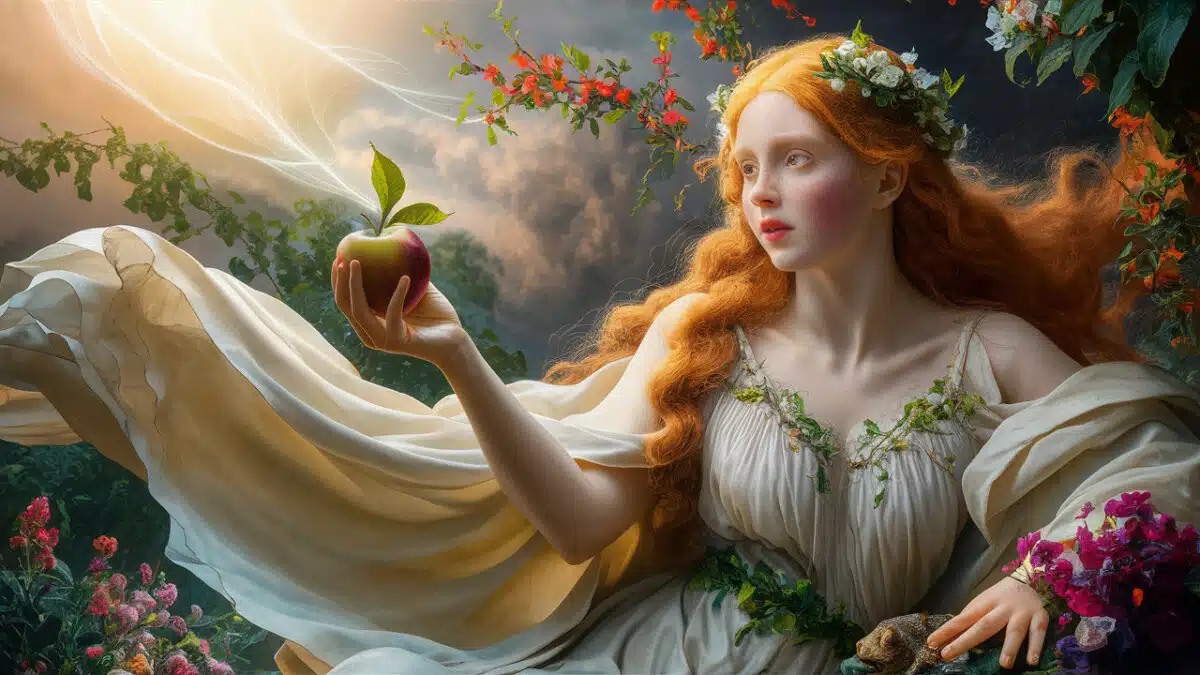
Eve, the first woman in the Bible, holds a unique place in Christian history. Her creation story is detailed in Genesis.
The Biblical Account of Eve’s Creation
God created Eve from Adam’s rib. According to Genesis 2:21-22 (NKJV), “And the Lord God caused a deep sleep to fall on Adam, and he slept; and He took one of his ribs, and closed up the flesh in its place. Then the rib which the Lord God had taken from man He made into a woman, and He brought her to the man.”
Adam needed a companion. So God decided to make someone suitable for him.
In Genesis 1:27 (NKJV), it’s written that “God created man in His own image; in the image of God He created him; male and female He created them.” This emphasizes their equal importance.
The Significance of Eve in Genesis
Eve symbolizes companionship. She was made because Adam was lonely.
Her creation signifies life. Eve’s name means “life” as she is considered the mother of all living beings.
She played a crucial role in humanity’s origin story. Her actions led to significant events like humanity’s fall from grace:
- Temptation: Satan tempted her.
- Disobedience: She ate the forbidden fruit.
- Consequences: Humanity faced God’s judgment.
Gerda Lerner suggests that Eve’s creation might be inspired by older myths like Enki and Ninhursag. In this Mesopotamian myth, Ninti heals Enki’s rib, linking ribs with life just as Eve does (Lerner).
Eve remains central to understanding human nature. Her choices reflect themes of temptation, obedience, and redemption found throughout Scripture.
Eve in the Garden of Eden

Eve, the first woman created by God, plays a key role in the biblical story of creation. According to Genesis 2:22, God formed her from one of Adam’s ribs.
Life Before the Fall
Before sin entered the world, Adam and Eve lived in innocence. They enjoyed a direct relationship with God. Their task was to tend to the Garden of Eden and name animals. They lived without shame or guilt.
God commanded them not to eat from “the tree of knowledge of good and evil” (Genesis 2:17 NKJV). They had free access to everything else in the garden.
The Role of Eve in the Garden
Eve’s role was significant as she was both companion and helper to Adam. She shared equally in their responsibilities for creation.
She was deceived by a serpent who represented Satan (1 Timothy 2:13-14). The serpent made her question God’s command by saying, “You will not surely die” (Genesis 3:4 NKJV).
Eve ate from the forbidden tree and gave some fruit to Adam. This act led to their awareness of good and evil. It resulted in both being expelled from Eden.
Her punishment included increased pain during childbirth. She became subordinate to her husband as part of this consequence (Genesis 3:16 NKJV).
Eve gave birth to several children including Cain, Abel, and Seth (Genesis 4:1-2 NKJV). Her actions had lasting impacts on humanity according to Scripture.
The Temptation and Fall of Eve
The story of Eve’s temptation and fall is a pivotal moment in the Bible. It marks the beginning of humanity’s struggle with sin.
The Serpent’s Deception
Eve, the first woman created by God, encountered the serpent in the Garden of Eden. Genesis 3:1 describes the serpent as “more cunning than any beast.” The serpent questioned God’s command not to eat from the tree of knowledge (Genesis 3:1).
The deception was clever. The serpent claimed eating the fruit would open Eve’s eyes, making her like God (Genesis 3:5). It said, “You will not surely die” (Genesis 3:4, NKJV). This lie led Eve to believe she could gain wisdom without consequences.
The Consequences of Disobedience
Eve ate the fruit and gave some to Adam, who also ate (Genesis 3:6). Their disobedience had immediate effects. They realized their nakedness and felt shame (Genesis 3:7).
God confronted them about their actions. As punishment:
- Pain in childbirth increased for women.
- Relationships suffered due to blame and guilt.
- Humanity faced mortality.
These events underscore human vulnerability to temptation and its lasting impact on our lives.
Eve’s Legacy and Redemption

Eve’s story isn’t just about failure. It’s also about hope and redemption.
Eve as the Mother of Humanity
Eve is known as the first woman and mother of all living. Genesis 3:20 states, “And Adam called his wife’s name Eve, because she was the mother of all living” (NKJV). She gave birth to Cain, Abel, and Seth. These sons continued humanity’s lineage even though her initial disobedience.
Promises and Prophecies Related to Eve
God announced redemption through Eve’s offspring after her disobedience. Genesis 3:15 mentions, “And I will put enmity between you and the woman, and between your seed and her Seed; He shall bruise your head, and you shall bruise His heel” (NKJV). This prophecy points to Christ’s victory over sin.
Eve hoped in God’s promise by naming her children with expectation. Cain means “acquired,” showing belief in God’s provision. Abel highlights life’s fleeting nature while Seth means “appointed,” reflecting trust in God’s plan for salvation.
Eve’s legacy teaches us faith amid consequences. Her story offers encouragement that even from failure can come redemption.
Eve’s Representation in Different Religions
Eve’s story has deep roots in both Judaism and Christianity. Her role varies slightly between these two faiths but remains significant.
Eve in Judaism
In Judaism, Eve is created from Adam’s rib to be his companion. This is found in Genesis 2:22. She symbolizes the soul and represents the feminine principle.
Her act of eating the forbidden fruit leads to humanity’s expulsion from the Garden of Eden (Genesis 3:1-7). This act shows her vulnerability to temptation.
Key Points:
- Created as a helper for Adam.
- Represents the feminine principle.
- Eats the forbidden fruit.
Eve in Christianity
Christianity also acknowledges Eve’s creation from Adam’s rib, emphasizing their unity (Genesis 2:22 NKJV). Her disobedience by eating the forbidden fruit is seen as pivotal (Genesis 3:6 NKJV).
Even though this, she symbolizes redemption too. God announces that through her offspring will come salvation (Genesis 3:15 NKJV).
- Unity with Adam.
- Disobedience leads to humanity’s fall.
- Symbolizes future redemption.
Eve’s representation sheds light on human nature and divine plans across religions.
Conclusion
Eve’s story serves as a foundational narrative that shapes our understanding of human nature and divine intent. Her experiences in the Garden of Eden provide profound insights into themes of temptation, disobedience, and redemption. As the mother of humanity, Eve’s legacy is one of both caution and hope, reminding us of the complex interplay between free will and divine grace.
Her portrayal across different religious traditions highlights her multifaceted role and enduring significance. Whether viewed through the lens of Judaism or Christianity her story continues to resonate deeply shedding light on the eternal quest for unity with god.
What Can We Learn About Eve’s Character in Comparison to Abigail’s Wisdom and Peacemaking?
Eve and Abigail provide contrasting insights into feminine strength and resilience. While Eve grapples with temptation and consequence, Abigail embodies wisdom and peacemaking. As we delve into their narratives, we can truly explore the remarkable life of abigail in scripture, highlighting her role as a diplomat and a woman of faith.
Share On Pinterest!


Related Posts

How to Choose the Right Bible Study on Love (What to Look For)
Last updated: May 2026 Not all Bible studies on love are created equal. Learn what to look for — theological depth, serious Scripture, and application that actually changes how you love.
 May 21, 2026
A 9-Week Rhythm for Studying the Fruit of the Spirit on Your Own
Last updated: June 2026 By Duke Taber Most personal Bible study plans die quietly in week two. You start with real intention. You buy the notebook.…
Jun 12, 2026
The 4 Greek Words for Love in the Bible (And Why They Matter)
Last updated: May 2026 By Duke Taber Most of us have grown up hearing the word "love" used for everything from pizza to marriage to God.…
May 27, 2026
Why Most People Study the Bible Wrong — And How a Structured Study Changes Everything
Last updated: May 2026 Most Christians read the Bible but never truly study it. Discover the common mistakes that keep believers spiritually stuck — and how a structured Bible study changes everything.
May 26, 2026


 By
By


