
By Duke Taber
Most personal Bible study plans die quietly in week two. You start with real intention. You buy the notebook. You read for three or four mornings in a row, and then a sick kid or a hard meeting or a bad night of sleep knocks you off the rails, and the plan slides into the pile of good things you meant to finish. If that is your history, I want you to know something before we go a single step further. You are not lazy, and you are not a spiritual failure. You are normal.
The numbers bear this out. Only about three in ten Protestant churchgoers read the Bible every day, according to Lifeway Research. And when people do open it on their own, more than half say they find it hard to make sense of, with 57 percent of Protestant churchgoers reporting that Scripture is challenging to understand without help. The encouraging news is that Bible reading is actually climbing again, with Barna finding that weekly engagement among self-identified Christians recently reached its highest level in over a decade. People want this. They simply need a path that holds.
That is what the next nine weeks can give you. Not a sprint. A rhythm. One fruit of the Spirit at a time, studied slowly, prayed honestly, and lived out before the people in your house. The fruit of the Spirit lists nine qualities, so nine weeks is not an arbitrary number. It is the shape the passage hands you.
There is one trap we have to name at the door, because it ruins more fruit of the Spirit studies than busyness ever will. It is the trap of treating this like a self-improvement project. So before you read a single verse, we need to settle what this fruit actually is.

Before You Begin, Settle What the Fruit Actually Is
Here is the verse the whole study orbits:
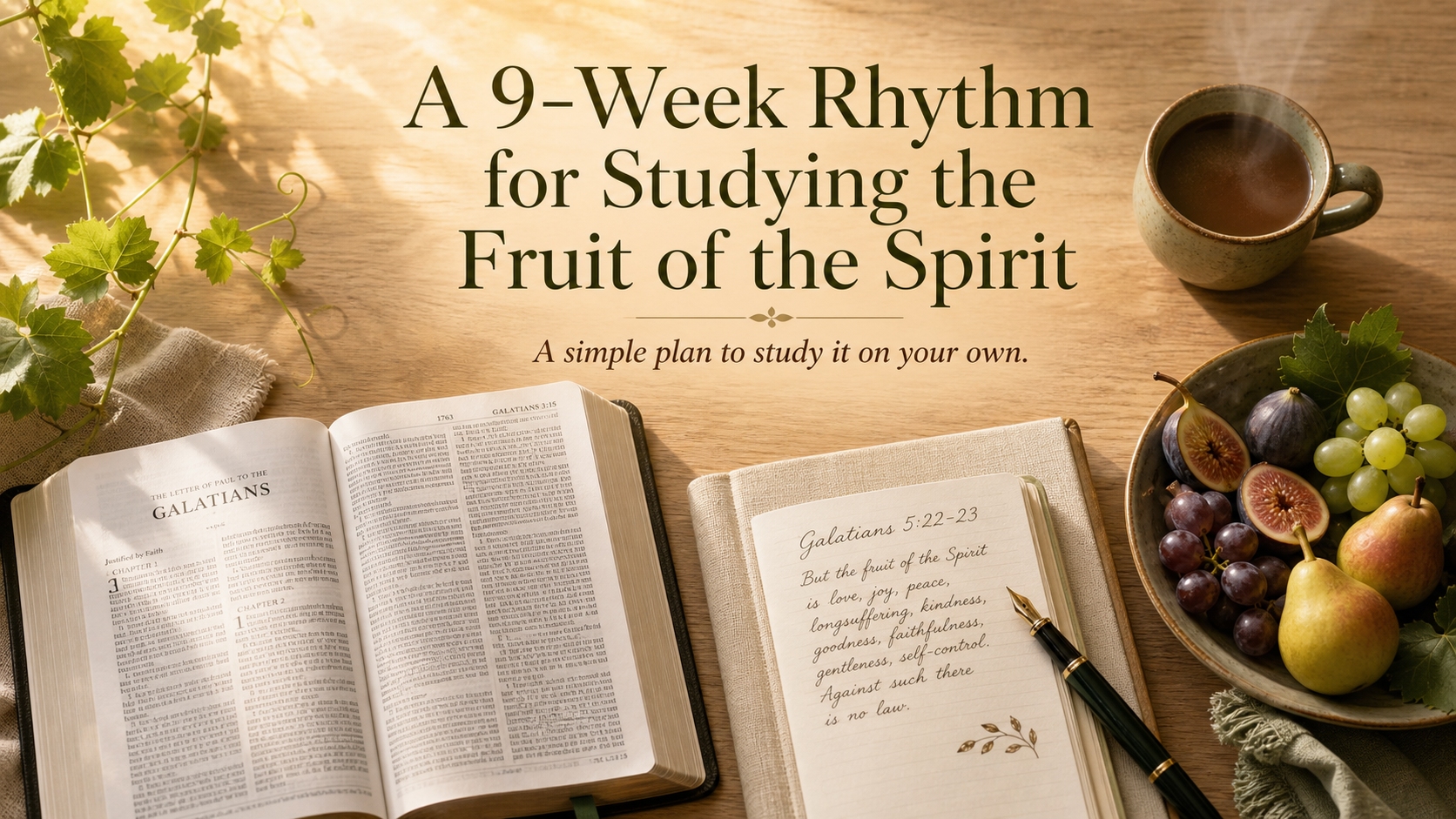
“But the fruit of the Spirit is love, joy, peace, longsuffering, kindness, goodness, faithfulness, gentleness, self-control. Against such there is no law.” — Galatians 5:22-23 (NKJV)
Notice the word “fruit.” In the original Greek it is karpos, and it is singular, not plural. Paul did not write “fruits.” He wrote one fruit with nine flavors. As Koine Foundations explains, this is the natural product of a living thing, the way grapes are the natural product of a healthy vine. One commentary cited by The Word Seattle pictures it as a single bunch of grapes rather than nine separate pieces of fruit. The Spirit does not grow patience in you while ignoring gentleness. He grows the whole cluster.
This matters more than it might seem. Fruit is not manufactured. It is grown. A branch does not strain and grunt to produce grapes. It simply stays connected to the vine, and the life of the vine does the rest. Jesus said it plainly.
“I am the vine, you are the branches. He who abides in Me, and I in him, bears much fruit; for without Me you can do nothing.” — John 15:5 (NKJV)
So this study is not a campaign to white-knuckle your way into being a nicer person. It is a nine-week invitation to abide. You are the branch. The Spirit is the one who produces the fruit. Your job across these weeks is to keep showing up, keep your roots in the Word, and keep your heart open and dependent. If you carry that posture into the study, even your stumbles will become soil. If you carry the self-improvement posture instead, you will burn out around week three feeling like a fraud. I have watched sincere believers do exactly that, gritting their teeth to seem more gentle while their hearts grow more anxious underneath. The overview of the fruit of the Spirit is worth reading before you start, simply to lock this truth in place.
Why Nine Weeks, and Why One at a Time

You could try to grow all nine qualities at once. Most people do, and most people get nowhere, because the heart cannot focus on everything and therefore focuses on nothing. A single lens each week changes that. You are not becoming a different person nine times. You are walking slowly around one cluster of fruit, looking at it from nine angles, letting each quality have its turn to teach you.
There is a quiet gift hidden in the calendar here. Behavioral researchers at University College London famously found that new habits take an average of 66 days to become automatic, not the 21 days folk wisdom promises. Nine weeks is 63 days. You are not just studying nine topics. You are, almost by accident, building a daily habit of time in the Word that lands right in the window where it starts to feel natural rather than forced. The structure does double duty. It teaches you about the fruit, and it grows the very practice that lets the fruit take root.
So we take them one at a time, in the order Paul wrote them. If you want a quick map of the territory before you begin, the summary of the nine qualities for everyday life gives you the lay of the land in a single sitting.
The Weekly Rhythm: Five Simple Movements

Here is the engine of the whole thing. Every week follows the same five movements. The sameness is the point. When the shape never changes, you stop spending energy deciding what to do and start spending it on the actual fruit. Plan on fifteen to twenty minutes a day. That is enough. Consistency beats intensity every time.
Read and Observe
Begin the week by reading Galatians 5:22-23 slowly, then the surrounding verses, Galatians 5:16-26, to feel the contrast between the works of the flesh and the fruit of the Spirit. This is the observation step that anchors the whole inductive Bible study method, the simple discipline of asking what the text actually says before you ask what it means. Write down what you notice about the week’s fruit. Where does it sit in the list? What sits next to it? Do not rush to application yet. Just look.
Dig Into the Word
Spend a day on the word itself. Each fruit carries a specific Greek term with a meaning richer than our English translations capture. Makrothumia, the word behind “longsuffering,” literally means long-tempered, slow to boil. Chrestotes, behind “kindness,” carries the sense of usefulness and grace toward others. A short word study in the Bible using a free tool like Blue Letter Bible will hand you the original meaning, every other place the word appears, and a depth of understanding you will never get from a single English verse.
Trace It Through Scripture and Real Lives
Spend a day or two watching the week’s fruit show up in actual people. Scripture is full of flesh-and-blood examples, and the biblical examples of the fruit of the Spirit make wonderful starting points. Watch how Joseph carried faithfulness through years of injustice. Watch how Jesus answered His accusers with gentleness. Cross-referencing this way lets Scripture interpret Scripture, and it pulls the fruit out of the realm of abstract virtue into the realm of decisions you recognize from your own week.
Search Yourself
This is the day the study gets personal. Take the fruit and hold it up like a mirror. Where is it already growing in you, and where is it conspicuously absent? Do not flinch from the answer. Invite God into the examination rather than running the inspection yourself.
“Search me, O God, and know my heart; try me, and know my anxieties; and see if there is any wicked way in me, and lead me in the way everlasting.” — Psalm 139:23-24 (NKJV)
Write what surfaces. There is real value in putting it on paper by hand. Research summarized by Scientific American shows that handwriting engages more of the brain and strengthens memory more than typing does, partly because the slower pace forces you to process rather than transcribe. Keeping a written record, the way the practice of Bible journaling the fruit of the Spirit describes, also gives you something to look back on in week nine and see how far the Spirit has carried you.
Pray It and Practice It
Close each week by praying the fruit back to God, asking the Spirit to grow in you what you cannot grow in yourself, and then choosing one concrete way to live it before the week ends. Application is the most neglected step in personal study, and Precept Ministries is right to insist that observation and interpretation are means to that end, not the end itself. If the week’s fruit is patience, the practice might be holding your tongue with the person who tests you most. Knowledge that never reaches your hands and feet has not finished its work.
The Nine Weeks at a Glance

Week one is love, agape, the self-giving love that anchors all the rest, and a rich place to start is the practice of cultivating love as the first fruit. Week two turns to joy, the deep gladness that does not depend on circumstances. Week three is peace, the settled wholeness Scripture calls shalom.
Then the order turns toward the qualities that tend to expose us. Week four is longsuffering, or patience, which God grows precisely in the seasons you would most like to skip, a truth worth sitting with in the study of the fruit of patience. Week five is kindness, grace made useful to others. Week six is goodness, integrity that holds when no one is watching. Week seven is faithfulness, the steady reliability that mirrors the heart of God.
Week eight is gentleness, which Scripture frames not as weakness but as strength under control. And week nine is self-control, the fruit that, fittingly, comes last, because it tends to grow only after the other eight have done their quiet work. The study of self-control as a fruit of the Spirit is a strong place to finish. Notice the arc. You begin in the love of God and end able to govern your own appetites, which is exactly the journey of a maturing disciple.
When the Rhythm Breaks, and It Will

Somewhere in these nine weeks, you will miss a day. You may miss most of a week. Hear me clearly, because this is where good plans usually die. A broken streak is not a failed study.
The same habit researchers who gave us the 66-day figure also found something pastors have known for centuries. Missing a single day did not meaningfully damage the habit-formation process. The people who eventually built the habit were not the ones who never stumbled. They were the ones who refused to let a stumble become a stop. The all-or-nothing voice that says you blew it so you might as well quit is lying to you, and it is not the voice of the Spirit.
I will be honest with you. There have been long seasons in my own walk when the morning rhythm fell apart, and the enemy of my soul tried to use that against me, whispering that I had disqualified myself. What I learned, slowly, is that grace meets you at the next open Bible, not at the end of a perfect record. So when you miss, you do not start the nine weeks over. You simply pick up where you left off, the way a branch keeps drawing life from the vine after a storm rather than detaching to punish itself.
There is a second kind of breaking you should expect, and it is actually good news. A fruit will convict you. You will land on gentleness and realize how sharp your words have become, or on self-control and feel the grip of a habit you have excused for years. When that happens, resist the urge to fix yourself by sheer effort. Take it to the Spirit. Confess it, ask Him to grow what you lack, and lean on the role of prayer in this kind of study. Conviction is not the study going wrong. It is the study working.
The Goal Is Not Information

It is possible to finish all nine weeks, fill a notebook, learn every Greek word, and remain unchanged. I do not say that to discourage you. I say it because the difference between a study that transforms and one that merely informs comes down to one question. Did you let the Word do its work on you, or did you only let it pass through your head?
The fruit of the Spirit was never meant to make you an expert on virtue. It was meant to make you like Jesus, for the sake of the people around you. Jesus tied fruitfulness directly to the Father’s honor.
“By this My Father is glorified, that you bear much fruit; so you will be My disciples.” — John 15:8 (NKJV)
Picture a tree by a river, the image of Psalm 1, “that brings forth its fruit in its season” (Psalm 1:3, NKJV). Fruit comes in season, on God’s timeline, watered by steady roots, not by anxious striving. Your nine weeks are simply you sinking your roots near the water and trusting the Gardener. Walk it at that pace, in that posture, and you will end up changed.
“If we live in the Spirit, let us also walk in the Spirit.” — Galatians 5:25 (NKJV)
A Simple Way to Start This Week
You do not need to wait for a perfect Monday. Begin with these few steps:
- Choose your tools. Pick an NKJV Bible, a notebook you actually like, and a pen. Keep them in one place.
- Set a time and a trigger. Attach your fifteen minutes to something you already do daily, like your first cup of coffee, so the habit has an anchor.
- Start with love. Read Galatians 5:16-26 today, then sit with verse 22, and write down the first thing the Spirit shows you about love in your life.
- Tell one person. Ask a friend or spouse to check in on you around week three, the week most plans fade.
If you would like a fuller framework to study these qualities week by week, AnsweredFaith.com offers a complete Fruit of the Spirit Bible study series in the shop, written to take you deeper than a solo plan can on its own. But you do not need it to begin. You need an open Bible, a willing heart, and the Spirit who already lives in you. Start there, today.
Grace and peace as you abide, Duke
Resources
- What Is Inductive Bible Study? — Precept Ministries
- Blue Letter Bible — Free Greek and Hebrew Word Study Tools
- Bible Gateway — Read the NKJV Online
- Lifeway Research — Bible Engagement Among Churchgoers
- Scientific American — How Long Does It Really Take to Form a Habit?
- Barna — Bible Reading Trends
Test Your Knowledge!
Answer all 10 questions, then submit to see your score.
Related Posts

How to Build a Personal Worship Rhythm That Actually Sticks
Last updated: June 2026 By Duke Taber You started strong. The alarm went off early, the Bible was open, the coffee was warm. For a few…
 Jun 1, 2026
Why Casual Bible Reading Isn't Enough — The Case for Structured Bible Study
Last updated: May 2026 Casual Bible reading is a good start — but it's not enough for real spiritual growth. Discover why structured Bible study transforms your faith in ways surface reading never can.
May 21, 2026
What You'll Learn in a Complete Bible Study on Faith
Last updated: May 2026 Discover what a complete Bible study on faith really covers — from the true biblical definition of faith, to doubt, healing, grace, and how faith grows. Grounded in Scripture, practical for everyday life.
May 13, 2026
Why Most People Study the Bible Wrong — And How a Structured Study Changes Everything
Last updated: May 2026 Most Christians read the Bible but never truly study it. Discover the common mistakes that keep believers spiritually stuck — and how a structured Bible study changes everything.
May 26, 2026


 By
By


