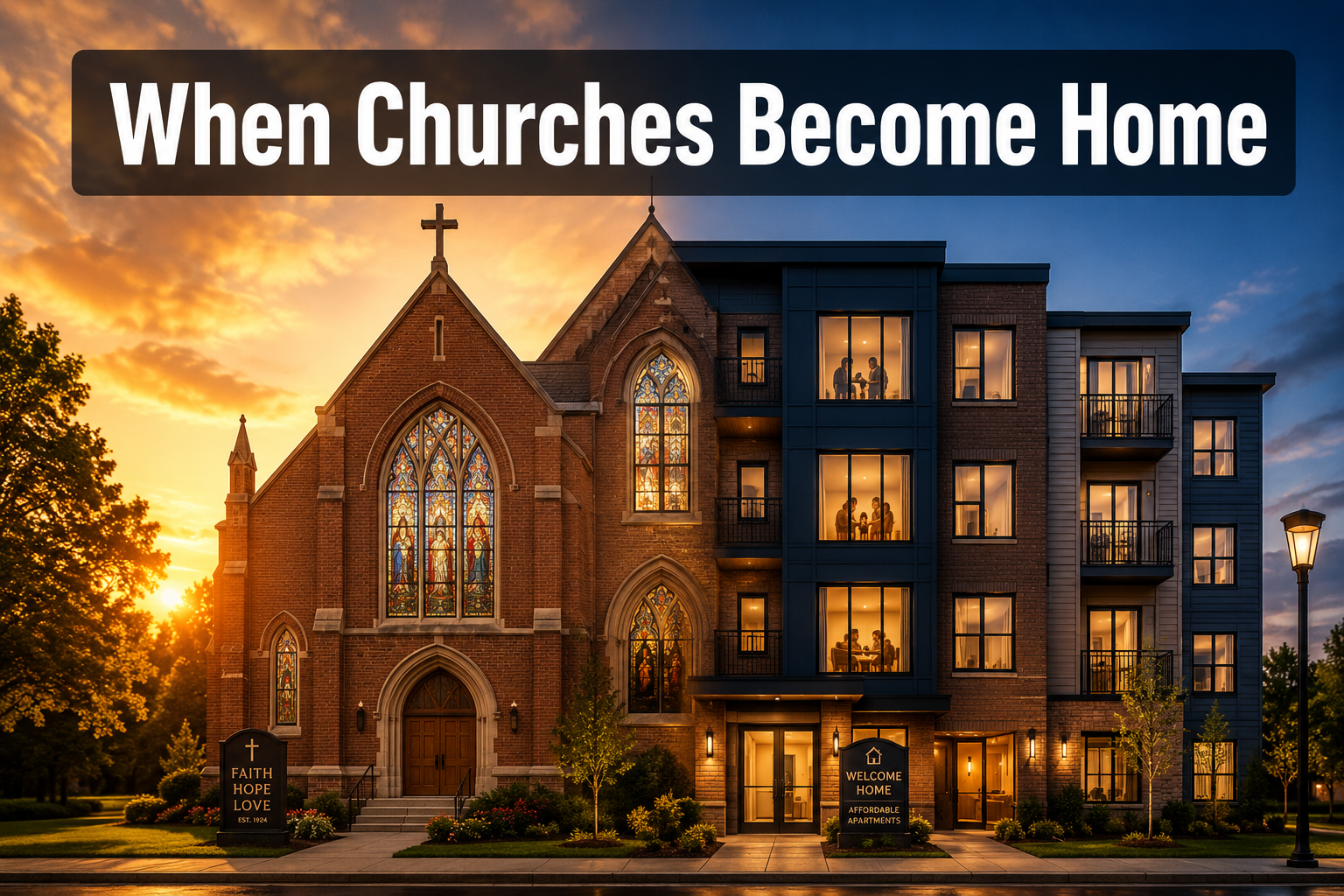

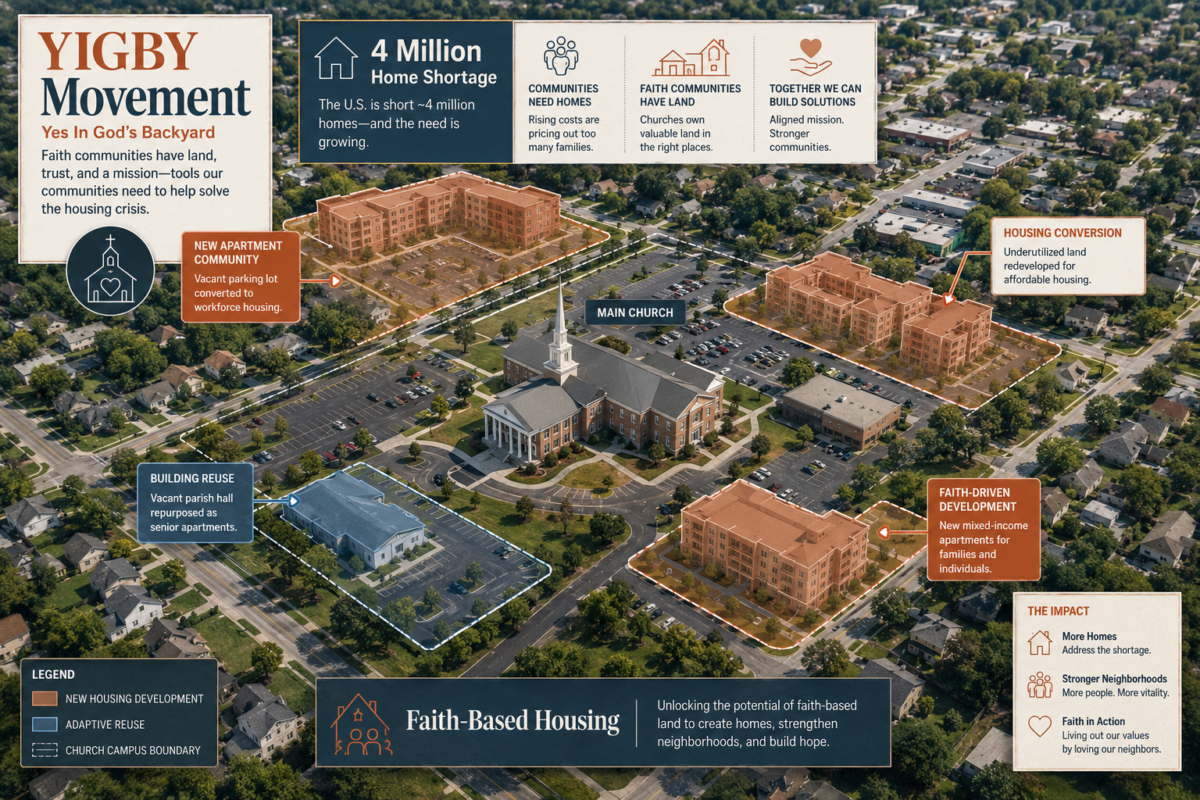
As many churches across the United States face dwindling congregations and mounting maintenance costs, a growing trend is emerging: transforming sacred spaces into practical, affordable housing. This innovative approach to shrinking US congregations reimagining church buildings as affordable housing addresses both urgent community needs and the long-term future of religious properties. The numbers behind this shift are hard to ignore. The United States faces a shortfall of more than 4 million homes, and at the same time, thousands of church buildings sit underused or empty every day of the week [1].
This is not just a real estate story. It is a story about the Church living out its calling.
“Religion that God our Father accepts as pure and faultless is this: to look after orphans and widows in their distress.” (James 1:27, NIV)
When a congregation chooses to open its doors, literally and structurally, to those who need a roof over their heads, that is Scripture in action.
Key Takeaways
- Thousands of US church properties sit underused while a national housing shortage grows more severe each year.
- Faith communities across the country are converting vacant buildings, parking lots, and surplus land into affordable housing units.
- Real-world examples from California, North Carolina, Virginia, and Iowa show this trend is accelerating in 2026.
- Churches face real obstacles including zoning laws, funding gaps, and community resistance, but many are finding workable paths forward.
- This movement connects biblical stewardship directly to practical community service.
Why So Many Church Buildings Are Sitting Empty
The decline in weekly church attendance has been gradual but steady. Denominations that once filled sanctuaries to capacity are now managing buildings designed for congregations two or three times their current size. Maintenance costs climb. Heating bills arrive. And the question becomes unavoidable: what do we do with all this space?
This is where the concept of stewardship becomes more than a sermon topic. The Bible is clear that what God entrusts to us should be used wisely. As Jesus taught in the parable of the talents, burying what you have been given is never the right answer (Matthew 25:14-30).
For a deeper look at what the Bible says about wise use of resources, explore these examples of stewardship in the Bible that speak directly to how believers are called to manage what God has placed in their hands.
Shrinking US Congregations Reimagining Church Buildings as Affordable Housing: Real Examples
The movement has a name now. Faith communities and housing advocates call it YIGBY, which stands for “Yes in God’s Backyard.” It is a direct response to the NIMBY (“Not in My Backyard”) resistance that often blocks affordable housing development. Churches, motivated by faith and mission, are saying yes where others say no [1].
Here are some of the most compelling examples happening right now:
First United Methodist Church of Inglewood, California
In April 2026, this congregation began converting three vacant buildings on its campus into 60 studio apartments for low-income seniors and working families. The project breathes new life into structures that were sitting idle while people in the surrounding community struggled to find affordable places to live [2].
Milner Memorial Presbyterian Church, Raleigh, North Carolina
In February 2026, this historic church building was transformed into an affordable housing complex for older adults. Architects preserved key elements of the original church architecture, honoring the building’s history while serving a new generation of residents [4].
Village of Faith Ministries, Sandston, Virginia
In March 2025, this congregation announced plans to develop 192 apartments and 40 townhomes on its 1.5-acre property, creating a significant source of affordable housing in a community that desperately needs it [5].
Arlington Presbyterian Church, Arlington, Virginia
This congregation sold its historic building to create Gilliam Place, a six-story complex with 173 affordable apartments. The decision aligned directly with the church’s mission to serve its neighbors, even when that meant letting go of the building itself [7].
Polk County, Iowa
A May 2026 report identified roughly 740 underused properties in the Des Moines metro area, including church parking lots, as potential sites for “missing middle” housing. This kind of systematic identification of faith-based land for housing development is a growing strategy for city planners [3].
The Challenges Churches Face in This Process
This path is not without its thorniness. Churches that want to convert their properties into housing often run into walls, sometimes literal bureaucratic ones.
Common obstacles include:
- Zoning restrictions that classify church land separately from residential use, requiring lengthy variance processes
- Funding gaps between what a congregation can raise and what a construction project actually costs
- Community opposition from neighbors who resist increased density or changes to neighborhood character
- Legal complexity around historic preservation when a building carries architectural or cultural significance
Catholic Charities USA addressed many of these hurdles directly in their guide “Paths to Project Development,” which provides a roadmap for converting surplus church property into affordable housing [9].
Some states are beginning to clear the path. Washington state, for example, passed legislation granting density bonuses to religious organizations that build 100% affordable housing on their property, making it easier for congregations to move forward without fighting zoning battles alone [10].
National Community Renaissance partnered with five churches in Southern California to build affordable housing on underutilized church land, with the first project, Legacy Square in Santa Ana, breaking ground in 2021. That kind of nonprofit-church partnership is becoming a proven model [6].
What This Means for the Body of Christ
There is something deeply moving about a congregation that chooses to serve its community even at great personal cost. When Arlington Presbyterian sold its building, they did not lose their church. They became the church in a more tangible way.
This is the kind of bold, obedient faith described throughout Scripture. The Bible study on trusting God reminds believers that stepping into the unknown with God’s mission in hand is never a mistake. It is an act of worship.
For small group leaders and pastors who want to explore what it means to be a servant community, a Bible lesson about serving can help your congregation connect this real-world trend to biblical values in a practical, grounded way.
The question every congregation with underused property should be asking is not “Can we afford to do this?” but rather “Can we afford not to?”
“For we are God’s handiwork, created in Christ Jesus to do good works, which God prepared in advance for us to do.” (Ephesians 2:10, NIV)
Those good works may look like a converted parking lot. They may look like 60 studio apartments where seniors can age with dignity. They may look like a six-story building where families no longer have to choose between rent and groceries.
If your congregation is wrestling with big questions about purpose, direction, or how to use what God has given you, the Top 10 Engaging Bible Study Topics for Small Groups offers a solid starting point for those conversations.
And for leaders who want to anchor their community discernment in Scripture, the guide to using commentaries in Bible study can help you dig deeper into the texts that speak to justice, generosity, and community care.
Conclusion: Sacred Space, Renewed Purpose
The movement of shrinking US congregations reimagining church buildings as affordable housing is one of the most compelling examples of the Church adapting without abandoning its core mission. Buildings change. Congregations shift. But the call to love your neighbor does not waver.
Here are practical next steps for any congregation considering this path:
- Audit your property. Walk through every building and lot you own and honestly assess what is being used and what is sitting idle.
- Connect with a nonprofit housing partner. Organizations like National Community Renaissance have already built the playbook. You do not have to start from scratch.
- Research your local zoning laws. Some states and cities have already created favorable pathways for faith-based housing development.
- Bring your congregation into the conversation. Use a Bible study on stewardship or service to help your people understand the spiritual foundation for this kind of decision.
- Pray with intention. Use a prayer strategy to seek God’s direction as a community before making major decisions.
The Church has always been at its best when it opens its arms widest. Converting an empty classroom into a senior apartment is not a sign of failure. It is a sign of a congregation that still believes its best days of service are ahead.
References
[1] Yigby Churches Build Housing Amid Shortage – https://www.theguardian.com/society/2026/mar/29/yigby-churches-build-housing-amid-shortage?utm_source=openai
[2] Inglewood Church Turns Empty School Into 60 Lifeline Apartments – https://hoodline.com/2026/04/inglewood-church-turns-empty-school-into-60-lifeline-apartments/?utm_source=openai
[3] Polk County Middle Housing Churches Strip Malls – https://www.axios.com/local/des-moines/2026/05/13/polk-county-middle-housing-churches-strip-malls?utm_source=openai
[4] Sanctuary To Senior Housing – https://www.northcarolinahealthnews.org/2026/02/16/sanctuary-to-senior-housing/?utm_source=openai
[5] Church Affordable Housing Service Faith – https://www.goodgoodgood.co/articles/church-affordable-housing-service-faith?utm_source=openai
[6] National Core Launches Pipeline Of Affordable Housing On Surplus Church Land – https://nationalcore.org/national-core-launches-pipeline-of-affordable-housing-on-surplus-church-land/?utm_source=openai
[7] New Ground Churches Transform Land Into Affordable Housing – https://www.csmonitor.com/USA/Society/2023/0512/New-ground-Churches-transform-land-into-affordable-housing?utm_source=openai
[8] Common Ground (Seattle) – https://en.wikipedia.org/wiki/Common_Ground_%28Seattle%29?utm_source=openai
[9] Paths To Project Development Converting Surplus Church Property Into Affordable Housing Second Edition – https://www.catholiccharitiesusa.org/publications/paths-to-project-development-converting-surplus-church-property-into-affordable-housing-second-edition/?utm_source=openai
[10] Churches Repurpose Land Affordable Housing – https://www.goodgoodgood.co/articles/churches-repurpose-land-affordable-housing?utm_source=openai
Test Your Knowledge!
Answer all 10 questions, then submit to see your score.
Related Posts

Religious Construction Surges in Q2 2026 Amidst Economic Slowdown
Last updated: June 2026 While many industries are tightening their belts, a surprising trend is emerging in the construction world: religious building projects are on the…
 Jun 11, 2026
Florida AG Mandates Release Time for Religious Instruction in Schools
Last updated: June 2026 A public school's front office is not the final word on whether a child can step away for an hour of faith-based…
Jun 11, 2026
Pentagon Revises Christian Religious Categories After Outcry (June 2026)
Last updated: June 2026 A recent decision by the Pentagon to revise its religious categorization system has ignited a firestorm of controversy, particularly concerning the classification…
Jun 8, 2026
Ohio Bill Bolsters Religious Freedom to Sue Over Inhibiting Laws
Last updated: June 2026 Religious freedom continues to be a hot-button issue across the United States, and Ohio is now at the forefront of a legislative…
Jun 12, 2026


 By
By


