

You’ve been asked to lead a Bible study. Maybe it’s for your small group, Sunday School class, or a few friends gathering in your living room. The excitement quickly turns to overwhelm: Where do I even start?
Here’s the truth: You don’t need a seminary degree to design a Bible study that changes lives. What you need is a clear framework, a shepherd’s heart, and a commitment to letting Scripture do the heavy lifting. When you learn how to design a Bible study effectively, you’re not just filling time—you’re creating space for the Holy Spirit to work, for community to deepen, and for God’s Word to transform hearts.
This guide will walk you through every step of the process, from choosing your topic to launching your first session with confidence. Whether you’re a seasoned teacher or leading your first study, you’ll discover practical tools that work.
Key Takeaways
- Start with clear spiritual goals that address your group’s specific needs and point them toward biblical truth
- Build a repeatable framework that includes Scripture reading, discussion, and practical application in every session
- Focus on engagement over information—transformation happens through conversation and real-life application, not just lecture
- Keep it simple and accessible—the best Bible studies prioritize depth over complexity and meet people where they are
- Launch with preparation and prayer—spiritual readiness matters more than perfect materials
Why Learning To Design A Bible Study Matters

The Body of Christ desperately needs equipped leaders who can guide others into God’s Word. When you design a Bible study, you’re not creating curriculum—you’re building a bridge between ancient truth and modern life.
Small group leaders often feel unprepared. According to research, nearly 60% of lay leaders say they lack confidence in their teaching abilities. But here’s what God promises:
“If any of you lacks wisdom, let him ask of God, who gives to all liberally and without reproach, and it will be given to him.” (James 1:5, NKJV)
You already have everything you need. God equips those He calls.
The Impact of Well-Designed Studies
When you invest time in learning how to design a Bible study properly, you create:
- Deeper biblical literacy in your community
- Stronger relationships built on shared spiritual growth
- Practical life change as people apply Scripture daily
- Multiplication as participants become future leaders
A well-crafted study doesn’t just inform—it transforms. It meets people in their anxiety, their questions about purpose, their leadership struggles, and points them consistently back to the sufficiency of Scripture.
Step 1: Define Your Purpose and Audience
Before you write a single question or choose a passage, you need clarity on two things: Who are you serving? and What does God want to accomplish?
Identify Your Audience’s Needs
Every group is different. A study for young parents looks different from one for college students or retirees. Ask yourself:
- What life stage are they in?
- What struggles keep them up at night?
- What biblical knowledge do they already have?
- How much time can they realistically commit?
Practical Example: If you’re leading a study for working moms, they’re likely battling exhaustion, guilt, and the challenge of balancing responsibilities. A study on rest, identity in Christ, or biblical priorities would meet them exactly where they are.
Set Clear Spiritual Goals
What do you want participants to know, feel, and do by the end of your study?
Effective goals are:
- ✅ Specific – “Understand God’s character” vs. “Understand how God’s faithfulness impacts daily trust”
- ✅ Biblical – Rooted in Scripture, not pop psychology
- ✅ Actionable – Leading to life change, not just head knowledge
- ✅ Measurable – You can observe growth or application
Write your goals down. Everything you design should serve these objectives.
“All Scripture is given by inspiration of God, and is profitable for doctrine, for reproof, for correction, for instruction in righteousness, that the man of God may be complete, thoroughly equipped for every good work.” (2 Timothy 3:16-17, NKJV)
Your study should equip, not just educate.
Choose Your Topic Wisely
The best Bible study topics either:
- Address a felt need (anxiety, relationships, purpose)
- Explore a book of the Bible (Philippians, James, John)
- Examine a biblical theme (grace, prayer, spiritual warfare)
- Study a biblical character (David, Esther, Paul)
Pro Tip: Start with shorter studies (4-6 weeks) before committing to longer series. This builds momentum and allows you to adjust based on feedback.
Step 2: Design A Bible Study Framework That Works
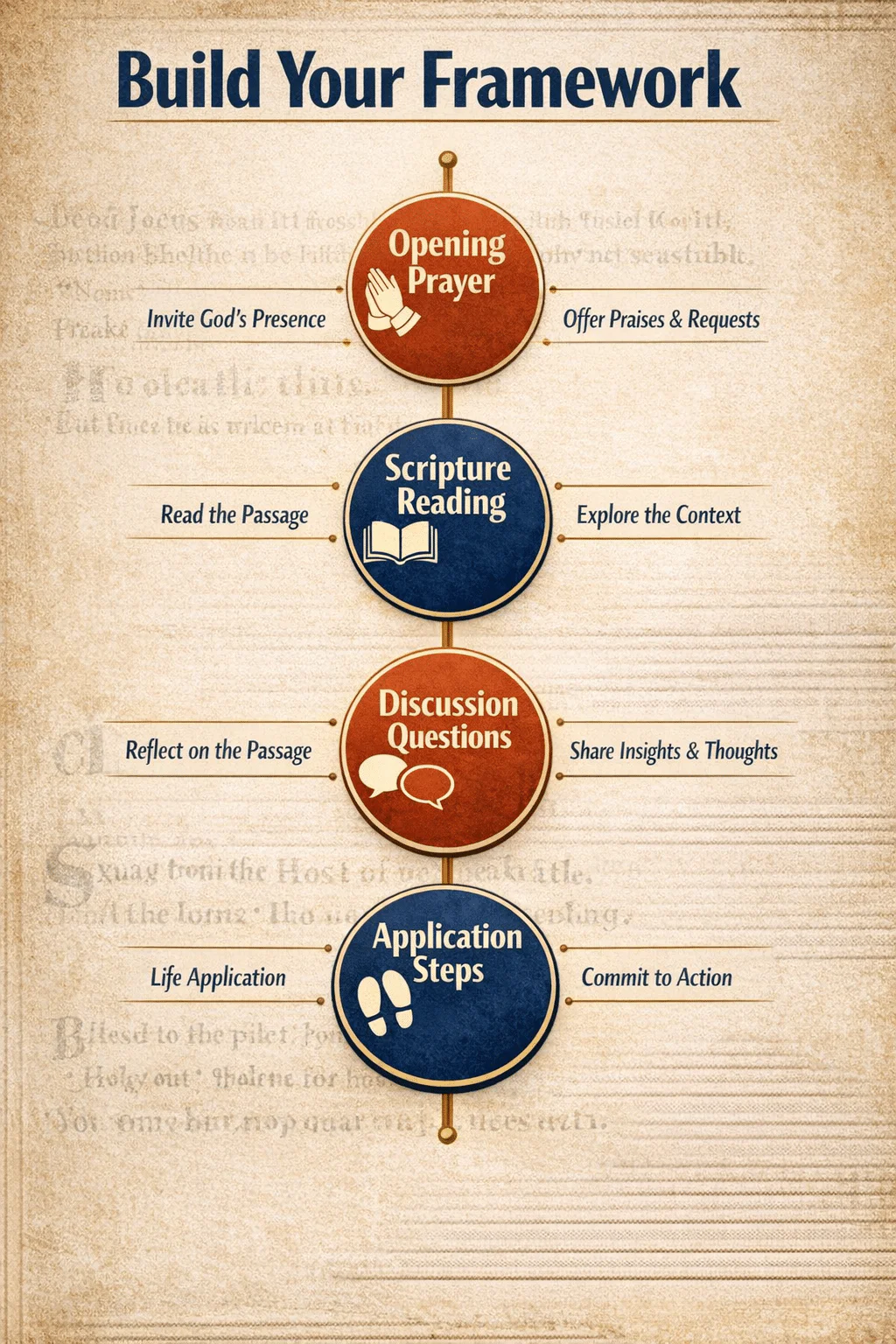
Once you know your purpose, it’s time to build the structure. A solid framework ensures consistency, builds confidence, and makes preparation easier week after week.
The Essential Components
Every effective Bible study session should include these elements:
| Component | Purpose | Time Allocation |
|---|---|---|
| Opening Prayer | Invite the Holy Spirit, set the tone | 2-3 minutes |
| Icebreaker/Connection | Build community, transition hearts | 5-7 minutes |
| Scripture Reading | Encounter God’s Word together | 5-10 minutes |
| Teaching/Context | Provide background and clarity | 10-15 minutes |
| Discussion Questions | Process and personalize truth | 20-30 minutes |
| Application Steps | Move from knowing to doing | 10 minutes |
| Closing Prayer | Commit to action, pray for needs | 5 minutes |
This framework works for 60-90 minute sessions and can be adjusted based on your group’s needs.
Create a Repeatable Template
When you design a Bible study with a consistent structure, participants know what to expect. This frees them to engage deeply rather than wondering what’s coming next.
Sample Session Template:
Week [#]: [Topic Title]
Main Scripture: [Reference]
Key Verse to Memorize: [Reference]
Big Idea: [One sentence summary]
Opening Question: [Icebreaker related to topic]
Scripture Reading: [Passage with context]
Teaching Points:
- [Point with supporting verses]
- [Point with supporting verses]
- [Point with supporting verses]
Discussion Questions:
- [Observation question]
- [Interpretation question]
- [Application question]
- [Personal reflection question]
This Week’s Challenge: [Specific, doable action step]
Prayer Focus: [How to pray about this topic]
This template keeps you organized and ensures you cover all the bases.
Balance Teaching and Discussion
Here’s a common mistake: talking too much. If you’re speaking for 45 minutes and leaving 10 for discussion, you’re missing the transformation zone.
People remember:
- 10% of what they hear
- 50% of what they discuss
- 90% of what they teach others
Aim for a 40/60 split: 40% teaching, 60% discussion and application.
“Let the word of Christ dwell in you richly in all wisdom, teaching and admonishing one another in psalms and hymns and spiritual songs, singing with grace in your hearts to the Lord.” (Colossians 3:16, NKJV)
Notice the emphasis on “one another”—Bible study is communal, not just instructional.
Write Questions That Go Deep
The quality of your questions determines the depth of your discussion. Use these question types strategically:
📖 Observation Questions – “What does the text say?”
- “What words or phrases are repeated?”
- “Who is speaking, and to whom?”
- “What’s the context of this passage?”
🤔 Interpretation Questions – “What does the text mean?”
- “Why did the author include this detail?”
- “How does this connect to the broader biblical narrative?”
- “What does this reveal about God’s character?”
❤️ Application Questions – “How does this change my life?”
- “Where do you see this playing out in your daily routine?”
- “What needs to change in light of this truth?”
- “How can we pray for each other about this?”
Avoid yes/no questions. Instead of “Is God faithful?” ask “How have you experienced God’s faithfulness this week?”
Step 3: Gather and Organize Your Resources
You don’t have to reinvent the wheel. When you design a Bible study, you’re standing on the shoulders of giants—faithful teachers who’ve gone before you.
Essential Study Tools
For Biblical Context:
- 📖 Study Bible (ESV, NKJV, NIV Study Bibles)
- 📚 Bible Dictionary (Holman, Zondervan)
- 🔍 Concordance (Strong’s, online tools like Blue Letter Bible)
- 📝 Commentary (Matthew Henry, Warren Wiersbe)
For Application:
- 💡 Topical Resources (Answered Faith articles and studies)
- 📱 Bible Apps (YouVersion, Logos, Olive Tree)
- 🎧 Sermon Archives (Trusted pastors in your tradition)
Warning: Don’t get lost in research. Set a time limit (2-3 hours max per session) and focus on what serves your specific goals.
Organize Your Material
Create a simple filing system:
Digital:
- One folder per study series
- Subfolders for each week
- Document naming: “Week1_Grace_TeacherGuide.docx”
Physical:
- Three-ring binder with dividers
- Printed Scripture passages
- Discussion questions on separate sheets
The 80/20 Rule: Spend 80% of your prep time in Scripture itself, 20% in supplemental resources. Let the Bible be your primary teacher.
Create Participant Materials
Keep it simple and usable. Participants need:
✅ Weekly handout with:
- Scripture passage
- Key verse
- Discussion questions
- Space for notes
- This week’s challenge
✅ Optional extras:
- Reading plan for the week
- Memory verse cards
- Prayer journal prompts
Answered Faith offers affordable, printable Bible studies designed specifically for small group leaders who need high-quality materials without the high cost. These resources are theologically sound, immediately usable, and created with the lay leader in mind.
Step 4: Plan for Engagement and Application

Information without transformation is just religious entertainment. The goal isn’t to fill heads—it’s to change lives.
Build in Interactive Elements
People engage differently. Design your study to include:
🗣️ Pair Shares
“Turn to someone next to you and share one way you’ve seen God work this week.”
✍️ Written Reflection
“Take 2 minutes to journal your answer to this question.”
🎭 Case Studies
“Imagine you’re counseling a friend dealing with [topic]. What biblical truth would you share?”
📊 Visual Aids
- Charts comparing biblical concepts
- Maps showing Paul’s journeys
- Timelines of biblical events
🎵 Worship Integration
Open or close with a song that reinforces your theme.
Make Application Concrete
Vague application leads to zero life change. Instead of “Pray more,” try:
Specific Application Steps:
- “Set a phone alarm for 7 AM and pray for 5 minutes before checking social media”
- “Text one person this week with a specific encouragement from today’s passage”
- “Write the memory verse on a sticky note and place it on your bathroom mirror”
“But be doers of the word, and not hearers only, deceiving yourselves.” (James 1:22, NKJV)
Give people a clear next step they can take before they leave the room.
Create Accountability Structures
Transformation happens in community. Build accountability into your design:
- Prayer partners who check in mid-week
- Group chat for sharing wins and struggles
- Opening question next week: “How did last week’s challenge go?”
- Celebration moments when someone shares breakthrough
When people know they’ll be asked about their application, they’re far more likely to follow through.
Address Common Obstacles
Your participants face real barriers to spiritual growth:
Time constraints → Provide 10-minute daily readings instead of hour-long homework
Biblical illiteracy → Define terms, provide context, never assume knowledge
Fear of judgment → Establish ground rules about confidentiality and grace
Spiritual dryness → Acknowledge the struggle, point to God’s faithfulness
Meet people where they are, not where you wish they were.
Step 5: Prepare Yourself Spiritually
Here’s the hard truth: You cannot give what you don’t have. Before you design a Bible study for others, you must encounter God yourself.
Personal Preparation Matters
The best Bible study leaders are those who:
✝️ Live in the text first
- Study the passage for your own growth before teaching it
- Journal your personal reflections
- Ask God to change you through the material
🙏 Pray for your participants
- Keep a list of names and specific prayer requests
- Ask God to prepare hearts before you meet
- Intercede for breakthrough and transformation
📖 Stay humble
- Remember you’re a fellow learner, not the expert
- Be willing to say “I don’t know, but I’ll find out”
- Share your own struggles and growth areas
“Take heed to yourself and to the doctrine. Continue in them, for in doing this you will save both yourself and those who hear you.” (1 Timothy 4:16, NKJV)
Your character matters as much as your content.
Deal With Your Own Insecurities
Every Bible study leader battles the same fears:
❌ “I’m not qualified enough”
✅ Truth: God uses ordinary people (see Moses, Gideon, Peter)
❌ “Someone else could do this better”
✅ Truth: God chose you for this group at this time
❌ “What if I mess up?”
✅ Truth: Grace covers mistakes, and humility builds trust
Pastor Duke Taber reminds us: “Biblical education should be accessible to all. You don’t need a degree to open God’s Word with others—you just need a willing heart and a commitment to let Scripture speak.”
Practice Your Delivery
Even with great content, delivery matters:
- Read aloud your teaching points to check flow
- Time yourself to ensure you’re not rushing or dragging
- Anticipate questions participants might ask
- Prepare transitions between sections
- Have a backup plan if discussion stalls or runs long
Confidence comes from preparation. Do the work, then trust God with the results.
Launch Your Bible Study With Confidence

You’ve done the preparation. You’ve prayed. You’ve designed a solid framework. Now it’s time to launch.
First Session Essentials
Your opening session sets the tone for everything that follows. Make it count:
✅ Week 1 Checklist:
- Arrive 15 minutes early to set up
- Arrange seating in a circle (avoid lecture-style rows)
- Have extra Bibles, pens, and handouts available
- Prepare name tags if it’s a new group
- Test any technology (video clips, music, etc.)
- Pray over the space before people arrive
📋 Cover These Logistics:
- Study overview – What you’ll cover and why it matters
- Schedule – How many weeks, what time, where
- Expectations – Homework (if any), attendance, participation
- Ground rules – Confidentiality, respect, grace for different views
- Contact info – How to reach you with questions
Create a Welcoming Environment
Physical space matters:
- Comfortable seating
- Good lighting
- Minimal distractions
- Coffee/snacks if possible
- Temperature control
Emotional space matters more:
- Warm greeting at the door
- Genuine interest in people’s lives
- Permission to ask questions
- Safety to share struggles
- Celebration of small wins
People won’t remember every word you teach, but they’ll remember how you made them feel.
Handle Difficult Dynamics
Even the best-designed Bible study faces challenges:
The Dominator – Politely redirect: “Great insight, John. Let’s hear from someone who hasn’t shared yet.”
The Silent One – Ask easier questions directly: “Sarah, what stood out to you in this verse?”
The Debater – Set boundaries: “That’s an interesting perspective. Let’s explore what the text says and continue this conversation after.”
The Distracted – Address privately, not publicly. There may be legitimate struggles you’re unaware of.
The Critic – Receive feedback graciously, but don’t let one voice derail the group.
Lead with grace, but lead. Your job is to shepherd the whole flock.
Evaluate and Adjust
After your first few sessions, ask for feedback:
Simple Evaluation Questions:
- What’s been most helpful so far?
- What could be improved?
- Are the discussion questions hitting the right level?
- Is the homework load reasonable?
- How can I pray for you specifically?
Be willing to adjust. Flexibility is a strength, not a weakness.
Celebrate Progress
Don’t wait until the end to acknowledge growth. Celebrate:
- 🎉 Someone sharing for the first time
- 📖 A participant who completed the memory verse challenge
- 💬 Breakthrough moments in discussion
- 🙏 Answered prayers
- ❤️ Growing community and care for one another
“Therefore encourage one another and build each other up, just as in fact you are doing.” (1 Thessalonians 5:11, NIV)
Encouragement fuels perseverance.
Common Mistakes To Avoid When You Design A Bible Study
Learn from others’ missteps and save yourself frustration:
❌ Mistake #1: Trying To Cover Too Much
The Problem: Cramming 10 points into one session leads to shallow engagement.
The Solution: Go deep on 2-3 key truths rather than skimming 10. Quality over quantity always wins.
❌ Mistake #2: Ignoring Different Learning Styles
The Problem: All lecture, no interaction bores visual and kinesthetic learners.
The Solution: Include variety—reading, discussion, writing, visual aids, and practical exercises.
❌ Mistake #3: Making It About You
The Problem: Sharing too many personal stories shifts focus from Scripture to you.
The Solution: Use personal examples sparingly and always to illuminate the text, not showcase your experience.
❌ Mistake #4: Avoiding Hard Topics
The Problem: Skipping controversial or difficult passages creates biblically illiterate believers.
The Solution: Address tough topics with humility, clarity, and grace. Point to Scripture’s authority, not your opinion.
❌ Mistake #5: Neglecting Follow-Up
The Problem: No mid-week contact means people drift and disengage.
The Solution: Send a weekly encouragement text, share a relevant article, or check in on prayer requests.
❌ Mistake #6: Using Exclusively Head Knowledge
The Problem: All theology, no application produces Pharisees, not disciples.
The Solution: Always answer “So what?” and “Now what?” in every session.
Resources To Help You Design A Bible Study
You don’t have to do this alone. Here are trusted resources:
Answered Faith Resources
Answered Faith provides:
- Printable Bible studies on relevant topics
- Daily devotionals for personal growth
- Articles addressing life’s pressing questions
- Affordable resources designed for lay leaders
These materials are created with you in mind—theologically sound, immediately usable, and accessible without breaking the budget.
Free Online Tools
- Blue Letter Bible (blueletterbible.org) – Free concordance and commentaries
- Bible Gateway (biblegateway.com) – Multiple translations and search tools
- YouVersion (bible.com) – Reading plans and devotionals
- Bible Project (bibleproject.com) – Visual summaries of biblical books
Recommended Books
- How to Lead a Small Group by Neal F. McBride
- The Discussion Book by Stephen D. Brookfield
- Transformational Groups by Ed Stetzer
- Leading Life-Changing Small Groups by Bill Donahue
Study Bibles Worth Investing In
- ESV Study Bible
- NIV Study Bible
- NKJV Study Bible
- Life Application Study Bible
Pro Tip: Check your local Christian bookstore for used study Bibles at significant discounts.
Conclusion: Your Next Steps To Design A Bible Study
You now have everything you need to design a Bible study that transforms lives. The question isn’t whether you’re capable—it’s whether you’re willing.
Here’s your action plan:
This Week:
- ✅ Identify your audience and their specific needs
- ✅ Set 2-3 clear spiritual goals for your study
- ✅ Choose your topic or book of the Bible
Next Week:
- ✅ Create your session template
- ✅ Outline your first 4 weeks
- ✅ Write discussion questions for week 1
Before Launch:
- ✅ Prepare participant handouts
- ✅ Pray daily for your group
- ✅ Invite participants personally
Remember, you’re not creating the perfect Bible study—you’re creating space for the Holy Spirit to work. Your faithfulness matters more than your perfection.
“And let us consider one another in order to stir up love and good works, not forsaking the assembling of ourselves together, as is the manner of some, but exhorting one another, and so much the more as you see the Day approaching.” (Hebrews 10:24-25, NKJV)
The Body of Christ needs what you have to offer. God has equipped you for this moment. Now step forward in faith and watch Him work through your willingness.
Need ready-made resources? Answered Faith offers affordable, printable Bible studies designed specifically for leaders like you. Visit us to explore materials that combine theological depth with practical application—because biblical education should be accessible to all.
The harvest is plentiful. The workers are few. But you’re here, ready, and equipped. Let’s get to work. 🙏
Share On Pinterest


Related Posts

Best Bible Studies About Faith: A Comprehensive Buyer's Guide
Last updated: May 2026 Discover the 5 best Bible studies about faith for individuals and groups. Compare prices, formats, and features to find the perfect study for your spiritual growth.
 May 12, 2026
What You'll Learn in a Complete Bible Study on Faith
Last updated: May 2026 Discover what a complete Bible study on faith really covers — from the true biblical definition of faith, to doubt, healing, grace, and how faith grows. Grounded in Scripture, practical for everyday life.
May 13, 2026
Why Most People Study the Bible Wrong — And How a Structured Study Changes Everything
Last updated: May 2026 Most Christians read the Bible but never truly study it. Discover the common mistakes that keep believers spiritually stuck — and how a structured Bible study changes everything.
May 26, 2026
What to Look for in a Bible Study on Faith
Last updated: May 2026 Learn what makes a Bible study on faith truly transformative — scriptural depth, honest theology, real application, and community accountability.
May 12, 2026


 By
By


