

A recent Barna study found that only 1 in 5 churchgoers reads the Bible daily. That number should stop us in our tracks. Not because we need guilt, but because it reveals a luminous opportunity. When people have the right tools and the right approach, Bible study transforms from a chore into a lifeline.
I have been a pastor for years, and I can tell you firsthand that the difference between a thriving small group and a stagnant one almost always comes down to the lesson plan. Good Bible study lesson ideas do not just fill an hour. They open hearts, spark real conversation, and send people home changed.
Whether you lead a Sunday School class, facilitate a home group, or simply want to go deeper in your personal quiet time, this guide is for you. I have gathered over 25 practical, Scripture-rooted ideas that you can start using this week. No seminary degree required.
Key Takeaways
- 📖 Variety keeps groups engaged. Rotating between topical, book-by-book, and character studies prevents burnout and reaches different learning styles.
- 🙏 Every lesson should point back to Scripture. The Bible itself is the curriculum; our job is to make it accessible and applicable.
- 💡 Simple frameworks work best. You do not need expensive materials to lead a transformative study.
- 🤝 Community is the catalyst. The early church grew through daily fellowship and shared learning (Acts 2:42-47) [1].
- ✏️ Application is everything. A lesson without a “now what?” step is just information.
Bible Study Lesson Ideas for Small Groups

Small groups are where real growth happens. There is something about sitting in a circle with five to twelve people that makes the Word come alive. Here are some of my favorite approaches.
1. The Acts 2 Community Study
The early church devoted themselves to “the apostles’ doctrine and fellowship, to the breaking of bread, and to prayers” (Acts 2:42, NKJV). A study on this passage asks your group a powerful question: What does an ideal Christian community look like today? [1]
Walk through Acts 2:42-47 over two to three weeks. Each session, focus on one element: teaching, fellowship, communion, or prayer. Then ask your group to honestly evaluate where your church excels and where it needs growth.
2. The Four-Question Discussion Framework
This is a simple structure I learned from a small group training resource [2] that works with almost any passage:
| Question | Purpose |
|---|---|
| What is God doing in this passage? | Observation |
| What does this reveal about God’s character? | Theology |
| What resonates with me personally? | Reflection |
| What is God inviting me to do? | Application |
These four questions turn any chapter of the Bible into a rich group discussion. Print them on a card and hand them out.
3. Book-by-Book Deep Dives
Pick a book and commit to it. Romans is a phenomenal choice for 2026. Lifeway’s Explore the Bible series, for example, covers Romans 1:1-7 and 16-25, emphasizing God’s saving power through Jesus [6]. You do not need to buy the curriculum. Just read a chapter a week, use the four questions above, and let the Holy Spirit do the heavy lifting.
4. Topical Series on Grace
Grace is one of those words we say constantly but rarely unpack. A multi-week series on grace can transform your group’s understanding of the gospel. You could trace grace from the Old Testament foundations through the parables of Jesus and into Paul’s theology. Each week builds on the last, and your group will never see grace the same way again.
5. Authority and Government Study
This is especially relevant right now. A lesson series on how believers respond to governmental authority uses Mark 12:17, Romans 13:1-8, and 1 Peter 2:13-17 to explore what it means to render unto Caesar while keeping our ultimate allegiance to God [3]. Structured discussion activities help groups navigate this topic without it turning into a political debate.
Creative Bible Study Lesson Ideas for Deeper Engagement

Sometimes the best thing you can do for your group is to change the method. Here are some inventive approaches that keep people leaning in.
6. Character Studies
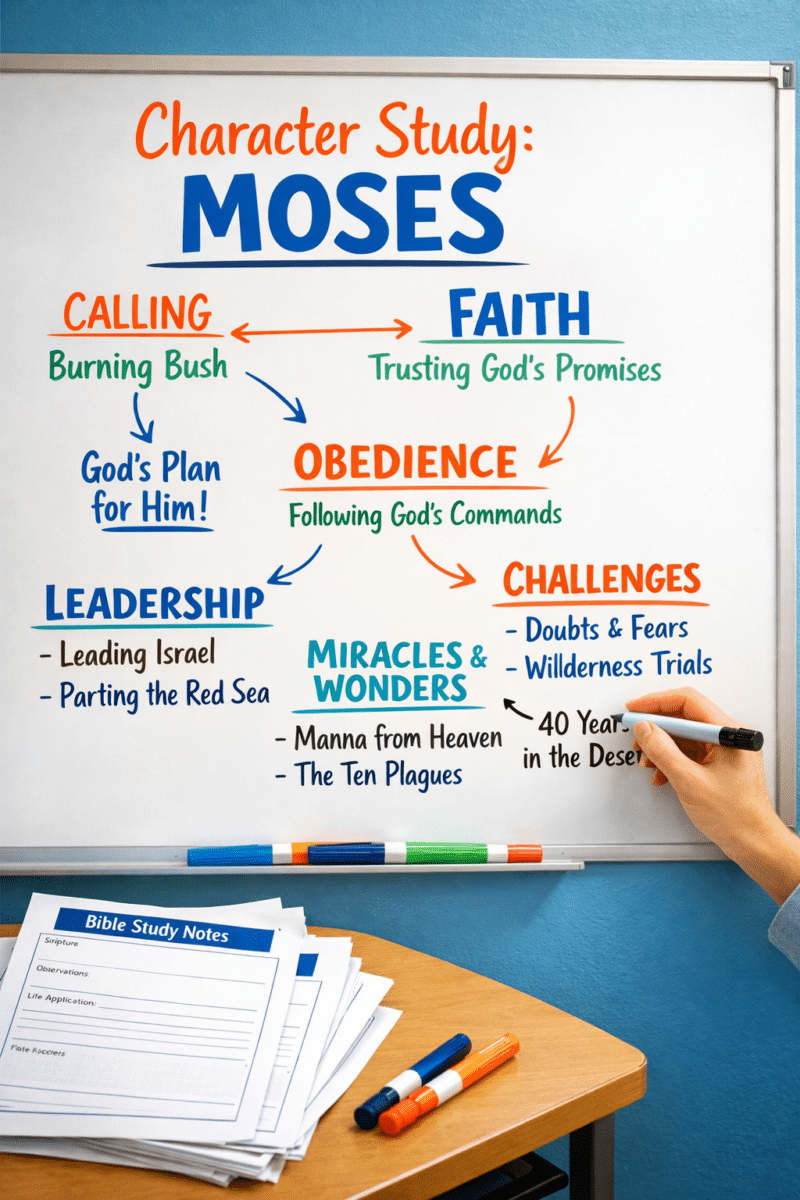
Pick a Bible character and spend three to four weeks walking through their life. Moses, Ruth, David, Esther. The key is to look at their failures as much as their victories. Our guide on how to do a Bible character study gives you a step-by-step framework that works for any figure in Scripture.
7. Inductive Bible Study Method
This is the gold standard for personal and group study. Observation, interpretation, application. You read the text carefully, ask what it meant to the original audience, and then determine what it means for you today. If you have never tried it, our inductive Bible study methods guide will walk you through the entire process.
8. Bible Journaling
Some people process truth best with a pen in hand. Encourage your group to try Bible study journaling where they write out verses, sketch illustrations, or record prayers alongside their reading. It slows people down and helps the Word soak in at a deeper level.
9. Year-Long Reading Plans
Tricia Goyer’s “26 Life Lessons from the Bible for 2026” offers a structured approach with daily readings from the Old Testament, New Testament, Psalms, and Proverbs, paired with devotional content [4]. This kind of plan gives your group a shared rhythm even outside of meeting times.
10. Scripture Mapping
This is a newer approach where you take a single verse or short passage and visually map out its context: who wrote it, who received it, the historical setting, cross-references, and personal application. It is particularly effective for visual learners.
11. The “One Verse” Study
Sometimes less is more. Spend an entire session on a single verse. Read it in multiple translations. Look up the original Greek or Hebrew words. Discuss every phrase. You will be amazed at the depth hiding in one sentence of Scripture.
“Your word is a lamp to my feet and a light to my path.” (Psalm 119:105, NKJV)
Topical Bible Study Lesson Ideas for Every Season
Topical studies meet people where they are. When someone in your group is struggling with anxiety, a study on peace hits differently than a random chapter in Leviticus. Here are some perennial topics that always resonate.
12. Marriage and Relationships
This is one of the most requested topics I encounter. A study on being a husband and wife according to Scripture gives couples practical, biblical tools. You can also explore broader marriage Bible study ideas that work for couples’ groups or mixed small groups.
13. Overcoming Fear with Faith
Fear is ubiquitous in our culture. A study that examines examples of conquering fear with faith from the Bible gives your group real stories of real people who trusted God in terrifying circumstances. Pair each story with a discussion about current fears your group faces.
14. The Busyness Epidemic
Most believers I know are exhausted. A study on what the Bible says about being busy is a refreshing corrective. It challenges the hustle culture and points people back to Sabbath rest and intentional living.
15. Worship as a Lifestyle
Worship is not just singing on Sunday morning. A study on biblical foundations of worship helps your group understand that every moment can be an act of worship. This is especially powerful for people who feel disconnected during corporate services.
16. Endurance and Perseverance
For groups walking through hard seasons, a study on biblical endurance provides both comfort and challenge. James 1:2-4 becomes more than a memory verse when you study it alongside people who are actually suffering.
17. Creation and Origins
This topic fascinates both new believers and mature Christians. A Bible study on creation for adults goes beyond the Sunday School flannel board and digs into the theological richness of Genesis 1-2.
18. Dreams and God’s Direction
People are curious about how God speaks. A study on dreams in the Bible examines figures like Joseph, Daniel, and the Magi while helping your group develop discernment about hearing God’s voice today.
19. Fellowship and Community
Building on the Acts 2 model, a dedicated study on biblical fellowship helps groups understand that community is not optional. It is essential to spiritual health.
20. Commitment and Discipleship
For groups ready to go deeper, a study on biblical commitment challenges casual Christianity and calls people to wholehearted devotion.
Practical Tips for Leading Any Bible Study Lesson
No matter which idea you choose, these principles will make your study more effective:
Prepare, but hold your plans loosely. Study the passage thoroughly before your group meets. But if the Holy Spirit takes the conversation somewhere unexpected, follow Him.
Ask open-ended questions. “What do you think?” is always better than “The answer is…” People remember what they discover far more than what they are told.
Create a safe environment. People will not share honestly if they fear judgment. Set ground rules early: what is shared in the group stays in the group.
Use multiple translations. Reading the same verse in the NKJV, NIV, and NLT side by side often illuminates meaning that a single translation might obscure [8].
Keep it applicable. End every session with one concrete step. Not “try to pray more” but “this week, set an alarm for 7 AM and pray for five minutes before checking your phone.”
Leverage new resources. In 2026, publishers like HarperChristian Resources are releasing fresh studies including updated editions of “Wild at Heart” and Matt Chandler’s new study “Becoming Like” [7]. Stay current with what is available.
Do not neglect children and teens. RH Boyd Publishing offers age-appropriate curriculum exploring resurrection faith and Jesus’ affirmation of children as models for the kingdom [5]. Invest in the next generation.
Conclusion
The best Bible study lesson ideas are the ones that actually get used. You do not need a perfect plan. You need an open Bible, a willing heart, and a few people gathered in Jesus’ name.
Start with one idea from this list. Just one. Try it this week. If it works, build on it. If it does not, try another. The goal is not a flawless curriculum. The goal is transformed lives.
Here are your next steps:
- Choose one study idea from this article that fits your group’s current season.
- Gather your materials. An open Bible and a notebook are often enough.
- Invite someone. Growth happens in community. Even one other person makes a difference.
- Pray before you plan. Ask the Holy Spirit to guide your preparation and your discussion.
- Start this week. Not next month. Not “when things settle down.” Now.
“For where two or three are gathered together in My name, I am there in the midst of them.” (Matthew 18:20, NKJV)
God is ready to meet you in His Word. The question is not whether He will show up. He always does. The question is whether we will open the Book.
References
[1] Bible Study Easter 4 A April 26 2026 – https://www.episcopalchurch.org/bible_study/bible-study-easter-4-a-april-26-2026/
[2] Watch – https://www.youtube.com/watch?v=ACmbqw_wa8s
[3] April 12 2026 Authority Belonging To God Mark 1217 Romans 131 6 8 1 Peter 213 17 – https://www.standardlesson.com/april-12-2026-authority-belonging-to-god-mark-1217-romans-131-6-8-1-peter-213-17/
[4] 26 Life Lessons From The Bible For 2026 – https://triciagoyer.com/26-life-lessons-from-the-bible-for-2026/
[5] Lessons For April 2026 – https://rhboyd.com/blogs/curriculum-lessons/lessons-for-april-2026
[6] Leader Training For Session 7 April 12 2026 – https://explorethebible.lifeway.com/blog/students/leader-training-for-session-7-april-12-2026/
[7] New Studies In April 2026 – https://www.harperchristianresources.com/blog/2026/03/24/new-studies-in-april-2026/
[8] Watch – https://www.youtube.com/watch?v=hLBixDud3W4

Pastor Duke has been preaching and teaching the Bible since 1988. He has shared his knowledge online since 2011.






 By
By