

A single verse changed everything for me. Years ago, I scribbled Psalm 119:105 in the margin of a cheap spiral notebook during a Wednesday night service, and something clicked. That one act of writing God’s Word by hand opened a door to a richer, more intentional faith life than I had ever known. If you have been searching for bible study journaling ideas that actually stick, you are in the right place.
Journaling through Scripture is not a new fad. Believers have been recording their encounters with God for centuries. But in 2026, we have more tools, methods, and creative approaches than ever before. Whether you are a small group leader looking for fresh ways to engage your team, a new believer taking your first steps, or a seasoned saint wanting to rekindle that fire, journaling can become the bridge between reading God’s Word and truly living it.
The beauty is this: there is no single “right” way to do it. What matters is that you show up, open the Book, and let the Holy Spirit guide your pen.

Key Takeaways
- 📖 Bible study journaling is for everyone, regardless of artistic ability, age, or spiritual maturity.
- ✍️ Structured methods like S.O.A.P. give beginners a clear framework to start journaling with confidence.
- 🎨 Creative and visual approaches (verse mapping, hand-lettering, color coding) help different learning styles engage deeply with Scripture.
- 📱 Digital tools now complement traditional journaling, including QR-code-enabled journals that link to audio and text resources [6].
- 🙏 Consistency matters more than perfection. Even five minutes of journaling daily transforms your spiritual walk over time.
Getting Started: Foundational Bible Study Journaling Ideas

Before diving into creative techniques, let’s lay the groundwork. The biggest hurdle most people face is not a lack of ideas. It is the paralysis of not knowing where to begin. Here are foundational bible study journaling ideas that anyone can start today.
The S.O.A.P. Method
This is one of the most beloved and accessible frameworks for Scripture journaling, and it has gained even more prominence in recent years as a go-to technique for beginners [7]. S.O.A.P. stands for:
| Letter | Step | What You Do |
|---|---|---|
| S | Scripture | Write out a verse or passage that stands out to you. |
| O | Observation | Note what you see in the text. Who is speaking? What is happening? |
| A | Application | Ask, “How does this apply to my life right now?” |
| P | Prayer | Write a prayer responding to what God revealed. |
This method is luminous in its simplicity. You do not need fancy supplies or artistic talent. A Bible, a notebook, and a pen will do. I have personally used S.O.A.P. for years, and it never gets old because the Scripture is always alive.
“Your word is a lamp to my feet and a light to my path.” — Psalm 119:105 (NKJV)
Scripture Writing Plans
Another powerful starting point is a scripture writing plan. These guided plans give you a specific passage to write out each day, often organized around a theme. Current plans for 2026 focus on topics like spiritual maturity and building strong faith foundations [5]. Writing Scripture by hand slows you down and forces you to meditate on every word.
If you want to explore how inductive Bible study methods can deepen your journaling even further, that is a wonderful next step once you are comfortable with the basics.
The Two-Journal System
Some dedicated students of the Word keep two separate journals: one for deep Bible study observation notes and another for everyday devotional reflections [2]. Think of it this way. Your deep-study journal is where you dig into word meanings, historical context, and cross-references. Your daily journal is where you record quick thoughts, prayers, and how God spoke to you that morning.
This layered approach prevents overwhelm. You do not have to do everything in one sitting.
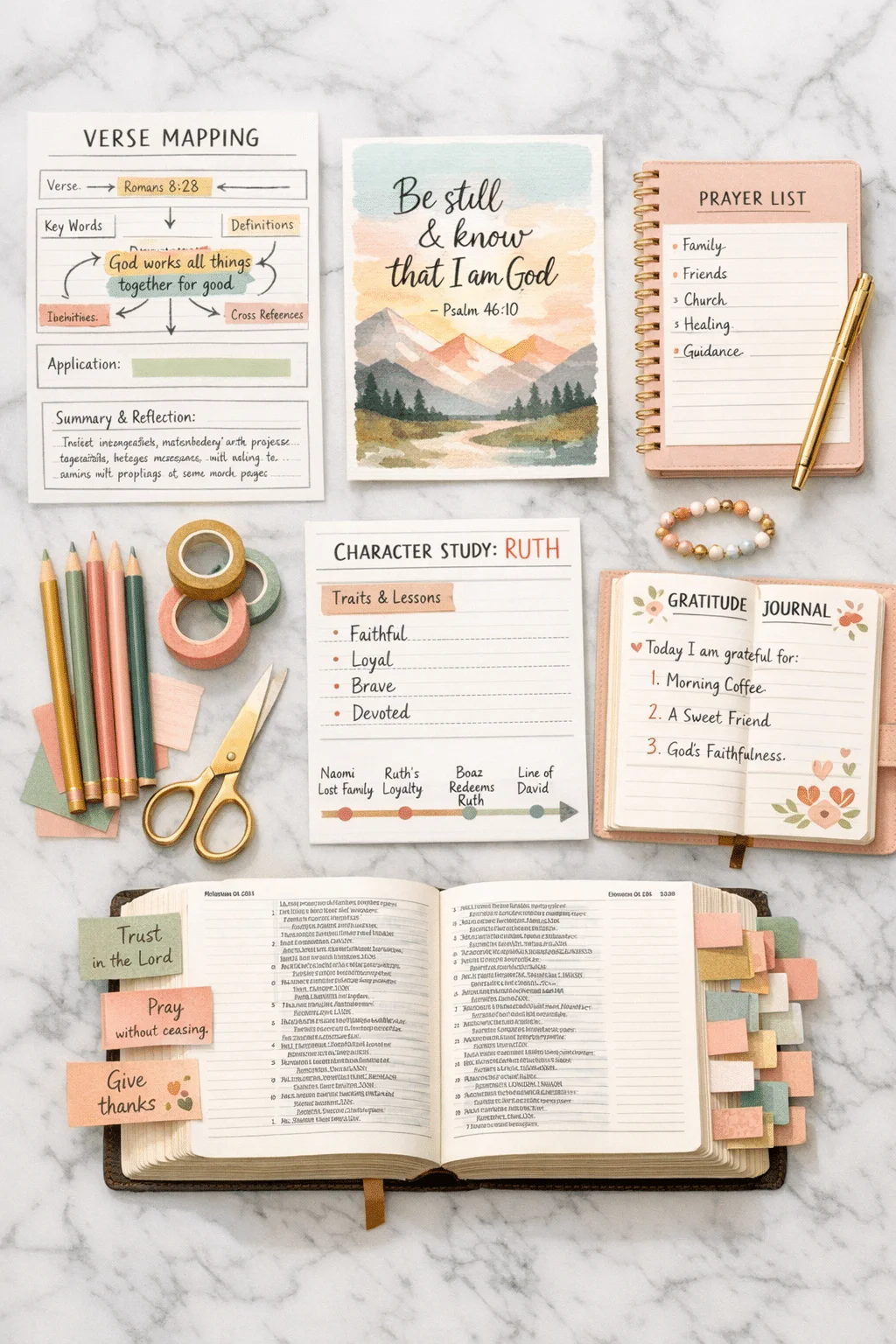
15 Creative Bible Study Journaling Ideas to Try in 2026
Now let’s get into the heart of it. Here are 15 bible study journaling ideas that range from simple to advanced. Pick one or two that resonate with you and start there.
📝 1. Verse Mapping
Verse mapping is a method where you take a single verse and break it apart visually. You write the verse in the center of your page, then branch out with notes on the original language, cross-references, historical context, and personal application. Word studies and cross-referencing techniques like these help you engage at a much deeper level [1].
🎨 2. Illustrated Scripture Pages
You do not need to be Michelangelo. Simple borders, stick figures, or watercolor washes alongside a written verse can make the Word come alive visually. This is especially effective for visual learners.
🙏 3. Prayer Journaling
Dedicate a section of your journal to written prayers. Date each entry. Over time, you will build a powerful record of God’s faithfulness. Looking back at answered prayers is one of the most encouraging things you can do for your faith. Explore how praise and thanksgiving connect to a vibrant prayer life.
📊 4. Character Studies
Choose a Bible character and journal through their entire story. Note their strengths, failures, and what God did through them. Our guide on how to do a Bible character study walks you through this step by step.
🌈 5. Color-Coded Highlighting
Assign colors to themes: yellow for promises, blue for commands, green for attributes of God, red for warnings. A solid Bible study highlighting system turns your Bible into a visual reference tool you will use for years.
✏️ 6. Topical Journaling
Pick a topic like grace, fear, or love and trace it through the entire Bible. Write down every verse you find and journal your reflections. You might be surprised how studying examples of goodness in the Bible reveals patterns you never noticed before.
📅 7. Gratitude Logs
Each day, write three things you are grateful for alongside a verse of thanksgiving. 1 Thessalonians 5:18 (NKJV) says, “In everything give thanks; for this is the will of God in Christ Jesus for you.” This practice rewires your mind toward hope.
💡 8. Question Journaling
Write down every question that arises as you read Scripture. Do not rush to answer them. Let them simmer. Come back later with study tools, commentaries, or a conversation with your pastor. Questions are not a sign of weak faith. They are a sign of an engaged mind.
🗺️ 9. Timeline Journaling
Create chronological timelines of biblical events. This is especially helpful when studying the Old Testament prophets or the life of Christ. Drawing a simple line with dates and events helps you see the grand narrative of redemption.
📖 10. Paraphrase Journaling
Read a passage, then close your Bible and rewrite it in your own words. This forces comprehension. You cannot paraphrase what you do not understand. It is a humbling and clarifying exercise.
🏠 11. Life Application Pages
After studying a passage, create a dedicated page titled “How I Will Live This Out.” Be specific. Instead of writing “I will be more loving,” write “I will call my neighbor this week and ask how she is doing.” Practical application is the hallmark of mature faith.
🎵 12. Worship Response Journaling
After a worship experience, whether at church or in your living room, journal what God stirred in your heart. Connect it to Scripture. This ties your emotional experience to biblical truth and deepens your understanding of biblical foundations of worship.
📬 13. Letter Writing to God
Write your journal entries as letters addressed to God. “Dear Father, today I read about Your faithfulness to Israel, and it reminded me of how You carried me through last year…” This format feels personal and intimate. It transforms journaling from an academic exercise into a conversation.
🔗 14. Cross-Reference Chains
Start with one verse. Find a cross-reference. Journal that verse. Find another cross-reference from it. Keep going. You will be astonished at how Scripture interprets Scripture. This method builds theological depth naturally [1].
🌱 15. Seasonal Reflection Pages
At the start of each season (or month), write down what God is teaching you, what you are struggling with, and what you are believing Him for. Revisit these pages later. Growth becomes tangible when you can see it on paper.

Tools and Resources for Bible Study Journaling in 2026
Having the right tools does not make or break your journaling practice, but they sure can help. Here is what is making waves in 2026.
Recommended Journaling Products
Some of the top-rated Bible journaling products this year include the 52 Week Scripture Prayer Journal for Women, the Graceful By Design Bible Verse Mapping Journal, and the Mr. Pen Bible Journaling Kit for those who love creative supplies [3]. You do not need to spend a fortune. Even a simple composition notebook works beautifully.
Digital and Hybrid Approaches
Technology is not the enemy of devotion. The Seeking Scripture Bible Study Journal now features daily QR codes that link directly to text and audio notes accessible from your phone [6]. This means you can scan a code in your physical journal and instantly hear a passage read aloud or access deeper study notes. It is a seamless blend of old and new.
Portable Journaling Kits
Life does not always happen at your desk. Many journalers now carry portable kits with a traveler’s notebook, a compact Bible, and a small pen pouch so they can write and reflect wherever they are [1]. Whether you are at a coffee shop, waiting at the doctor’s office, or sitting in your car during lunch break, having your supplies ready removes one more barrier to consistency.
What You Actually Need to Start
Let me be honest with you. You need three things:
- A Bible (any translation you can understand)
- Something to write with
- Something to write on
That is it. Everything else is a bonus. Do not let the lack of a fancy journal keep you from starting today.

Building a Consistent Journaling Habit That Lasts
Ideas are wonderful, but they mean nothing without follow-through. Here is how to make Bible study journaling a lasting part of your life.
Start Small
Do not commit to an hour a day if you have never journaled before. Start with five minutes. One verse. One observation. One prayer. Joshua 1:8 (NKJV) tells us, “This Book of the Law shall not depart from your mouth, but you shall meditate in it day and night.” Meditation does not require marathon sessions. It requires faithfulness.
Anchor It to an Existing Habit
Attach your journaling to something you already do. Journal right after your morning coffee. Journal during your lunch break. Journal before bed. When you tie a new habit to an established one, it sticks.
Give Yourself Grace
Some days your journal entry will be a full page of deep insight. Other days it will be a single sentence: “God, I need You today.” Both are valid. Both are worship. Do not let perfectionism steal the gift of presence with God. Understanding grace and faith frees you from the pressure of performance.
Share What You Learn
Journaling does not have to be solitary. Share a nugget from your journal with your small group, your spouse, or a friend. When you verbalize what God is teaching you, it solidifies the truth in your own heart and encourages others. Stories of unwavering faith from the Bible become even more powerful when shared in community.
Review Regularly
Set a monthly reminder to flip back through your journal. You will see prayers that have been answered. You will notice themes God keeps bringing to your attention. You will be reminded of truths you had forgotten. This review process is where journaling becomes truly transformative.
Conclusion
Bible study journaling is not about creating Instagram-worthy pages or following a rigid formula. It is about meeting God in His Word and recording the encounter. Whether you use the S.O.A.P. method, verse mapping, prayer journaling, or simply write out Scripture by hand, the act of putting pen to paper engages your mind and heart in ways that passive reading cannot.
Here are your next steps:
- Choose one method from the 15 ideas above that excites you.
- Gather your supplies. A Bible and a notebook are enough.
- Set a time. Even five minutes tomorrow morning counts.
- Write your first entry. Do not overthink it. Just begin.
- Come back the next day. And the next. Let consistency do its quiet, powerful work.
God’s Word is living and active (Hebrews 4:12, NKJV). When you journal through it, you create a written testimony of His faithfulness in your life. Years from now, those pages will be among your most treasured possessions.
Pick up your pen. Open the Book. Start writing. He is waiting to meet you there. ✝️
References
[1] Watch – https://www.youtube.com/watch?v=hXZtfIczBqA
[2] Watch – https://www.youtube.com/watch?v=kswM-suSojk
[3] Watch – https://www.youtube.com/watch?v=aQLcK6GJpZ4
[5] April Scripture Writing Plan Spiritual Maturity – https://www.theruffledmango.com/april-scripture-writing-plan-spiritual-maturity/
[6] Journal – https://seekingscripture.com/journal/
[7] Watch – https://www.youtube.com/watch?v=QjUMt4SRFwI
Test Your Knowledge!
Answer all 10 questions, then submit to see your score.
Related Posts

Why a Guided Bible Study on Faith Changes Everything
Last updated: May 2026 Discover why a guided Bible study on faith does what casual reading can't — and how going deep in Scripture on this one subject changes the way you pray, trust, and live.
 May 12, 2026
Why Casual Bible Reading Isn't Enough — The Case for Structured Bible Study
Last updated: May 2026 Casual Bible reading is a good start — but it's not enough for real spiritual growth. Discover why structured Bible study transforms your faith in ways surface reading never can.
May 21, 2026
How A Faith Bible Study Changed My Walk with God
Last updated: May 2026 Discover how a faith Bible study can transform your walk with God — deepening prayer, replacing thin faith with solid trust, and bringing Scripture to life.
May 13, 2026
Best Bible Studies About Faith: A Comprehensive Buyer's Guide
Last updated: May 2026 Discover the 5 best Bible studies about faith for individuals and groups. Compare prices, formats, and features to find the perfect study for your spiritual growth.
May 12, 2026


 By
By


