
Jeroboam is one of the most complex and consequential figures in the history of Israel. His rise to power and subsequent reign as the first king of the northern kingdom of Israel marked a turning point in the biblical narrative. While he was chosen by God to lead the northern tribes, his legacy is marred by idolatry, rebellion, and a failure to trust in the Lord. Jeroboam’s story is a cautionary tale of how fear and self-reliance can lead to spiritual downfall, even for those who are called by God. This article explores the life and reign of Jeroboam, drawing primarily from the New King James Version (NKJV) of the Bible.
The Rise of Jeroboam
Jeroboam’s story begins during the reign of King Solomon. He was a capable and industrious man, and Solomon noticed his talents, appointing him as an overseer over the labor force of the house of Joseph (1 Kings 11:28). However, Jeroboam’s rise to prominence was not merely a result of his abilities; it was also part of God’s plan to fulfill His judgment on Solomon’s idolatry.
The prophet Ahijah played a pivotal role in Jeroboam’s ascent. Ahijah met Jeroboam on the road and delivered a dramatic prophecy. He tore his new garment into twelve pieces, giving ten to Jeroboam and saying:
“Take for yourself ten pieces, for thus says the Lord, the God of Israel: ‘Behold, I will tear the kingdom out of the hand of Solomon and will give ten tribes to you (but he shall have one tribe for the sake of My servant David, and for the sake of Jerusalem, the city which I have chosen out of all the tribes of Israel).'” (1 Kings 11:31-32, NKJV)
Ahijah explained that this division was a consequence of Solomon’s idolatry and his failure to walk in the ways of the Lord. However, Ahijah also offered Jeroboam a conditional promise:
“Then it shall be, if you heed all that I command you, walk in My ways, and do what is right in My sight, to keep My statutes and My commandments, as My servant David did, then I will be with you and build for you an enduring house, as I built for David, and will give Israel to you.” (1 Kings 11:38, NKJV)
This promise was contingent on Jeroboam’s obedience to God. Unfortunately, as we shall see, Jeroboam failed to meet this condition.
The Division of the Kingdom
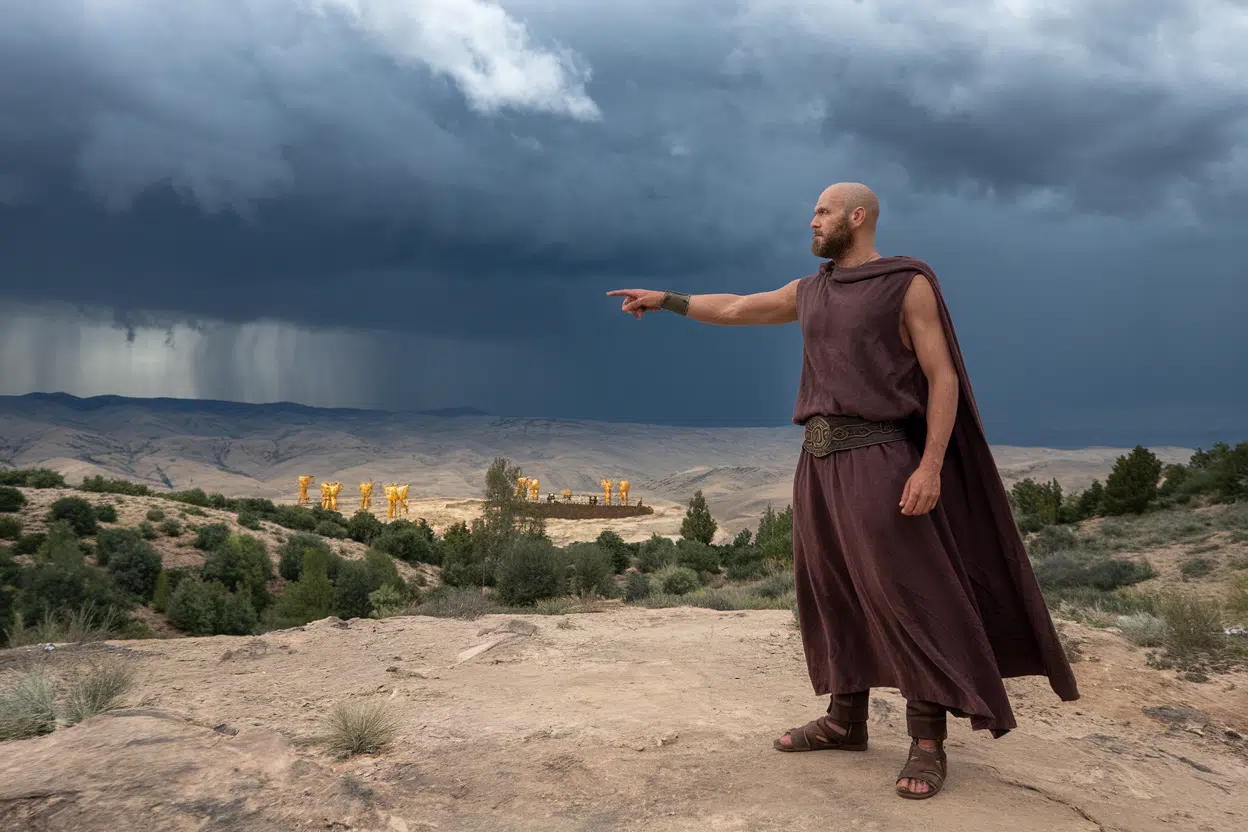
After Solomon’s death, his son Rehoboam succeeded him as king. However, Rehoboam’s harsh response to the people’s request for lighter burdens led to a rebellion. The northern tribes, disillusioned with Rehoboam’s leadership, turned to Jeroboam as their king. This division fulfilled the prophecy of Ahijah and marked the beginning of the northern kingdom of Israel, with Jeroboam as its first ruler.
Jeroboam’s reign began with great potential. He had been chosen by God and given a clear mandate to lead the northern tribes. However, his fear and lack of faith soon led him down a path of disobedience.
Jeroboam’s Idolatry
One of Jeroboam’s first acts as king was to establish alternative places of worship in Bethel and Dan. He feared that if the people continued to go to Jerusalem to worship at the Temple, they might eventually turn their allegiance back to Rehoboam. To prevent this, Jeroboam made two golden calves and set them up in Bethel and Dan, declaring:
“It is too much for you to go up to Jerusalem. Here are your gods, O Israel, which brought you up from the land of Egypt!” (1 Kings 12:28, NKJV)
This act of idolatry was a direct violation of the first and second commandments (Exodus 20:3-4). Jeroboam’s decision to create these idols was not only a rejection of God’s command but also a repetition of the sin of the Israelites at Mount Sinai (Exodus 32:1-8).
In addition to the golden calves, Jeroboam appointed priests from among the people who were not Levites and instituted a new religious festival to compete with the Feast of Tabernacles in Judah (1 Kings 12:31-33). These actions further entrenched idolatry in the northern kingdom and led the people away from the true worship of God.
The Consequences of Jeroboam’s Sin

Jeroboam’s idolatry had far-reaching consequences, both for his own reign and for the future of Israel. The Bible records that his actions became a “sin” for the people of Israel, leading them into persistent idolatry (1 Kings 12:30). This sin would plague the northern kingdom throughout its history, ultimately contributing to its downfall and exile.
God did not remain silent in the face of Jeroboam’s disobedience. He sent a prophet to Bethel to pronounce judgment on Jeroboam’s altar. The prophet declared:
“O altar, altar! Thus says the Lord: ‘Behold, a child, Josiah by name, shall be born to the house of David; and on you he shall sacrifice the priests of the high places who burn incense on you, and men’s bones shall be burned on you.'” (1 Kings 13:2, NKJV)
This prophecy was fulfilled centuries later during the reign of King Josiah of Judah (2 Kings 23:15-20). It served as a reminder that God’s word is sure and His judgments are inevitable.
Jeroboam’s personal life was also marked by tragedy. His son Abijah fell ill, and Jeroboam sent his wife to the prophet Ahijah to inquire about the child’s fate. Ahijah, now old and blind, delivered a harsh message:
“Go, tell Jeroboam, ‘Thus says the Lord God of Israel: “Because I exalted you from among the people and made you ruler over My people Israel, and tore the kingdom away from the house of David and gave it to you; and yet you have not been as My servant David, who kept My commandments and who followed Me with all his heart, to do only what was right in My eyes; but you have done more evil than all who were before you, for you have gone and made for yourself other gods and molded images to provoke Me to anger, and have cast Me behind your back—therefore behold! I will bring disaster on the house of Jeroboam.”‘” (1 Kings 14:7-10, NKJV)
Ahijah foretold the death of Jeroboam’s son and the eventual destruction of his dynasty. This prophecy was fulfilled when Jeroboam’s son Nadab succeeded him but was soon assassinated by Baasha, who wiped out Jeroboam’s entire family (1 Kings 15:25-30).
Lessons from Jeroboam’s Life
Jeroboam’s life offers several important lessons for believers today:
- The Danger of Fear: Jeroboam’s fear of losing his kingdom led him to make decisions that were contrary to God’s will. Fear often drives us to rely on our own understanding rather than trusting in God’s promises.
- The Consequences of Idolatry: Jeroboam’s idolatry not only led to his own downfall but also had a lasting impact on the northern kingdom. Idolatry, in any form, separates us from God and leads to spiritual ruin.
- The Importance of Obedience: Jeroboam’s failure to heed God’s command to walk in His ways resulted in the loss of God’s blessing. Obedience is essential for experiencing God’s favor and fulfilling His purposes in our lives.
- The Sovereignty of God: Despite Jeroboam’s disobedience, God’s plan for Israel continued to unfold. This reminds us that God is sovereign and His purposes will ultimately prevail, even in the face of human failure.
- The Need for Repentance: Jeroboam’s story is a tragic example of what happens when we refuse to repent and turn back to God. Repentance is the key to restoration and reconciliation with God.
Conclusion
Jeroboam’s reign is a sobering reminder of the consequences of fear, idolatry, and disobedience. While he was chosen by God to lead the northern tribes, his failure to trust in the Lord and follow His commands led to his downfall and the spiritual decline of Israel. Yet, even in the midst of Jeroboam’s failures, we see the faithfulness of God, who remains true to His word and His promises.
As we reflect on Jeroboam’s life, may we be encouraged to trust in the Lord, walk in obedience, and turn away from anything that draws us away from Him. Let us remember the words of Proverbs 3:5-6 (NKJV):
“Trust in the Lord with all your heart, and lean not on your own understanding; in all your ways acknowledge Him, and He shall direct your paths.”
Jeroboam’s story serves as a warning, but it also points us to the grace and mercy of God, who is always ready to forgive and restore those who turn back to Him.
How Did Abijam’s Reign Relate to Jeroboam’s Division of the Kingdom?
Abijam’s reign marked by contrasts in leadership revealed the ongoing effects of Jeroboam’s division of the kingdom. While Abijam upheld Davidic traditions, he failed to fully turn Judah from idolatry. His short rule reflected instability, highlighting the lasting consequences of Israel’s split and Jeroboam’s influence on both northern and southern kingdoms.
Share On Pinterest!


Related Posts

JD Vance's Journey to Catholicism Explored in New Memoir 'Communion'
Last updated: June 2026 Few political figures have written as openly about their inner spiritual life as JD Vance does in his new book. JD Vance's…
 Jun 16, 2026
The Hebrews 11 'Hall of Faith' — A Deep Dive
Last updated: May 2026 Explore Hebrews 11's hall of faith and discover how biblical heroes like Abel, Noah, and Abraham trusted God against impossible odds. Read our deep dive analysis.
May 15, 2026
How A Faith Bible Study Changed My Walk with God
Last updated: May 2026 Discover how a faith Bible study can transform your walk with God — deepening prayer, replacing thin faith with solid trust, and bringing Scripture to life.
May 13, 2026
Best Bible Studies About Faith: A Comprehensive Buyer's Guide
Last updated: May 2026 Discover the 5 best Bible studies about faith for individuals and groups. Compare prices, formats, and features to find the perfect study for your spiritual growth.
May 12, 2026


 By
By


