
By Duke Taber
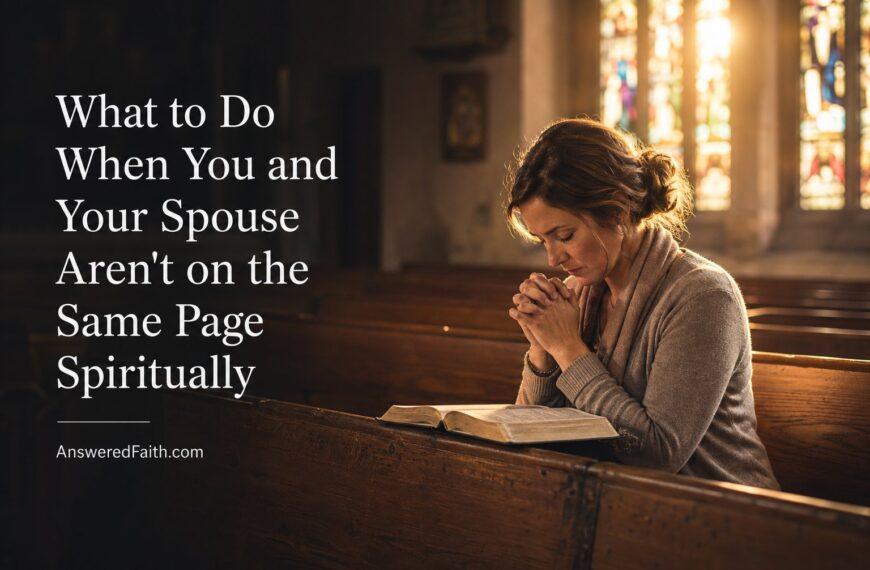
You sit in the third pew on Sunday morning, your Bible open, your heart lifted — and the seat beside you is empty again. Or maybe your spouse is there in body, but their mind is somewhere else entirely, scrolling on their phone or fidgeting through the sermon they’ve already decided doesn’t apply to them. Perhaps they believe, technically, but they haven’t opened a Bible in years. Or they’ve grown cold toward the faith you both once shared. Or they never shared it to begin with, and you realize now — somewhere between the wedding vows and this ordinary Tuesday — just how wide that gap has become.
This is one of the quieter heartaches in Christian marriage. It doesn’t have the dramatic weight of infidelity or addiction, but it hollows out something essential. When the person you are most intimately joined to is walking a different spiritual road, the loneliness can be profound.
If this is your situation, you are not alone — and you are not without hope.

Understanding the Problem: What “Not on the Same Page” Actually Means
Spiritual misalignment in marriage takes many forms. Some couples are classically unequally yoked — one partner is a committed believer, the other is not. Others are both Christians but have drifted to opposite ends of the spectrum: one is deeply devoted, the other nominally so. Some couples entered marriage in spiritual sync and then watched a spouse walk away from faith — through disillusionment, trauma, intellectual doubt, or simple neglect.
According to Pew Research Center data, roughly 26 percent of married Americans say their spouse has a different religious identity from their own. Among those who are in same-religion marriages, only 51 percent report that their religious beliefs are “very similar” to their spouse’s. That means even among couples who share a tradition, nearly half are navigating some degree of spiritual misalignment.

The practical consequences reach into nearly every corner of a marriage. Where you worship, how you raise your children, how you spend Sunday mornings, what you do in a crisis, how you make major decisions — all of these are shaped by faith. Research from the Pew Religion and Family Life study found that adults in religiously mixed marriages are, on average, less religious than those married to spouses who share their faith, attend services less often, and are less likely to pray or read Scripture with their children. The spiritual tide in a mixed home tends to pull downward.
This does not mean your marriage is doomed. But it does mean the problem is real, it has documented consequences, and ignoring it will cost you something.
What Scripture Says: The Biblical Foundation

The Bible addresses spiritual mismatch in marriage with both directness and compassion.
The clearest warning comes from Paul:
“Do not be unequally yoked together with unbelievers. For what fellowship has righteousness with lawlessness? And what communion has light with darkness?” — 2 Corinthians 6:14 (NKJV)
The agricultural image is instructive. A yoke joins two animals at the neck so they can pull a load together. When the animals are mismatched — different in size, stride, and strength — they don’t pull together. They pull against each other. One is constantly compensating for the other. Both are rubbed raw. The work doesn’t get done, and both animals suffer.
But Paul also knew that not everyone reading his letters was unmarried and free to choose. Some had come to faith after their wedding day. Some had married with different expectations. And so he wrote to them too:
“But to the rest I, not the Lord, say: If any brother has a wife who does not believe, and she is willing to live with him, let him not divorce her. And a woman who has a husband who does not believe, if he is willing to live with her, let her not divorce him. For the unbelieving husband is sanctified by the wife, and the unbelieving wife is sanctified by the husband.” — 1 Corinthians 7:12–14 (NKJV)
This is a remarkable passage. Paul is not saying the unbelieving spouse receives salvation by association — he is saying that the presence of a devoted believer in the home creates a sanctifying influence. The believing spouse brings something holy into the marriage, something the other spouse is exposed to simply by living with them. The home becomes a place where the gospel has access.
Peter expands this into practical pastoral counsel:
“Wives, likewise, be submissive to your own husbands, that even if some do not obey the word, they, without a word, may be won by the conduct of their wives, when they observe your chaste conduct accompanied by fear.” — 1 Peter 3:1–2 (NKJV)
Though addressed to wives, the principle applies broadly: the most powerful form of evangelism within your marriage is not argument — it is a life that looks like Christ. Your conduct, your patience, your joy, your integrity — these things speak when words have stopped being heard.
The Cost of Doing Nothing

I want to say this plainly: spiritual disconnection in a marriage does not stay static. Left unaddressed, it tends to widen. One spouse grows in faith while the other grows resentful of it. Church attendance becomes a point of conflict. Parenting decisions fracture along spiritual lines. The believing spouse begins to share their most meaningful inner world with people outside the marriage — a small group, a pastor, a close friend — because it feels too painful to share it with a spouse who doesn’t care. That emotional migration, small as it seems, is one of the early steps away from intimacy.
A nationwide study on faith and relationships by Communio, conducted in over 100 congregations across 13 states, found that more married women in church struggle in their marriages than married men — and that spiritual and relational dissatisfaction are deeply intertwined. Marriage is not merely a legal contract or a domestic partnership. It is, according to Scripture, a covenant — a living picture of Christ’s relationship with His church. When that picture loses its spiritual dimension on one side, something essential is missing.
The cost of doing nothing is not just personal unhappiness. It is the slow erosion of the very thing marriage is meant to reflect.
Seven Practical Steps for the Spiritually Mismatched Couple

1. Be Honest With Yourself About What Kind of Mismatch You’re In
Not all spiritual misalignment is the same, and the approach that fits one situation may be wrong for another. There is a meaningful difference between a spouse who is genuinely hostile to faith, one who is spiritually indifferent but not opposed, one who once believed and has drifted, and one who believes differently but sincerely. Before you can address the problem, you need to name it accurately.
I’ve seen couples in ministry who called their marriage “spiritually mismatched” when what they really had was a growth-rate difference — both believing, both committed, but one running and one walking. That is a very different challenge from a marriage where one spouse has flatly rejected Christ. Honest diagnosis leads to appropriate response. Spend time in prayer and reflection, perhaps with a journal, to articulate clearly what is actually happening before you take any action.
This kind of self-worth and identity grounding is also important for the believing spouse — knowing who you are in Christ, apart from your spouse’s validation, is essential before you can engage the problem with grace rather than desperation.
2. Make Peace With What You Cannot Control — and Focus on What You Can
One of the most painful temptations for the spiritually devoted spouse is to treat the marriage as a conversion project. The believing spouse becomes a spiritual campaign manager, leaving books on nightstands, inviting the reluctant spouse to every church event, narrating their faith journey in ways designed to persuade. This almost never works, and it often hardens the resistant spouse further.
Focus on the Family’s pastoral counsel on spiritually mixed marriages is clear: your purpose is to attract your spouse to Christ through who you are, not through spiritual pressure. Peter’s instruction — to win them “without a word” through conduct — is not a passive resignation. It is an active, intentional strategy of embodied faith. You cannot manufacture faith in another person’s heart. But you can be faithful, kind, patient, joyful, and honest in your own walk — and trust that the Holy Spirit is working in ways you cannot see.
This requires a genuine surrender of outcomes. Surrender is not defeat. It is releasing into God’s hands what was never yours to control.
3. Guard Your Own Spiritual Life Fiercely
When the domestic environment is spiritually thin, it is easy for the devoted spouse to slowly absorb the atmosphere of indifference. The worship attendance that once felt non-negotiable becomes negotiable because skipping it keeps the peace. The daily Bible reading fades because you feel guilty doing something your spouse doesn’t do. Without realizing it, the spiritual life of the more devoted spouse can be gradually flattened by the gravitational pull of the less devoted one.
Do not let this happen. Your Bible study practice, your prayer life, your church community — these are not luxuries. They are the oxygen that sustains your ability to love well in a difficult marriage. If you are running on empty spiritually, you will have nothing of Christ to offer your spouse. The believing spouse who tends their own soul is the believing spouse who can demonstrate what a life with God actually looks like.
Find a women’s Bible study group or a men’s accountability circle. Do not try to carry this alone. Paul’s image of the body of Christ — each part supporting the others — was written precisely for moments like this.
4. Create Space for Honest, Calm Conversation
Many spiritually mismatched couples have never had a direct, non-confrontational conversation about the spiritual gap in their marriage. The subject is either avoided entirely or raised only during arguments, when it becomes a weapon rather than a bridge. Neither approach moves anything forward.
Approach the conversation as an expression of love and longing, not as an accusation or an ultimatum. You might say something like: “I want to share something that matters deeply to me, not to push you toward anything, but because I want you to know my heart.” Ask questions — genuine ones. What do they believe? What are their doubts? What was their experience of faith growing up? Where did things shift for them? Listening well is itself a form of love, and it earns you the credibility to be heard when you speak.
Avoid the common mistake of turning these conversations into debates. You are not trying to win an argument. You are trying to understand and be understood.
5. Engage a Qualified Counselor — Sooner Than You Think You Need To
Spiritual misalignment in marriage is both a theological issue and a relational one, which means it almost always benefits from an outside perspective. A licensed Christian counselor can help a couple navigate the specific tensions — parenting decisions, Sunday mornings, prayer habits, financial giving — in ways that honor both spouses and preserve the relationship.
Many couples wait until the marriage is in serious crisis before seeking help. By that point, patterns of resentment and withdrawal have calcified, and the work of repair is far more difficult. The couples who fare best are those who engage a counselor while they still have goodwill toward each other, while communication channels are still open, while there is something to work with.
The Bible study on marriage and the work of a skilled counselor are not mutually exclusive — they reinforce each other. Scripture shapes the values; the counselor helps you apply them in the specific relational dynamics of your home.
6. Pray Specifically and Persistently for Your Spouse
This is not a platitude. Persistent, specific, believing prayer for a spouse’s spiritual awakening is one of the most documented experiences in Christian testimony — and it is exactly what Paul and Peter commend. The believing spouse has direct access to the God who “is not willing that any should perish but that all should come to repentance” (2 Peter 3:9, NKJV). Your spouse is not beyond the reach of that will.
The discipline of intercession — praying for someone else’s spiritual good — has a transforming effect on the one who prays as well. It softens bitterness, renews compassion, and keeps love oriented toward the other person’s ultimate good rather than your immediate comfort. Keep a prayer journal for your spouse. Be specific. Ask God to move in the places you cannot reach. Then watch — sometimes slowly, sometimes suddenly — for movement.
“The effective, fervent prayer of a righteous man avails much.” — James 5:16b (NKJV)
7. Build a Long-Term Vision of Faithfulness, Not a Short-Term Demand for Change
The spiritually mismatched marriage is almost never resolved quickly. It requires the long obedience C.S. Lewis described — day after day of choosing to love faithfully, to pray honestly, to live openly as a person whose faith is genuinely good news. This can feel exhausting when you are in the middle of it. Weeks become months, months become years, and your spouse’s heart still seems closed.
But God works in the long arc. I’ve witnessed marriages where a spouse who was vocally contemptuous of Christianity came to faith ten or fifteen years later, specifically because of what they had seen in their believing spouse’s life over that decade. Those years were not wasted. They were the sermon. The patience and endurance you exercise through a spiritually difficult marriage is itself a form of gospel proclamation.
Build a long-term vision: not “my spouse will be in church with me by Easter” — but “I will be faithful in this marriage, and I will trust God with the outcome.”
But What If My Spouse Is Actively Hostile to My Faith?

There is a significant difference between a spouse who is spiritually indifferent and one who is actively antagonistic — one who mocks your faith, who forbids you from church attendance, who undermines your spiritual formation of your children, who treats your prayer life with contempt. This is a harder situation, and it deserves a frank word.
The Gospel Coalition’s counsel on the unequally yoked marriage is helpful here: a wife or husband’s godly conduct is not to be confused with spiritual doormat behavior. Gentleness and submission are Christian virtues, not licenses for spiritual abuse. If your spouse is actively working to destroy your faith or the faith of your children, that is not a spiritual difference to navigate — that is a spiritual threat to confront, and you need the counsel of a pastor and potentially a licensed counselor immediately.
Short of that extreme, even in marriages with a hostile spouse, the path Peter commends — faithful conduct, quiet dignity, genuine love — has proven remarkably effective in the long testimony of the church. This does not mean silence about your faith. It means that the life you live speaks louder than the arguments you make.
If you find yourself in a situation where the marriage itself is endangered by the spiritual conflict, please do not navigate that alone. Reach out to your pastor, a trusted mentor, or a licensed counselor who shares your faith commitments. God’s design for marriage is covenant faithfulness — but it is not designed to destroy the believing spouse in the process.
God’s Faithfulness in the Gaps You Cannot Fill

There is a deeper theological truth that deserves to be named directly. You cannot be the Holy Spirit for your spouse. You are not responsible for their salvation. You did not cause their spiritual distance, and you cannot engineer their return.
What you can do is what Paul and Peter both commend: remain faithful in your own walk with God, love your spouse as Christ loves the church — with a love that costs something, that endures without demanding reciprocation — and trust the God who “is able to do exceedingly abundantly above all that we ask or think” (Ephesians 3:20, NKJV).
The covenant of marriage, even a spiritually mismatched one, is held not just by two human commitments but by the God who instituted it. He is present in your marriage even when your spouse does not acknowledge Him. He is working in your spouse’s heart even when you cannot see evidence of it. He hears every prayer you have prayed in the middle of the night when the seat beside you is empty and your heart is full of aching hope.
This is not naive optimism. It is the historic faith of the church, confirmed in the lives of countless men and women who stood in exactly the place you are standing now — and who watched God move in ways they could not have anticipated.
“And we know that all things work together for good to those who love God, to those who are the called according to His purpose.” — Romans 8:28 (NKJV)
Start This Week: A Short Action List

- Spend 15 minutes in honest prayer — not asking for your spouse to change, but asking God to shape your own heart toward them with Christlike love.
- Have one open conversation — not a debate, not an appeal, but a genuine question: “What do you believe? I want to understand.”
- Contact a Christian counselor — even one session can clarify what kind of help your specific situation needs.
- Find your community — a small group, a Bible study, a trusted friend who shares your faith. You were not designed to carry this alone.
- Read or revisit 1 Peter 3 — let the apostle’s words speak directly to your situation, and ask the Spirit what faithful conduct looks like in your specific marriage.
The road ahead may be long, but it is not traveled alone. God is with you in this. He is with your spouse in this. And the same God who transforms hearts is the God who can restore what feels broken beyond recovery.
“Now may the God of hope fill you with all joy and peace in believing, that you may abound in hope by the power of the Holy Spirit.” — Romans 15:13 (NKJV)
Resources
- Focus on the Family: Living With a Spiritually Mixed Marriage
- Spiritually Unequal Marriage Ministry (SpirituallyUnequalMarriage.com)
- Family Fire: Navigating an Unequally Yoked Marriage
- The Gospel Coalition: Honoring God in an Unequally Yoked Marriage
- GotQuestions.org: How Should a Christian Respond in a Difficult Marriage?
- Pew Research Center: Religion in Marriages and Families
If this article spoke to your situation, share it with a friend who might need it — or with your small group leader who may know exactly the right person to pass it along. You are not the only one sitting in that pew alone, and someone in your community may need to know they’re not either.

Pastor Duke has been preaching and teaching the Bible since 1988. He has shared his knowledge online since 2011.

 By
By