
By Duke Taber
You don’t search for an article on divine healing because everything is going well. You search for it because someone you love is sick, because the diagnosis came back worse than expected, because you’ve prayed and prayed and nothing seems to be changing. Or maybe you’ve heard conflicting things from different preachers — one telling you that healing is guaranteed, another warning you not to expect too much — and you’re not sure who to believe.
I’ve been in both places. I’ve stood at hospital bedsides and prayed with everything in me. I’ve also held the hands of faithful believers who didn’t receive the miracle they asked for, and I’ve had to sit with that grief honestly, without pretending I had all the answers. What I’ve come back to, every time, is the Bible itself. Not a system or a formula, but the living Word of God — which takes healing seriously, holds its promises firmly, and doesn’t shy away from the complicated questions.
So let’s open it up together.

Healing Is God’s Nature, Not Just His Activity
Before we look at any specific healing verse, it helps to understand who is doing the healing. Scripture doesn’t present healing as a lucky exception to God’s normal behavior. It presents healing as an expression of who God is.
One of God’s covenant names in the Old Testament is Yahweh Rapha — the LORD who heals you. After Israel crossed the Red Sea, God made a stunning declaration:
“If you diligently heed the voice of the LORD your God and do what is right in His sight, give ear to His commandments and keep all His statutes, I will put none of the diseases on you which I have brought on the Egyptians. For I am the LORD who heals you.” — Exodus 15:26 (NKJV)
Notice the structure: “For I am the LORD who heals you.” The healing isn’t something God does occasionally. It’s a declaration of identity. The Psalms echo this repeatedly. Psalm 103 opens with a cascade of blessings, and the third one listed is this:
“Who forgives all your iniquities, who heals all your diseases.” — Psalm 103:3 (NKJV)
Forgiveness and healing are placed side by side, both flowing from the same divine source. This is significant. When the Bible connects sickness and healing to God’s redemptive purposes, it isn’t treating the body as an afterthought. God cares about the whole person — body, soul, and spirit.
This doesn’t mean every prayer for healing will be answered with immediate physical restoration. But it does mean we never have to wonder whether God wants people to be well. His character answers that question before we even ask it. You can find more on who God is and what His character reveals in a dedicated Bible study on His nature.
The Healing Ministry of Jesus
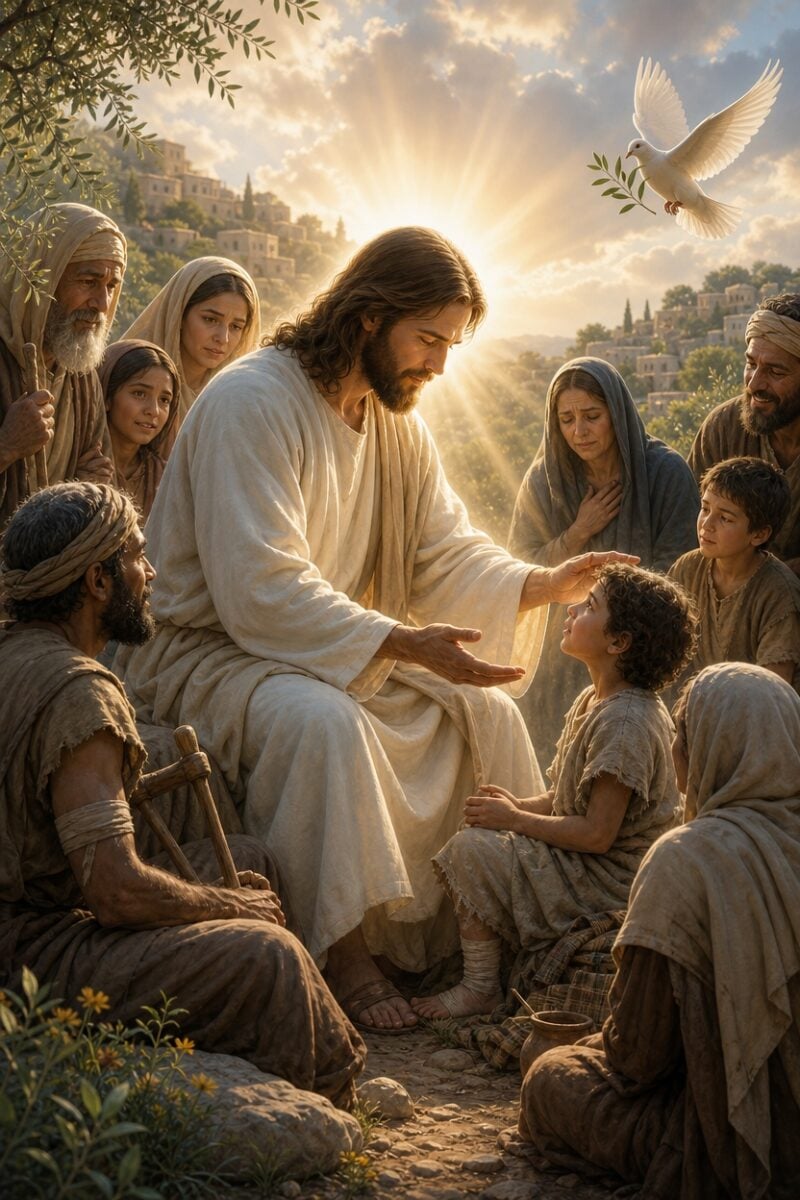
If you want to understand divine healing, you have to spend time watching Jesus. His ministry was not primarily one of sermons followed by healing as a kind of bonus feature. The Gospels present healing as inseparable from the proclamation of the Kingdom.
“And Jesus went about all Galilee, teaching in their synagogues, preaching the gospel of the kingdom, and healing all kinds of sickness and all kinds of disease among the people.” — Matthew 4:23 (NKJV)
The word all appears twice in that verse. All kinds of sickness. All kinds of disease. Matthew doesn’t want you to miss this. As the Assemblies of God’s position paper on divine healing notes, the healing ministry of Jesus was integral to the proclamation of the gospel — it was a witness to His identity as the promised Messiah and Savior.
There’s a deeper layer here, too. Jesus didn’t heal merely to demonstrate power. He healed because He was moved with compassion. The Greek word the Gospels use — splagchnizomai — describes a visceral, gut-level reaction of love. When Jesus saw suffering, He didn’t just observe it. He was stirred by it. The leper, the blind beggar, the woman bent double for eighteen years — each one received not just a miracle but the personal attention of a God who cared.
One of the most theologically charged healing accounts comes in Matthew 8:
“When evening had come, they brought to Him many who were demon-possessed. And He cast out the spirits with a word, and healed all who were sick, that it might be fulfilled which was spoken by Isaiah the prophet, saying: ‘He Himself took our infirmities and bore our sicknesses.'” — Matthew 8:16–17 (NKJV)
Matthew is explicitly connecting Jesus’s healing ministry to Isaiah 53 — the great suffering servant passage. Whatever else we conclude about that text, this much is clear: Jesus healing the sick was not accidental. It was the fulfillment of prophecy, the in-breaking of God’s redemptive plan into human suffering.
The Hard Question: Isaiah 53 and the Atonement

Here is where the conversation gets more complex, and I want to be honest with you rather than give you a tidy answer that doesn’t hold up under pressure.
Isaiah 53:5 is one of the most important — and most debated — healing texts in all of Scripture:
“But He was wounded for our transgressions, He was bruised for our iniquities; the chastisement for our peace was upon Him, and by His stripes we are healed.” — Isaiah 53:5 (NKJV)
Two questions hang over this verse: What kind of healing is being promised? And is that healing guaranteed in the present age?
On the first question, there is genuine diversity among faithful evangelical scholars. Some argue that the Hebrew word rapha (healed) refers specifically to physical healing, and that Christ’s atoning work secured healing for the body just as it secured forgiveness for the soul. Others, appealing to how Peter quotes this verse in 1 Peter 2:24 in the context of our dying to sin, argue that the primary reference is to spiritual healing — restoration from the brokenness of sin. Evangelical scholars like Andrew Wilson and others at the Gospel Coalition have wrestled carefully with this text, noting that the effects of Christ’s victory over death aren’t fully realized yet.
A balanced reading acknowledges both dimensions. The cross addresses the whole person — spiritual, emotional, and physical. We have good reason to pray for physical healing and to expect that God can and does grant it. The Christian Research Institute helpfully notes that while physical healing is ultimately included in Christ’s redemptive work, the full realization of bodily restoration awaits the resurrection age: “One day there will be no more death or mourning or crying or pain, for the old order of things has passed away” (Revelation 21:4). We live in the tension of the “already and not yet” — citizens of a Kingdom that has come, but is not yet fully consummated.
This means healing is a legitimate and Spirit-driven hope. It does not mean that every sickness will be healed before glory. Holding both of those truths at once is not a compromise of faith. It’s a mature reading of Scripture.
Healing in the Early Church

The ministry of healing didn’t evaporate when Jesus ascended. The book of Acts reads like a continuation of everything Jesus started.
“And through the hands of the apostles many signs and wonders were done among the people.” — Acts 5:12 (NKJV)
Peter healed the lame man at the Beautiful Gate (Acts 3). Paul healed the father of Publius on the island of Malta (Acts 28). James gave the church a pattern for healing prayer that has guided believers for two millennia:
“Is anyone among you sick? Let him call for the elders of the church, and let them pray over him, anointing him with oil in the name of the Lord. And the prayer of faith will save the sick, and the Lord will raise him up. And if he has committed sins, he will be forgiven.” — James 5:14–15 (NKJV)
Several things stand out in this text. First, the sick person is called to take initiative — to call for the elders. Second, healing is embedded in community. It is not a private transaction between an individual and God alone; it happens through the body of Christ gathered in prayer. Third, there is a connection (not a strict causation) between forgiveness and restoration. Healing and reconciliation belong together.
Paul also speaks of “gifts of healings” as one of the gifts of the Holy Spirit given to the body of Christ (1 Corinthians 12:9). You can explore the full scope of what the spiritual gift of healing means for the church today. The New Testament does not treat these gifts as relics of the apostolic age. It treats them as part of how the Spirit equips and ministers through ordinary believers in every generation.
What About When Healing Doesn’t Come?

This may be the most important section of this entire article, because it’s the one that actually meets most of us where we live.
The Bible does not present a world in which faith, properly exercised, always produces immediate physical healing. Paul himself had what he called a “thorn in the flesh” — a source of persistent affliction. He prayed three times for its removal. The Lord’s answer was not healing but something arguably better:
“And He said to me, ‘My grace is sufficient for you, for My strength is made perfect in weakness.'” — 2 Corinthians 12:9 (NKJV)
Paul’s sustained suffering did not indicate a failure of faith. It became the very context in which God’s strength was displayed. Timothy, whom Paul instructed with pastoral wisdom, had frequent stomach ailments (1 Timothy 5:23). Epaphroditus, Paul’s fellow worker, “was sick almost unto death” (Philippians 2:27) — not because of unbelief, but in the course of faithful ministry.
I have sat with believers who wondered whether their unanswered prayer for healing meant they lacked faith, or that God was angry with them, or that they had done something wrong. That question is agonizing. And the Bible will not let it stand unchallenged. Job’s friends made that same argument — that suffering must be the result of sin — and God called them out for it. Suffering is not always a punishment. Sometimes it is a mystery. Sometimes it is a refining. Sometimes the healing comes differently than we imagined.
The Bible reading plan on healing on this site may be a helpful companion if you are walking through a season of illness and need Scripture to anchor you day by day.
What we can say with confidence is this: God is present in the suffering. He has not abandoned you. The same Jesus who wept at Lazarus’s tomb (John 11:35) — before He raised him — weeps with you in yours. And every healing that has not yet come in this life is not lost. It is postponed to the resurrection, where “this mortal must put on immortality” (1 Corinthians 15:53).
How to Pray for Healing

If you are seeking healing — for yourself or someone you love — here is the posture Scripture calls you to:
Pray boldly. Jesus praised persistence in prayer. He told the parable of the persistent widow (Luke 18:1–8) specifically to teach that we should not give up. Persistence in prayer is not a sign of unbelief — it’s a sign of faith.
Pray in community. James 5 gives us a model: involve the elders. Ask others to pray with you. There is something Scripture repeatedly affirms about prayer in agreement — “if two of you agree on earth concerning anything that they ask, it will be done for them by My Father in heaven” (Matthew 18:19).
Pray with anointing. The practice of anointing with oil, described in James 5, is not mere ritual. It is a physical expression of invoking God’s presence and power over a person. Explore what anointing oil and healing mean from a biblical and practical standpoint.
Trust the healer more than the outcome. This is the hardest posture to hold, and the most important. Jesus in Gethsemane prayed, “Not My will, but Yours, be done” (Luke 22:42). That prayer was not a failure of faith. It was the highest expression of it.
The Hope That Does Not Disappoint

Divine healing is a real biblical promise. The God who parted the Red Sea, who raised Lazarus, who made the lame walk and the blind see — He has not retired. He still heals. He still works miracles. I have seen it. The examples of healing miracles in the Bible are not ancient curiosities; they are evidence of a living God who has not changed.
But healing is not a formula. It is not a transaction you complete with the right amount of faith, the right prayer, the right anointing. It is a gift, freely given by a sovereign God who loves you more than you can comprehend, and who is working all things — including your pain — toward a glory that “far outweighs them all” (2 Corinthians 4:17).
If you are hurting today, I want you to hold onto this:
“He heals the brokenhearted and binds up their wounds.” — Psalm 147:3 (NKJV)
God is not distant from your suffering. He is present in it, working through it, and moving toward you with the same compassion that moved Jesus to heal everyone who came to Him. Bring your need to Him. Call your church community to pray with you. Hold the promises of Scripture firmly. And trust the character of the God who calls Himself Yahweh Rapha — the LORD who heals.
He has not stopped being who He is.
A Call to Action
If this article has stirred something in you, here are a few next steps:
- Start a healing prayer journal. Write your prayers, your fears, and your faith. Record what you’re trusting God for and watch how He moves — sometimes dramatically, sometimes quietly, always faithfully.
- Get your church community involved. James 5 is a community mandate. Don’t carry this alone. Ask your pastor or elders to pray over you.
- Dig deeper into Scripture. Study these key passages: Exodus 15:26; Psalm 103:1–5; Isaiah 53:4–5; Matthew 8:14–17; James 5:14–16; 1 Peter 2:24; Revelation 21:3–4.
- Read through the healing scriptures compiled for believers walking through sickness.
- If you’re new to faith and unsure how to pray, consider starting with the basics of how to become a Christian and building from there.
— Duke Taber
Resources
- Assemblies of God Position Paper on Divine Healing — A thorough theological statement on divine healing from an evangelical perspective.
- The Gospel Coalition: A Theology of Healing in Six Questions — A concise and pastoral overview of key questions surrounding faith and healing.
- Christian Research Institute: Does Isaiah 53:5 Guarantee Healing Today? — Careful exegesis of one of the most debated healing texts in Scripture.
- Graham Hill: The Atonement and Healing — A scholarly evangelical examination of healing’s relationship to Christ’s atoning work.
- AnsweredFaith.com: Examples of Healing Miracles in the Bible — A survey of divine healing throughout Scripture.
- AnsweredFaith.com: The Gift of Healings — A study of the spiritual gift of healing and how it operates in the church today.

Pastor Duke has been preaching and teaching the Bible since 1988. He has shared his knowledge online since 2011.

 By
By