
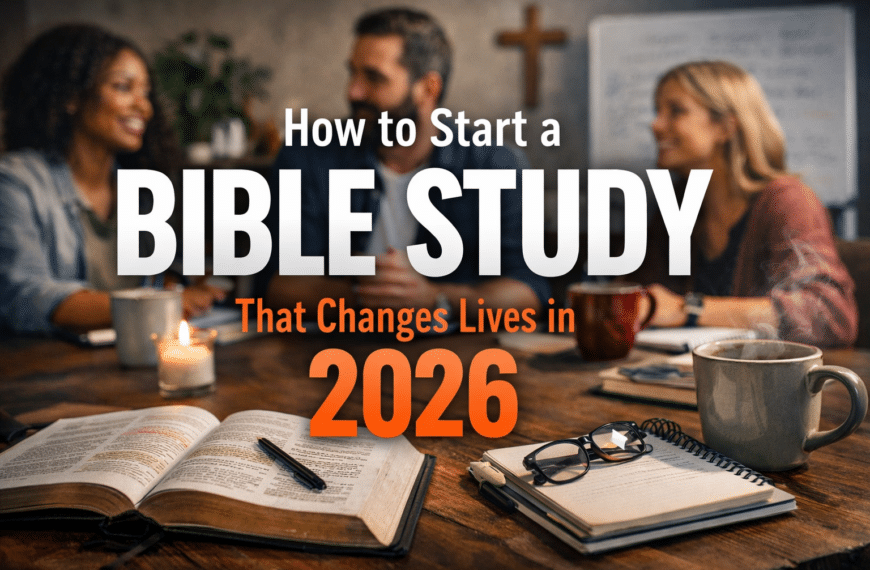
I’ll never forget the first Bible study I tried to lead. I was 19, fresh with enthusiasm but completely unprepared. Three people showed up to my dorm room, and I had no plan beyond “let’s read John 3:16 and talk about it.” We sat in awkward silence for about 45 minutes before everyone made polite excuses to leave.
If you’ve ever wanted to Start a Bible Study but felt overwhelmed by where to begin, I understand completely. The good news? You don’t need a seminary degree or years of ministry experience. What you need is a willing heart, basic preparation, and practical steps to guide you forward.
Starting a Bible study is one of the most rewarding ministries you’ll ever undertake. It’s where theology meets real life, where Scripture transforms hearts, and where genuine Christian community flourishes.
Key Takeaways
- Prayer is your foundation – Start with seeking God’s direction before making any plans or inviting anyone
- Keep it simple – You don’t need elaborate materials or a theology degree to lead an effective Bible study
- Consistency matters more than perfection – Regular meetings with basic structure beat sporadic gatherings with elaborate plans
- Community drives growth – The relational connections formed in Bible study often matter as much as the content studied
- Start small and sustainable – Begin with a manageable group size and time commitment you can maintain long-term

Why Start a Bible Study? The Biblical Foundation
Before we dive into the practical steps, let’s anchor ourselves in Scripture. The practice of gathering to study God’s Word isn’t just a good idea—it’s a biblical mandate.
The early church prioritized communal learning. Acts 2:42 tells us, “And they continued steadfastly in the apostles’ doctrine and fellowship, in the breaking of bread, and in prayers” (NKJV). Notice the pattern: doctrine (teaching), fellowship (community), and prayer—the exact elements of a healthy Bible study.[1]
Paul instructed Timothy, “The things that you have heard from me among many witnesses, commit these to faithful men who will be able to teach others also” (2 Timothy 2:2, NKJV). This multiplication principle is what happens when you Start a Bible Study—you’re not just learning Scripture yourself, you’re creating a space where others can grow and eventually lead others.[2]
The Transformative Power of Group Study
I’ve seen Bible studies rescue marriages, break addictions, and restore faith. There’s something powerful that happens when believers gather around Scripture together.
Hebrews 10:24-25 reminds us: “And let us consider one another in order to stir up love and good works, not forsaking the assembling of ourselves together, as is the manner of some, but exhorting one another, and so much the more as you see the Day approaching” (NKJV).
Individual study is essential, but communal study is irreplaceable. In community, we:
- Gain perspectives we’d never see alone
- Experience accountability that keeps us growing
- Build relationships that sustain us through trials
- Practice using our spiritual gifts
- Learn to articulate our faith
Step 1: Pray and Seek God’s Direction First
Here’s where most people get it backwards. They start planning logistics before seeking God’s heart for the study.
I learned this lesson after my third failed attempt at leading a Bible study. I had picked the perfect book, secured a great location, and invited a dozen people. But I’d spent maybe five minutes praying about it. The study lasted three weeks before fizzling out.
Prayer isn’t the opening ceremony—it’s the foundation.
What to Pray About
When you’re preparing to Start a Bible Study, bring these specific requests before God:
- Direction on who to invite – God knows who needs this community right now
- Wisdom for what to study – The right content at the right time makes all the difference
- Clarity on timing and location – Practical details matter to God too
- Humility and dependence – Ask God to keep you reliant on Him, not your abilities
- Protection and spiritual breakthrough – Expect spiritual opposition and pray accordingly
James 1:5 promises, “If any of you lacks wisdom, let him ask of God, who gives to all liberally and without reproach, and it will be given to him” (NKJV).
Spend at least a week in prayer before making concrete plans. Journal what you sense God saying. This prayer foundation will sustain you when challenges come—and they will come.
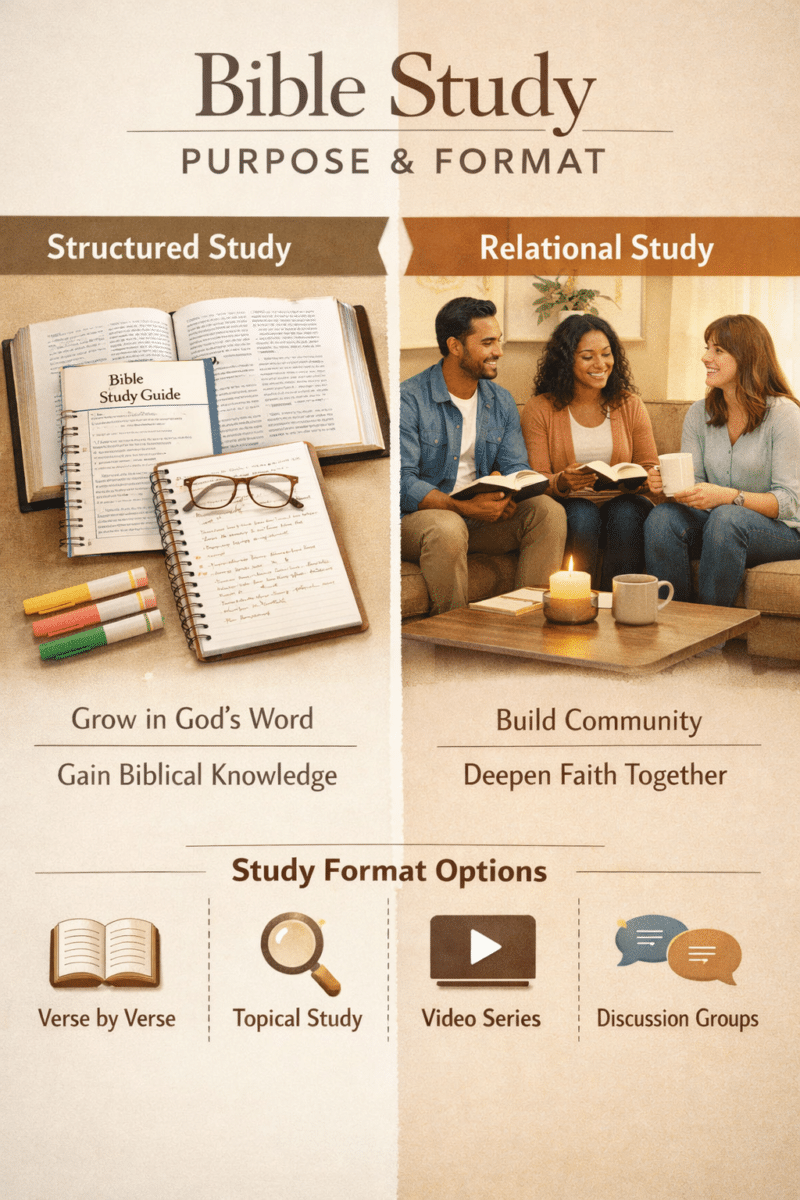
Step 2: Define Your Purpose and Format
Not all Bible studies serve the same purpose, and that’s perfectly fine. Clarity about your specific goals will shape every decision moving forward.
Common Bible Study Formats
| Format | Best For | Time Commitment | Preparation Level |
|---|---|---|---|
| Topical Study | Addressing specific issues (anxiety, marriage, finances) | 4-8 weeks | Moderate |
| Book Study | Deep dive into one biblical book | 8-16 weeks | Moderate to High |
| Character Study | Learning from biblical figures | 6-10 weeks | Moderate |
| Devotional-Based | Building consistent spiritual habits | Ongoing | Low to Moderate |
| Inductive Study | Developing Bible study skills | 8-12 weeks | High |
When I Start a Bible Study now, I always ask these clarifying questions:
Purpose Questions:
- Is this primarily for outreach or discipleship?
- Are we targeting new believers or mature Christians?
- What specific need are we addressing?
- What would success look like in 6 months?
Format Questions:
- How long will each session last? (I recommend 60-90 minutes)
- How many weeks will we commit to? (Start with 6-8 weeks)
- Will we use a curriculum or create our own?
- What’s our meeting frequency? (Weekly works best for momentum)
My Recommendation for First-Time Leaders
If this is your first time leading, start with a devotional-based or topical study using existing materials. You can find affordable, high-quality resources at Answered Faith that provide structure without overwhelming you.
Don’t try to reinvent the wheel. Use proven materials, then add your personal insights and applications. As you gain confidence, you can develop more customized content.
How to Start a Bible Study: The Practical Launch Steps

Now we get to the nuts and bolts. These are the specific actions that will take your Bible study from idea to reality.
Choose Your Study Material
This decision shapes everything else. Here’s my framework for selecting content:
Good study materials should:
✅ Be deeply rooted in Scripture (not just inspirational thoughts)
✅ Include discussion questions that prompt real conversation
✅ Offer practical application steps
✅ Match your group’s spiritual maturity level
✅ Fit your time constraints
I’ve wasted money on beautiful studies that were too academic for my group and simple studies that bored mature believers. Know your audience.
Popular starting options:
- Gospel of John – Perfect for mixed groups with seekers and believers
- Book of James – Extremely practical for everyday life application
- Philippians – Encouraging and accessible for new leaders
- Topical studies on prayer, identity in Christ, or spiritual disciplines
At Answered Faith, we create printable Bible studies specifically designed for small group leaders who need substance without the premium price tag. These resources bridge theological depth with practical usability.
Determine Logistics
Details matter more than you think. Unclear logistics kill Bible studies before they start.
Location considerations:
- Homes – Most intimate and flexible (my preference for groups under 12)
- Church buildings – Good for larger groups or when homes aren’t available
- Coffee shops – Works for smaller groups (3-5 people) during daytime
- Online via Zoom – Expands reach but requires stronger facilitation skills
Scheduling wisdom:
- Poll potential members about preferred days/times
- Avoid Sunday mornings (church conflict) and Friday nights (family time)
- Tuesday-Thursday evenings work well for most people
- Consistency is crucial—same day, same time, every week
Childcare reality:
- This is often the biggest barrier for young parents
- Consider rotating childcare among members
- Or schedule during school hours for stay-at-home parents
- Budget for paid childcare if possible—it’s worth the investment
Invite the Right People
Who you invite determines the culture of your group. Start small and intentional.
My invitation strategy:
- Pray over a specific list of names – Don’t mass-invite; personally consider each person
- Extend personal invitations – Face-to-face or phone calls, not just group texts
- Start with 4-8 people – Small enough for intimacy, large enough to survive absences
- Aim for some diversity – Different ages, life stages, or backgrounds enrich discussion
- Be clear about expectations – Commitment level, homework (if any), and duration
Here’s the actual language I use when inviting someone:
“I’m starting a Bible study on [topic/book], and I immediately thought of you. We’ll meet [day/time/location] for [duration]. It’s going to be a safe space to ask hard questions, dig into Scripture, and grow together. Would you prayerfully consider joining us?”
Don’t over-invite initially. It’s easier to add people later than to manage an overwhelming group from day one.
Leading Your First Bible Study Session
The first meeting sets the tone for everything that follows. Here’s how to make it count.
First Meeting Agenda (90 minutes)
Welcome and Icebreaker (15 minutes)
- Provide refreshments (never underestimate the power of food)
- Use a simple question: “Share your name and your earliest memory of church or the Bible”
- Keep it light and relational
Set Expectations Together (15 minutes)
- Discuss group guidelines (confidentiality, respect, participation)
- Clarify logistics (start/end times, attendance expectations)
- Explain the study format and duration
- Address practical questions
Opening Prayer (5 minutes)
- Keep it simple and welcoming
- Invite God’s presence and guidance
- Pray for open hearts and minds
First Study Session (45 minutes)
- Don’t try to cover too much content
- Focus on 5-10 verses maximum
- Ask open-ended questions
- Allow silence—don’t fill every gap
- Redirect off-topic conversations gently
Application and Closing (10 minutes)
- “What’s one thing God showed you today?”
- “What’s one specific way you’ll apply this this week?”
- Preview next week’s topic
- Close in prayer (invite others to pray too)
Discussion Facilitation Tips
Leading discussion is an art you’ll develop over time. Here are principles that have saved me countless times:
Ask better questions:
- ❌ “Does anyone have thoughts?” (too vague)
- ✅ “What does verse 5 tell us about God’s character?”
- ❌ “What did you think of this passage?” (too broad)
- ✅ “When have you experienced what Paul describes in verse 12?”
Handle common challenges:
The dominator – Someone who monopolizes discussion
Solution: “That’s a great insight, Marcus. Let’s hear from someone who hasn’t shared yet.”
The silent member – Someone who never speaks
Solution: Don’t force it. Ask easier questions: “Would anyone like to read the next verse?”
The rabbit trail – Conversation veers off-topic
Solution: “That’s an interesting question. Can we table that and come back to it after we finish this passage?”
The theological debate – Two members arguing doctrine
Solution: “Both perspectives have merit. Let’s look at what the text specifically says here and continue this conversation after our study.”
Building Sustainable Bible Study Habits
Starting strong is one thing. Sustaining momentum is another.
Create Consistent Structure
People thrive with predictable rhythms. After experimenting with various formats, here’s the structure I use for most studies:
Standard Session Flow:
- Welcome and catch-up (10 min) – Build relationships
- Review and prayer requests (10 min) – Accountability and intercession
- Scripture reading (5 min) – Read passage aloud together
- Teaching/Discussion (40-50 min) – The heart of your study
- Application (10 min) – Make it practical
- Prayer (10 min) – Close with specific prayers
This framework provides structure while allowing flexibility for the Holy Spirit to move.
Develop Co-Leaders
Don’t try to do everything yourself. From the beginning, identify potential co-leaders and delegate responsibilities.
Rotation responsibilities:
- Host – Provides location and refreshments
- Facilitator – Leads discussion (can rotate after you establish culture)
- Prayer coordinator – Tracks and follows up on prayer requests
- Communication – Sends reminders and updates
This multiplication approach follows Paul’s instruction in 2 Timothy 2:2. You’re not just leading a Bible study; you’re developing future leaders.
Handle Attendance Expectations
Life happens. People miss sessions. How you handle this affects group culture.
My attendance philosophy:
- Encourage consistent attendance but extend grace
- Send gentle reminders 24 hours before meetings
- Provide brief recaps for those who miss
- After two consecutive absences, reach out personally
- If someone misses frequently, have a caring conversation about their capacity
Don’t guilt people. Instead, create such a valuable, life-giving environment that people don’t want to miss.
Overcoming Common Challenges When You Start a Bible Study

Every Bible study leader faces obstacles. Here’s how to navigate the most common ones.
Challenge 1: “I Don’t Feel Qualified”
This is the number one barrier I hear. Let me be direct: You don’t need to be a Bible scholar to lead a Bible study.
What you need:
- ✅ A love for God’s Word
- ✅ Willingness to prepare
- ✅ Humility to say “I don’t know, but let’s find out”
- ✅ Commitment to the group
- ✅ Basic facilitation skills (which you’ll develop)
Moses felt unqualified. Gideon felt unqualified. Timothy felt unqualified. God uses willing vessels, not perfect ones.
Practical confidence-builders:
- Study the passage thoroughly before each meeting
- Use quality study guides and commentaries
- Have a trusted mentor you can call with questions
- Remember: you’re a facilitator, not a professor
Challenge 2: Maintaining Momentum
The initial excitement fades around week 4-6. Expect it and plan for it.
Momentum strategies:
- Celebrate progress – Acknowledge growth and insights
- Mix up the format occasionally – Add a service project or social gathering
- Share testimonies – Let members share how the study is impacting them
- Revisit the “why” – Remind everyone of the study’s purpose
- Plan the next study before the current one ends – Maintain continuity
Challenge 3: Spiritual Warfare
Whenever God’s Word is taught, expect opposition. I’m not being dramatic—this is biblical reality.
Ephesians 6:12 reminds us, “For we do not wrestle against flesh and blood, but against principalities, against powers, against the rulers of the darkness of this age, against spiritual hosts of wickedness in the heavenly places” (NKJV).[3]
Common spiritual attacks:
- Sudden conflicts between members
- Unexpected schedule disruptions
- Personal discouragement or doubt
- Technical difficulties (for online studies)
- Physical illness or family emergencies
Your defense:
- Pray protection over your group regularly
- Encourage members to pray for each other
- Don’t be surprised by opposition—expect it
- Stay rooted in Scripture and dependent on God
- Maintain unity and address conflicts quickly
Growing and Multiplying Your Bible Study
If your Bible study is healthy, it will grow. Here’s how to steward that growth wisely.
When to Multiply
There’s a sweet spot for group size. Too small feels fragile; too large loses intimacy.
Optimal group sizes:
- 4-8 people – Ideal for deep sharing and discussion
- 9-12 people – Still manageable with strong facilitation
- 13+ people – Consider multiplying into two groups
Signs it’s time to multiply:
- Consistent attendance above 12 people
- Not everyone can share during discussions
- You’ve developed a co-leader ready to launch their own group
- New people want to join but the group feels full
Multiplication Strategy
Don’t just split randomly. Be intentional.
Healthy multiplication:
- Prepare the group – Talk about multiplication as a goal from the beginning
- Identify the new leader – Someone you’ve been mentoring
- Divide thoughtfully – Consider relationships, geography, and spiritual maturity
- Celebrate the launch – Frame it as success, not loss
- Stay connected – New leaders need ongoing support
I’ve multiplied three Bible studies into twelve over the past decade. Each multiplication felt hard initially but resulted in exponential kingdom impact.
Resources to Help You Start a Bible Study Successfully
You don’t have to create everything from scratch. Leverage quality resources that save time and enhance depth.
Recommended Study Materials
For New Leaders:
- Gospel-focused studies (John, Mark, or Luke)
- Topical studies on foundational topics (prayer, identity, faith)
- Devotional-based studies with built-in discussion questions
For Intermediate Leaders:
- Book studies (Romans, Ephesians, James)
- Character studies (David, Paul, women of the Bible)
- Thematic studies (suffering, leadership, spiritual warfare)
For Advanced Leaders:
- Inductive Bible study methods
- Theological topics (justification, sanctification, ecclesiology)
- Challenging books (Revelation, Old Testament prophets)
At Answered Faith, we provide affordable printable Bible studies designed specifically for small group leaders. These resources combine theological depth with practical application, giving you substance without the premium price tag. Our materials are created by Pastor Duke Taber with small group leaders in mind—usable, accessible, and deeply rooted in Scripture.
Essential Tools
Physical resources:
- Quality study Bible (NKJV, NIV, or ESV)
- Notebook for preparation and prayer requests
- Whiteboard or large notepad for group discussion
- Highlighters and pens for members
Digital resources:
- Bible apps (YouVersion, Logos, Blue Letter Bible)
- Group communication (GroupMe, WhatsApp, or simple text thread)
- Online commentaries for preparation
- Video teaching supplements when appropriate
Continuing Education
Keep growing as a leader:
- Read books on small group leadership
- Attend workshops or conferences when possible
- Connect with other Bible study leaders for encouragement
- Seek feedback from your group members
- Stay in your own personal Bible study and prayer life
Remember: You can’t lead people where you haven’t been yourself. Your personal walk with God fuels your ability to lead others.
Conclusion: Your Next Steps to Start a Bible Study
Starting a Bible study might feel overwhelming right now, but remember—every experienced leader started exactly where you are. The difference between those who lead thriving Bible studies and those who only think about it is simply taking the first step.
Let me leave you with this encouragement: God doesn’t call the equipped; He equips the called. If you sense His prompting to Start a Bible Study, that’s His calling. He will provide everything you need.
Your Action Plan This Week
Don’t let this article become just another piece of information you consume and forget. Take action:
Day 1-2: Spend focused time in prayer asking God about starting a Bible study. Journal what you sense Him saying.
Day 3-4: Define your purpose and format. Answer the clarifying questions from this article in writing.
Day 5: Select your study material. Browse resources at Answered Faith or other trusted sources.
Day 6: Create your invitation list and begin personally inviting people.
Day 7: Set your first meeting date and secure your location.
The Ripple Effect
Here’s what keeps me leading Bible studies year after year: I’ve watched God use these simple gatherings to transform lives in ways I never could have orchestrated.
I’ve seen:
- A struggling marriage restored through a study on Ephesians
- A young man overcome addiction through the accountability of a men’s study
- A widow find community and purpose in a women’s study
- Teenagers develop authentic faith through a youth Bible study
- New believers grow from milk to solid food through systematic study
You have no idea who God wants to reach through the Bible study you’re about to start. That person struggling with doubt, that couple on the verge of divorce, that young believer hungry for truth—they might be waiting for you to take this step.
The early church turned the world upside down through small gatherings where they devoted themselves to the apostles’ teaching, fellowship, breaking bread, and prayer (Acts 2:42). You’re not just starting a Bible study—you’re participating in a 2,000-year-old movement of God’s Spirit transforming lives through His Word in community.
Start small. Start simple. Start prayerfully. But start.
The body of Christ needs what you have to offer. Your community needs the light of Scripture. And God is ready to do immeasurably more than you can ask or imagine through your willingness to lead.
“For I am not ashamed of the gospel of Christ, for it is the power of God to salvation for everyone who believes” (Romans 1:16, NKJV).
That power is unleashed when God’s people gather around God’s Word. Will you be the one who creates that space?
I’m praying for you as you take this step. The kingdom of God is advancing, one Bible study at a time. Yours might be next.
Grace and peace,
A fellow laborer in the harvest
References
[1] Bruce, F.F. (1988). The Book of Acts, Revised. Grand Rapids: Eerdmans. p. 73.
[2] Stott, John R.W. (1973). Guard the Gospel: The Message of 2 Timothy. Downers Grove: InterVarsity Press. p. 58.
[3] Arnold, Clinton E. (1992). Powers of Darkness: Principalities and Powers in Paul’s Letters. Downers Grove: InterVarsity Press. p. 107.
Share On Pinterest



Pastor Duke has been preaching and teaching the Bible since 1988. He has shared his knowledge online since 2011.

 By
By