
By Duke Taber
Peter thought he was being generous. When he came to Jesus and asked how many times he was supposed to forgive someone, he floated a number that sounded almost saintly. The rabbis of his day taught that three times was plenty. Peter more than doubled it.
“Then Peter came to Him and said, ‘Lord, how often shall my brother sin against me, and I forgive him? Up to seven times?’ Jesus said to him, ‘I do not say to you, up to seven times, but up to seventy times seven.'” — Matthew 18:21-22 (NKJV)
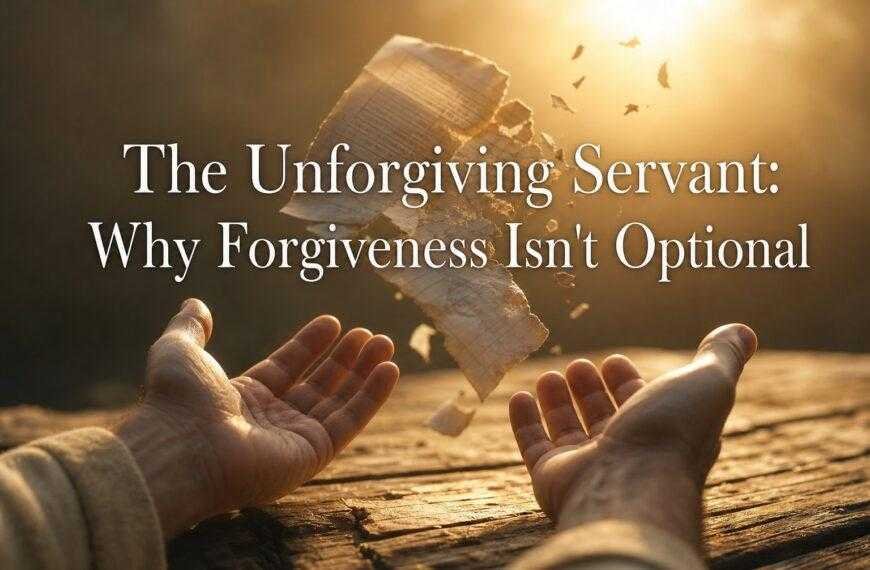
Seventy times seven was never meant to be a quota you count down. Jesus was telling Peter to stop keeping the ledger altogether. And then, because He knew the human heart would resist that, He told a story.
If you have landed on this page, there is a decent chance someone has wronged you in a way that still aches. Maybe it was recent. Maybe it has been decades, and the wound has simply learned to live quietly underneath everything else. You are not here for a lecture. You are here because the word “optional” in that title struck a nerve, and part of you wants to know whether Jesus really meant it the way it sounds.
He did. But what He meant is both harder and kinder than most of us were taught.

The Math That Doesn’t Add Up
The parable hinges on a number so large it would have made the original audience laugh out loud.
“And when he had begun to settle accounts, one was brought to him who owed him ten thousand talents. But as he was not able to pay, his master commanded that he be sold, with his wife and children and all that he had, and that payment be made.” — Matthew 18:24-25 (NKJV)
Ten thousand talents. To grasp why Jesus chose that figure, you have to understand the currency. A single talent represented roughly twenty years of wages for a common laborer. Ten thousand talents came to something like two hundred thousand years of labor, a debt no human being could ever repay. Scholars note that the annual tax revenue of entire regions like Judea and Samaria ran a small fraction of that sum. Jesus was not describing a large debt. He was describing an impossible one.
The servant begs for patience and promises to pay it all back, which is its own kind of comedy. He could no more repay ten thousand talents than he could empty the sea with a spoon. And here the story turns.
“Then the master of that servant was moved with compassion, released him, and forgave him the debt.” — Matthew 18:27 (NKJV)
The king does not restructure the loan. He does not set up a payment plan. He absorbs the entire loss himself and lets the man walk away free. That is the gospel in a single sentence, and it is the foundation for everything that follows.
Then the forgiven man walks out the door and finds a coworker who owes him a hundred denarii.
“But that servant went out and found one of his fellow servants who owed him a hundred denarii; and he laid hands on him and took him by the throat, saying, ‘Pay me what you owe!'” — Matthew 18:28 (NKJV)
A hundred denarii was real money, about a hundred days of wages. It was not nothing. I want to be honest about that, because this parable is sometimes preached as though the second debt were trivial. It was not. The point is not that what was done to you is small. The point is the staggering disproportion between what you have been forgiven and what you are being asked to forgive. One debt was roughly six hundred thousand times the other.
What Jesus Is Not Saying

Before we go further, we have to clear away the wreckage of how this passage gets misused. Because it does get misused, and the people it wounds are usually the ones who were already wounded.
Forgiveness Is Not Reconciliation
This is the distinction that sets a lot of people free. Forgiveness is something you can do by yourself, in your own heart, before God. Reconciliation takes two people, and it depends on the other person’s repentance and changed behavior. Pastors and counselors consistently draw this line, noting that you are commanded to forgive but you are not commanded to trust someone who has destroyed your trust.
Think about how God Himself works. His forgiveness is offered freely to everyone. Reconciliation with Him, though, requires a response: acknowledgment, repentance, a turning. If even God’s forgiveness does not automatically restore the relationship, then neither does yours. Scripture gives us models of genuine reconciliation, and in every one of them, something changed on both sides.
This matters enormously for anyone who has survived abuse. Forgiving an abuser does not mean walking back into the room where you were harmed. Counselors who work with survivors are clear that forgiveness releases your own bondage to bitterness, and it does not require re-entering an unsafe situation. Jesus walked away from hostile crowds. He set boundaries. So can you. Letting go of the right to revenge is one thing. Pretending the harm never happened, or exposing yourself to it again, is something else entirely, and Scripture never asks it of you.
Forgiveness Is Not Excusing or Forgetting
To forgive is not to say that what happened was acceptable. The Mayo Clinic, writing from a purely clinical standpoint, puts it plainly: you can forgive a person without excusing the act. Forgiveness does not deny the other person’s responsibility, and it does not minimize the wrong. It loosens your grip on the offense so that the offense loses its grip on you.
The king in the parable did not pretend the debt was imaginary. He named it, then chose to carry it himself. Real forgiveness always names the real debt. It simply refuses to spend the rest of its life collecting on it.
Why Jesus Calls It Non-Optional

Here is where the parable stops comforting and starts confronting. The fellow servants report what happened, and the king calls the man back in.
“You wicked servant! I forgave you all that debt because you begged me. Should you not also have had compassion on your fellow servant, just as I had pity on you?” — Matthew 18:32-33 (NKJV)
The logic is inescapable. A man who has been forgiven an unpayable fortune has no standing to throttle someone over pocket change. His refusal to forgive is not merely stingy. It is a denial of the very mercy that saved him. And the ending of the story is one of the most sobering things Jesus ever said.
“And his master was angry, and delivered him to the torturers until he should pay all that was due to him. So My heavenly Father also will do to you if each of you, from his heart, does not forgive his brother his trespasses.” — Matthew 18:34-35 (NKJV)
That is why forgiveness is not optional. Jesus ties our willingness to forgive directly to our experience of being forgiven. He said the same thing in the Lord’s Prayer, in case anyone missed it the first time.
“For if you forgive men their trespasses, your heavenly Father will also forgive you. But if you do not forgive men their trespasses, neither will your Father forgive your trespasses.” — Matthew 6:14-15 (NKJV)
Notice what He is not saying. He is not saying you earn your salvation by forgiving. He is saying that a heart genuinely transformed by the grace and mercy of God cannot simultaneously clamp down on someone else with unforgiveness. The two postures cannot occupy the same heart at the same time. If we have truly received the cancellation of our ten thousand talents, mercy starts to leak out of us toward the people who owe us a hundred denarii. When it does not, something is wrong at the root.
Paul drove the same nail.
“And be kind to one another, tenderhearted, forgiving one another, even as God in Christ forgave you.” — Ephesians 4:32 (NKJV)
The standard is never how the offender behaved. The standard is always how God in Christ forgave you. That is why a quota of seven misses the entire point. You do not forgive because the other person earned it. You forgive because you remember what you were forgiven. Paul says it once more to the Colossians, in case we are still tempted to negotiate.
“bearing with one another, and forgiving one another, if anyone has a complaint against another; even as Christ forgave you, so you also must do.” — Colossians 3:13 (NKJV)
“So you also must do.” Not should. Must. The same grace that ran downhill to us is meant to keep running, through us, to the next person.
The Prison You Build Yourself

There is a detail in the parable that is easy to skim past. The unforgiving servant is handed over to the torturers. Jesus is making a spiritual point, yet the imagery turns out to be uncomfortably accurate about real life. Unforgiveness is a prison, and the person locked inside it is almost always the one holding the grudge.
Modern medicine has measured the bars of that cell. Researchers at Johns Hopkins describe chronic anger as a stress response that stays switched on, keeping the body in fight-or-flight mode that wears it down over time. The documented cost of carrying that load is steep. Holding on to resentment is associated with higher blood pressure, a weakened immune response, poorer sleep, and elevated rates of anxiety and depression. The act of forgiving, by contrast, has been linked to lower risk of heart attack, reduced pain, and meaningfully better mental health.
One widely cited survey found that most American adults sense they need more forgiveness in their own lives. We feel the weight even when we cannot name it. The bitterness we nurse in private does not punish the person who hurt us. They are often sleeping just fine. It punishes us.
I have sat with people who could describe a wound from forty years ago with the heat and detail of yesterday. The offender was sometimes long dead. The grudge had outlived its target and was now simply eating its owner alive. Scripture is full of warnings about what unforgiveness does to a soul, and bitterness is the worst kind of tenant. It never pays rent, and it never moves out on its own.
“And whenever you stand praying, if you have anything against anyone, forgive him, that your Father in heaven may also forgive you your trespasses.” — Mark 11:25 (NKJV)
Jesus links unforgiveness to a hindered prayer life for a reason. You cannot hold someone by the throat with one hand and lift both hands to God in worship. The grip has to be released before the hands are free.
How Forgiveness Actually Happens

If you believe all of this and still feel utterly unable to do it, good. That honesty is the right place to start, because forgiveness is far less a feeling than it is a decision that feelings slowly follow.
It begins as a choice, often made through clenched teeth, long before the emotions cooperate. Karen Swartz of Johns Hopkins describes forgiveness as an active, conscious decision to release negative feelings whether or not the person deserves it. You are not waiting to feel forgiving. You are deciding to forgive, and asking God to bring the feelings into line behind the decision.
It is usually a process, not a single event. You may forgive someone on Monday and discover the resentment has crept back by Thursday. That does not mean your forgiveness was fake. It means you are human, and the seventy times seven Jesus mentioned sometimes applies to forgiving the same person for the same offense across many mornings until it finally takes. Researchers like Everett Worthington, who forgave the man who murdered his mother, have built entire evidence-based models around forgiveness as a repeatable practice rather than a one-time act of willpower.
It leans hard on what you have already received. The only sustainable fuel for forgiving others is a fresh memory of your own forgiveness. When the debt someone owes you starts to feel unbearable, the remedy is to walk back into the throne room of the king and remember the ten thousand talents he tore up on your behalf. Joseph was able to forgive the brothers who sold him into slavery because he had learned to see a larger hand at work behind the wound.
“But as for you, you meant evil against me; but God meant it for good, in order to bring it about as it is this day, to save many people alive.” — Genesis 50:20 (NKJV)
Sometimes the hardest person to forgive is the one in the mirror. If your own failures are the debt that haunts you, the same mercy applies, and learning to forgive yourself is part of receiving what Christ has already done.
And finally, forgiveness often needs help. Some wounds are too deep to process alone. Talking with a trusted pastor, a wise friend, or a licensed Christian counselor is not a sign of weak faith. It is frequently the very means God uses to set a captive free. There is no shame in needing company on the road.
A Place to Begin

Forgiveness is not optional because the gospel is not optional. The two rise and fall together. A heart that has truly grasped how much it has been forgiven cannot keep its hands around someone else’s throat for long. That is the whole weight of the parable, and it is meant to land on us the same way it landed on Peter.
But notice the direction of the pressure. Jesus is not standing over you with a stopwatch, demanding that you manufacture warm feelings toward someone who broke you. He is inviting you to set down a weight you were never meant to carry, in the strength of a mercy you did not earn. The freedom on offer is real, and it is yours, and it is far better than the prison.
If today you can name the person, name the debt, and whisper even a reluctant willingness to begin, that is enough for God to work with. He has carried far heavier things than the one you are about to hand Him.
If you want to take a next step:
- Write down the name and the offense, then bring both to God in honest prayer, holding nothing back.
- Spend time in Scripture about God’s forgiveness toward you until the size of your own canceled debt comes back into focus.
- Work through a deeper Bible study on forgiveness, or sit quietly with this parable on your own.
- If the wound is too heavy to carry alone, reach out to a trusted pastor or a licensed Christian counselor this week.
You do not have to finish the journey today. You only have to begin it.
Grace and peace to you as you take that first step. — Duke
Resources
- Forgiveness: Your Health Depends on It — Johns Hopkins Medicine
- Forgiveness: Letting Go of Grudges and Bitterness — Mayo Clinic
- What Is the Meaning of the Parable of the Unforgiving Servant? — GotQuestions.org
- The Parable of the Unmerciful Servant, Matthew 18:23-35 — Reading Acts
- When Does Forgiveness Not Lead to Reconciliation? — Founders Ministries
- How Forgiveness Can Save Your Life — Deseret News, on Everett Worthington’s REACH research


Pastor Duke has been preaching and teaching the Bible since 1988. He has shared his knowledge online since 2011.


 By
By