

A seed smaller than a pinhead changed the way an entire generation understood the Kingdom of God. That is not an exaggeration. The Parable of the Mustard Seed is one of the shortest stories Jesus ever told, yet it carries one of the most luminous truths in all of Scripture. In just a few sentences, Jesus took something ordinary, something a first-century farmer would barely notice in the dirt, and used it to describe the unstoppable expansion of God’s Kingdom on earth.
If you have ever felt like your faith is too small to matter, or your ministry too insignificant to make a difference, this parable was spoken directly to people just like you and me. It is a reminder that God does not need big to do big things. He specializes in small beginnings.

Key Takeaways
- 🌱 The Parable of the Mustard Seed appears in three Gospels (Matthew 13:31–32, Mark 4:30–32, Luke 13:18–19), making it one of the most widely recorded teachings of Jesus [1].
- 🌳 The core message is contrast: the tiniest seed produces a plant up to 10–15 feet tall, illustrating how God’s Kingdom grows from humble origins into something vast and sheltering [2].
- ✝️ This parable challenged Jewish expectations of a grand, militaristic Messiah by revealing a kingdom that grows quietly, organically, and invasively [4].
- 💡 Your small acts of faith matter. God uses what seems insignificant to accomplish extraordinary purposes.
- 📖 Practical application is key: this parable is not just theology. It is an invitation to trust God with your “small” and watch Him multiply it.
Where the Parable of the Mustard Seed Appears in the Bible

Before we dig into meaning, let’s get grounded in the text itself. The Parable of the Mustard Seed is recorded in all three Synoptic Gospels, which tells us something important: this was a teaching the early church considered essential [1].
Here are the three accounts:
| Gospel | Reference | Key Detail |
|---|---|---|
| Matthew | 13:31–32 | Describes the seed as “the least of all the seeds” |
| Mark | 4:30–32 | Emphasizes it becomes “greater than all herbs” |
| Luke | 13:18–19 | Notes it grew into “a great tree” |
Matthew 13:31–32 (NKJV) puts it this way:
“The kingdom of heaven is like a mustard seed, which a man took and sowed in his field, which indeed is the least of all the seeds; but when it is grown it is greater than the herbs and becomes a tree, so that the birds of the air come and nest in its branches.”
Each Gospel writer highlights a slightly different angle, but the core truth remains the same. The Kingdom of God starts small. It does not stay small.
It is also worth noting that this parable appears in the non-canonical Gospel of Thomas (verse 20), which shows how widely this teaching circulated in the ancient world [1]. But our authority rests in the canonical Scriptures, where the Holy Spirit preserved this story three times over.
If you want to explore more of Jesus’ parables and their life-changing lessons, check out this guide on unlocking life lessons from Jesus’ parables.
What the Mustard Seed Parable Actually Means

The Power of Small Beginnings
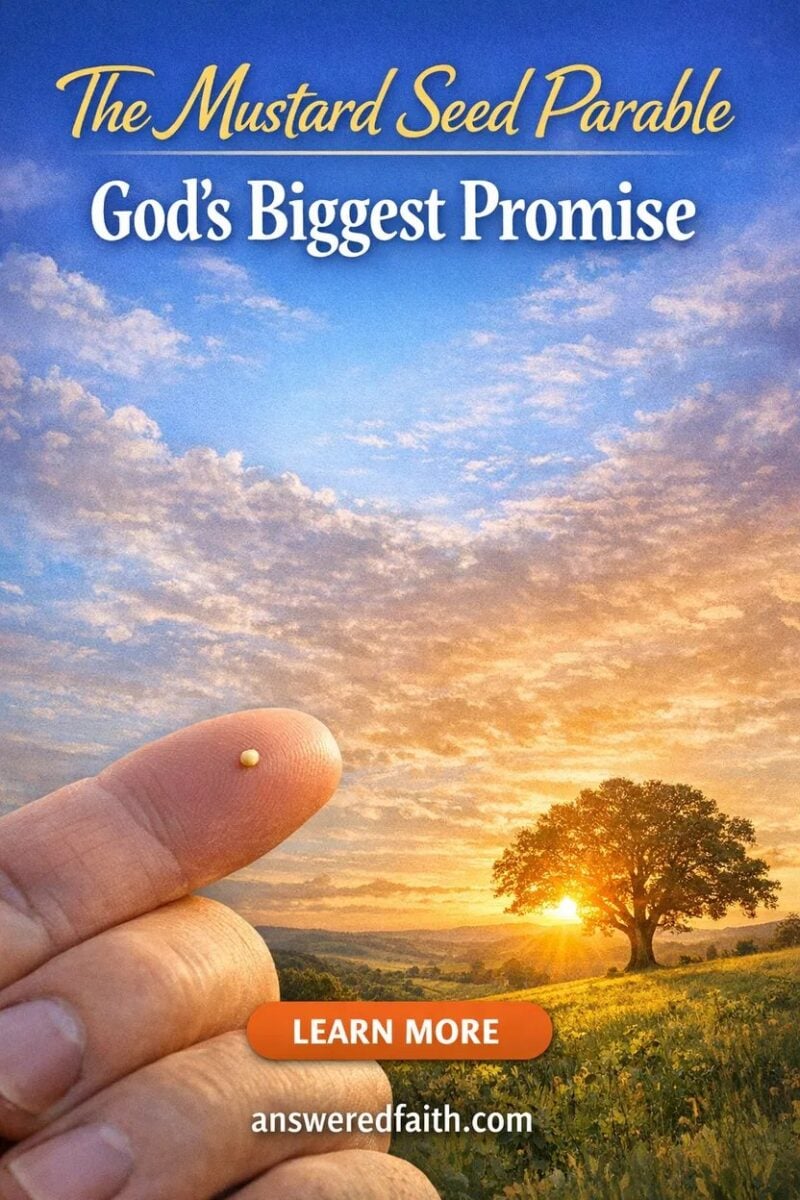
Let’s talk about that seed for a moment. A mustard seed is roughly 1 to 2 millimeters in diameter. You could lose one between your fingers without even noticing. In the agricultural world of first-century Palestine, it was proverbially the smallest seed a farmer would plant [2].
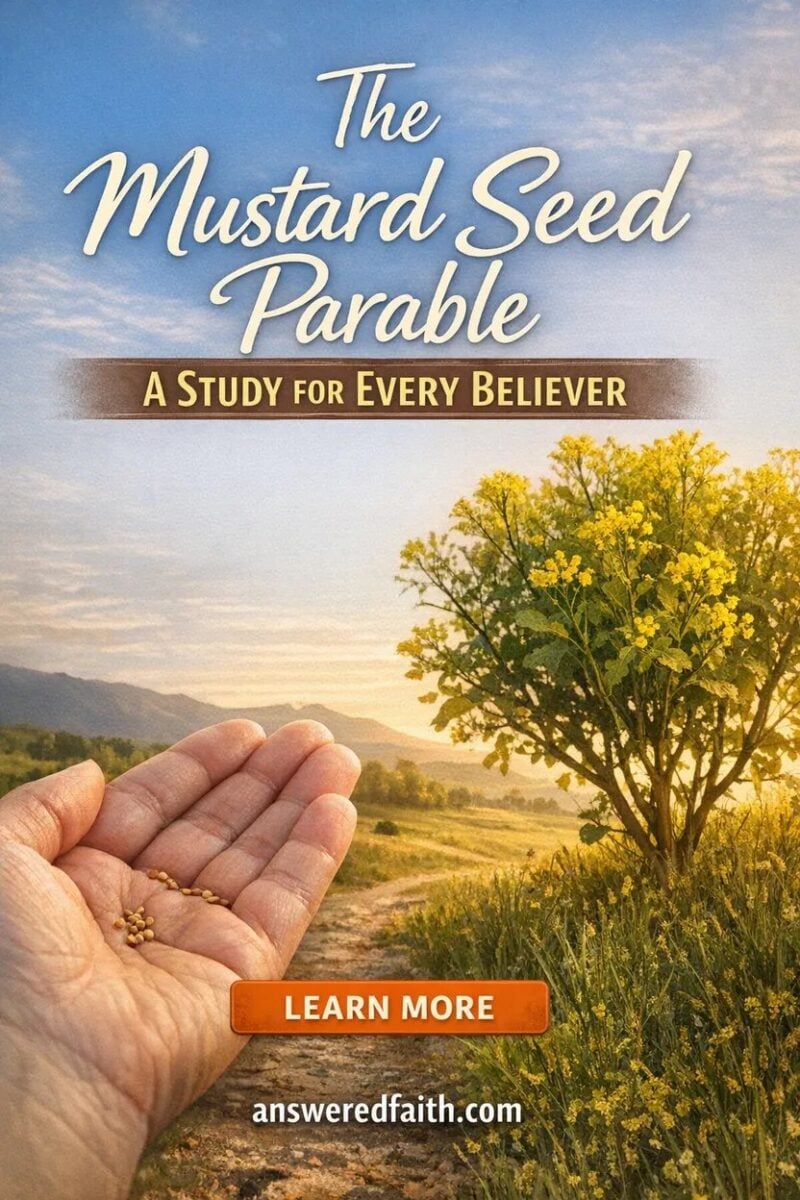
But here is what makes this parable so arresting. That minuscule seed, once planted, grows into a shrub that can reach 10 to 15 feet in height [3]. Some species of mustard plants grow so aggressively that they take over entire fields. Birds come and roost in its branches. It becomes a fixture of the landscape.
Jesus was not giving a botany lesson. He was making a theological point that would have stunned His audience.
The Kingdom of God does not arrive with trumpets and armies. It arrives like a seed.
Challenging First-Century Expectations
This is where the parable gets really interesting. Most Jews in Jesus’ day expected the Messiah to establish a political and military kingdom. They wanted a conqueror who would overthrow Rome and restore Israel to its former glory. Instead, Jesus described a kingdom that starts almost invisibly and grows organically, even invasively [4].
Think about that word: invasive. Mustard plants were not always welcome in a carefully tended garden. They spread. They took over. They were relentless. And that is exactly how the Kingdom of God operates. It does not ask permission. It grows wherever the seed is planted [7].
As Ligonier Ministries notes, the parable emphasizes “the contrast between humble beginnings and the final, consummated form of God’s kingdom” [4]. The disciples standing around Jesus that day had no idea that this tiny movement, a rabbi and a handful of followers, would become the largest faith movement in human history.
The Shelter of the Kingdom
There is one more detail that is easy to overlook. Jesus says the birds of the air come and nest in its branches. This is not just a nice image. In Old Testament prophetic literature, a great tree sheltering birds often symbolized a kingdom providing refuge for many nations (see Ezekiel 17:23 and Daniel 4:12) [5][10].
Jesus was saying: My Kingdom will be a place of refuge for all people. Not just Israel. Not just the powerful. Everyone who comes will find shelter.
That truth should encourage every believer reading this in 2026. No matter where you are in the world, no matter how small your church or your ministry feels, you are part of a Kingdom that shelters nations.
5 Practical Lessons from the Parable of the Mustard Seed
Theology matters, but so does application. Here at Answered Faith, we believe that every spiritual truth should lead to a practical step. So let me break down five lessons you can carry with you from this parable.

1. Stop Despising Small Beginnings
Zechariah 4:10 (NKJV) says, “For who has despised the day of small things?”
I have pastored long enough to watch people give up on a ministry, a prayer life, or a Bible study because it felt too small to matter. The mustard seed parable demolishes that thinking. God is not impressed by size. He is moved by faithfulness.
If you are leading a small group of three people, that is a mustard seed. Water it. Tend it. Watch what God does.
If you are feeling stuck in your spiritual walk, our biblical guide to getting unstuck can help you take that next step.
2. Trust the Process of Growth
Seeds do not sprout overnight. There is a season of hiddenness, a time when the seed is buried in dark soil and nothing visible is happening. But beneath the surface, roots are forming.
Galatians 6:9 (NKJV) reminds us: “And let us not grow weary while doing good, for in due season we shall reap if we do not lose heart.”
If you have been praying for something and have not seen results yet, do not dig up your seed. Let it grow.
3. Recognize That God Uses the Unlikely
A mustard seed was not a noble plant. It was common. Ordinary. Even a nuisance to some farmers. Yet Jesus chose it to represent the most powerful kingdom in existence.
God has a pattern of choosing the unlikely. He chose a shepherd boy to be king. He chose fishermen to be apostles. He chose a manger instead of a palace. For more stories of unwavering faith in unlikely people, explore these powerful Bible narratives.
He can use you, too. Regardless of your background, education, or resources.
4. Plant Seeds Everywhere You Go
The man in the parable did something simple but essential: he planted the seed. He did not just admire it. He did not put it on a shelf. He put it in the ground.
Your kind word to a coworker is a seed. Your prayer for a neighbor is a seed. Teaching your kids about Jesus at the dinner table is a seed. Sharing a devotional with a friend is a seed.
You may never see the full tree that grows from what you plant. But plant anyway.
5. Expect an Outsized Harvest
Here is the math of the Kingdom: tiny input, massive output. That is not how the world works, but it is how God works. One act of obedience can produce generational fruit.
Think about the early church in the book of Acts. A small band of 120 believers in an upper room became a movement that turned the Roman Empire upside down. You can read about some of those pivotal moments in our summary of Acts 11, where the Gospel first broke into the Gentile world.
How to Teach This Parable in Your Small Group or Church
If you are a small group leader, Sunday School teacher, or pastor looking to teach the Parable of the Mustard Seed, here is a simple framework you can use. Contemporary church curriculum, including a Spring 2026 New City Groups series on parables, continues to feature this parable as a centerpiece for group study [9].

A Simple Teaching Outline
- Read the text together. Use Matthew 13:31–32 as your primary text. Have someone also read the Mark and Luke versions for comparison.
- Show a mustard seed. If possible, bring actual mustard seeds to pass around. The physical object makes the lesson visceral and memorable.
- Ask the contrast question: “What is the smallest thing God has used in your life to produce something big?”
- Discuss the Old Testament background. Reference Ezekiel 17:23 and Daniel 4:12 to show how the “great tree” image connects to God’s plan for the nations [10].
- Apply it personally. Have each person identify one “mustard seed” action they can take this week: a conversation, a prayer, a step of obedience.
Discussion Questions
- What “small beginnings” in your life is God asking you to be faithful with right now?
- How does this parable change the way you view success in ministry?
- Where have you seen God produce an outsized result from a small act of faith?
For additional study resources, our guide on how to study the Bible for yourself can equip your group with deeper tools.
The Mustard Seed and Your Faith in 2026
Let me get personal for a moment. I have seen this parable play out in real life more times than I can count. I have watched a single mom start a prayer group in her living room that eventually became a thriving women’s ministry. I have seen a teenager share a Bible verse on social media that led a stranger to Christ. I have seen churches that started with five people in a garage grow to impact entire communities.
None of those stories started with something big. They started with a seed.
Romans 8:28 (NKJV) tells us, “And we know that all things work together for good to those who love God, to those who are the called according to His purpose.” If you want to go deeper into that promise, our Romans chapter 8 summary unpacks it beautifully.
The Parable of the Mustard Seed is not just ancient history. It is a present-tense promise. God is still planting. He is still growing. And He is still using small, faithful people to build His Kingdom.
If you have been waiting for God to do something new in your life, take heart. He may already be doing it. You just cannot see it yet because it is still underground. Read more about how God is doing a new thing even when you can’t see it.
Conclusion
The Parable of the Mustard Seed delivers one of the most encouraging messages in all of Scripture: God does not need big to accomplish big. He takes the smallest seed, the humblest beginning, and grows it into something that shelters nations.
Here is what I want you to walk away with today:
- Your faith is not too small. Even faith the size of a mustard seed moves mountains (Matthew 17:20).
- Your ministry is not too insignificant. God measures faithfulness, not size.
- Your next step matters. Plant the seed. Water it with prayer. Trust God with the growth.
Whether you are a pastor leading a small congregation, a parent teaching your children about Jesus, or a believer simply trying to be faithful in your daily life, you are part of the mustard seed story. The Kingdom of God is growing, and you are in it.
So go plant something this week. Say the prayer. Start the study. Have the conversation. Share the verse. And trust that the God who turns seeds into trees is working in your life right now.
“The kingdom of heaven is like a mustard seed… when it is grown it is greater than the herbs and becomes a tree.” — Matthew 13:31–32 (NKJV)
References
[1] Parable Of The Mustard Seed – https://en.wikipedia.org/wiki/Parable_of_the_Mustard_Seed
[2] Parable Mustard Seed – https://www.gotquestions.org/parable-mustard-seed.html
[3] Lessons From The Mustard Seed Parable – https://www.christchurchmemphis.org/stories/lessons-from-the-mustard-seed-parable
[4] Parable Mustard Seed – https://learn.ligonier.org/devotionals/parable-mustard-seed
[5] The Parable Of The Mustard Seed Matthew 1331 32 – https://ncec.catholic.edu.au/faith/scripture-resources/commentaries/the-gospel-of-matthew/the-parable-of-the-mustard-seed-matthew-1331-32/
[7] The Parable Of The Mustard Seed – https://equipper.gci.org/2025/08/the-parable-of-the-mustard-seed
[9] Watch – https://www.youtube.com/watch?v=EInLTd1SS2s
[10] The Parable Of The Mustard Seed – https://catholicproductions.com/blogs/blog/the-parable-of-the-mustard-seed
Share On Pinterest

Test Your Knowledge!
Answer all 10 questions, then submit to see your score.
Related Posts

The Difference Between Faith and Hope in the Bible
Last updated: May 2026 Faith and hope are not the same thing — and the Bible makes that distinction carefully. Discover what Scripture really says and why it changes everything about how you trust God.
 May 16, 2026
What Does the Bible Actually Say About Faith?
Last updated: May 2026 What does the Bible really say about faith? Discover the biblical definition, what Jesus taught, and how faith actually works in everyday life.
May 16, 2026
How to Have Faith When Life Gets Hard — What the Bible Says
Last updated: May 2026 When life falls apart, faith can feel impossible. Discover what the Bible actually says about trusting God in hard times — honest, practical, and grounded in Scripture.
May 15, 2026
Why Casual Bible Reading Isn't Enough — The Case for Structured Bible Study
Last updated: May 2026 Casual Bible reading is a good start — but it's not enough for real spiritual growth. Discover why structured Bible study transforms your faith in ways surface reading never can.
May 21, 2026


 By
By


