


By Duke Taber
We have heard it so many times that it has almost stopped meaning anything. “Good Samaritan” is now the name of hospitals, charities, and laws that protect people who stop to help at the scene of an accident. The phrase has become a compliment we hand out to kind strangers. That is not a bad thing. But it is a tamed thing.
When Jesus first told this story, the words “good” and “Samaritan” did not belong in the same sentence. Putting them together would have landed on his audience the way “honest thief” or “trustworthy traitor” lands on us. The shock was the whole point. And when we lose the shock, we lose the story.
So let us slow down and read it the way the first hearers did. There is far more here than a reminder to be nice. This is one of the most pointed, uncomfortable, and beautiful of all the parables Jesus told, and it was aimed straight at a man who thought he already had the answer.

The Question Behind the Question
The parable does not begin with a wounded man. It begins with a clever one.
And behold, a certain lawyer stood up and tested Him, saying, “Teacher, what shall I do to inherit eternal life?” — Luke 10:25 (NKJV)
This was not a seeker. He was an expert in the law of Moses, and he stood up to test Jesus, to see whether this traveling rabbi could be tripped. Jesus answered a question with a question, asking what the law said. The lawyer recited it perfectly.
So he answered and said, “‘You shall love the Lord your God with all your heart, with all your soul, with all your strength, and with all your mind,’ and ‘your neighbor as yourself.'” — Luke 10:27 (NKJV)
He knew the words by heart. He had probably taught them. Jesus told him he had answered rightly, and that if he did this, he would live. The conversation could have ended there. It did not, because the lawyer was not finished defending himself.
But he, wanting to justify himself, said to Jesus, “And who is my neighbor?” — Luke 10:29 (NKJV)
There is the hinge of the whole story. He wanted to justify himself. He was not asking so he could obey. He was asking so he could draw a line. If “neighbor” could be defined narrowly enough, if it meant his own people and his own circle, then he had already kept the command and could walk away clean. The question “who is my neighbor” is almost always a way of asking “who is not.” It is the question of a heart looking for the edge of its obligation.
I have asked it myself more times than I would like to admit. We all draw that line somewhere, usually right at the boundary of our own comfort. Jesus does not answer the lawyer’s question. He dismantles it.
A Road Everyone Knew

Then Jesus answered and said: “A certain man went down from Jerusalem to Jericho, and fell among thieves, who stripped him of his clothing, wounded him, and departed, leaving him half dead.” — Luke 10:30 (NKJV)
The geography was not random. The road from Jerusalem to Jericho was a roughly eighteen-mile descent through bleak, rocky wilderness. Jerusalem sits about 2,500 feet above sea level and Jericho about 700 feet below it, so a traveler dropped more than 3,000 feet over a short, winding, ambush-friendly path. The red rocks and blind turns gave the route a grim nickname. One stretch was known as the “Way of Blood” because so many people were robbed and killed there.
Nobody in that crowd needed the danger explained. They had walked it, or knew someone who had. When Jesus said a man fell among thieves on that road, every listener pictured it instantly. The victim is stripped and beaten and left half dead, which means he is unconscious and unidentifiable. You cannot tell from his clothing whether he is rich or poor. You cannot tell from his accent whether he is one of yours. He is simply a bleeding human being in a ditch. Jesus stripped away every marker we use to decide whether someone deserves our help. That, too, is part of the design.
The Two Who Passed By

Now by chance a certain priest came down that road. And when he saw him, he passed by on the other side. Likewise a Levite, when he arrived at the place, came and looked, and passed by on the other side. — Luke 10:31-32 (NKJV)
Here is where the story turns its first knife. The two men who walk past are not villains in anyone’s eyes. They are the religious establishment. A priest served at the temple. A Levite assisted in its worship. These were the men the lawyer would have expected to be the heroes. They were professionally holy.
Why did they pass by? The most common explanation is ritual purity. The law warned priests against defiling themselves by touching a corpse, and a priest who became unclean could not perform his temple duties or eat the holy tithe. If the man looked dead, the reasoning goes, the priest had a religious excuse to keep his distance.
It is a tidy explanation, and it is worth holding loosely. Careful scholars have pointed out the problem with it. The man in the ditch is described as “half dead,” not dead, so no real issue of corpse impurity applies, and the purity law in question fell on priests, not on Levites. Both men avoid him, which suggests the lesson is not really about a technical purity loophole. Even on the strictest reading, both were traveling away from Jerusalem, not toward temple service, so the duty to help should have outweighed any concern.
Strip away the excuses and you are left with something more familiar and more convicting. They saw him, and they kept their distance. They had reasons. People with hard hearts usually do. The text lingers on the fact that they looked. They were not ignorant of his need. They simply decided it was not theirs to carry.
The One Nobody Expected
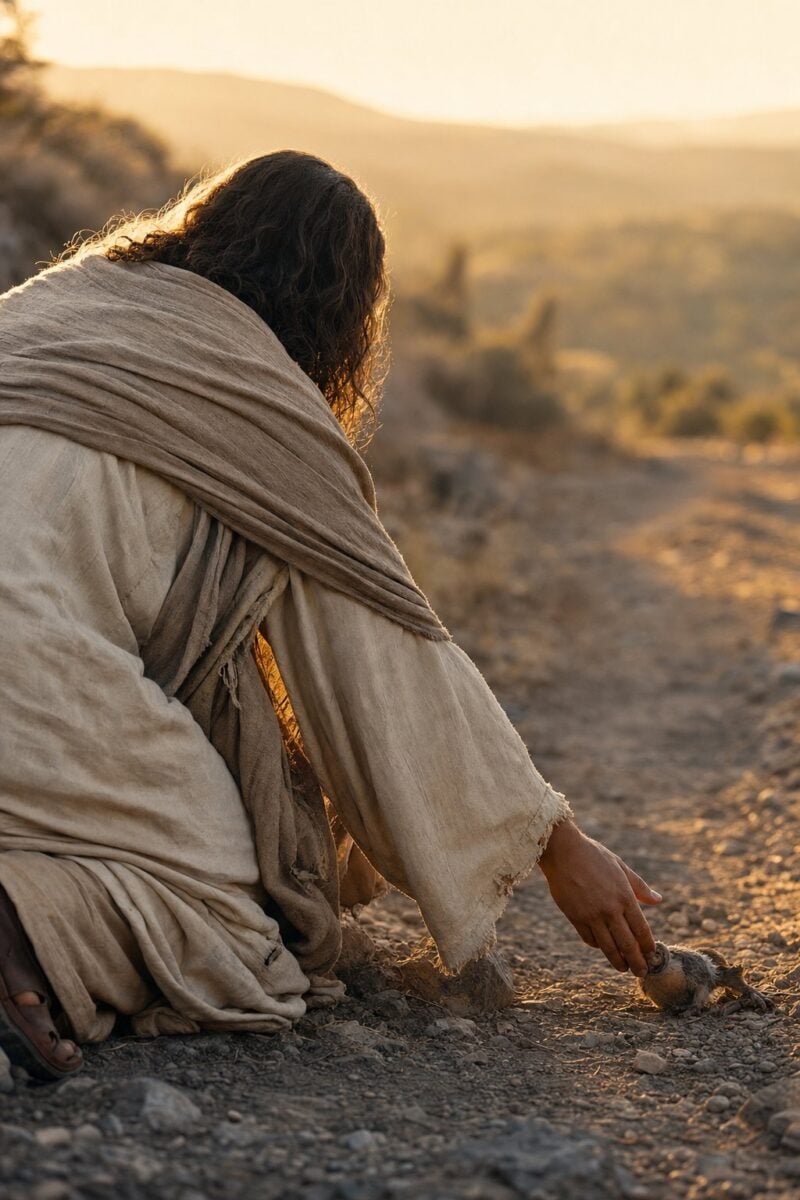
But a certain Samaritan, as he journeyed, came where he was. And when he saw him, he had compassion. — Luke 10:33 (NKJV)
To feel the force of this verse, you have to understand how the word “Samaritan” hit a first-century Jewish ear. This was not a minor rivalry. The two peoples had been estranged for centuries. After the northern kingdom fell, foreign settlers intermarried with those left in the land, and a separate people with a rival worship took shape. Relations reached a distinct low point when the Samaritan temple on Mount Gerizim was destroyed in 128 BCE, and in the early first century Samaritans were remembered for desecrating the Jewish temple with human bones. John’s Gospel sums up the social reality in a single line: the Jews had no dealings with Samaritans.
So Jesus took the one figure his audience despised most and made him the hero. Not a fellow Jew. Not a Roman, who at least held power. A Samaritan. The crowd would have braced for a punchline that never came. Instead, the despised outsider does what the holy insiders would not.
The verb matters. He “had compassion.” It is the same kind of gut-level mercy the Gospels use to describe Jesus himself when he looked on the crowds. The Samaritan does not calculate. He does not ask whether this man is one of his own. He sees suffering and his heart moves, and then his hands follow. This is what the compassion of Jesus looks like wearing a stranger’s face.
What Love Actually Cost

Jesus does not let the compassion stay abstract. He itemizes it.
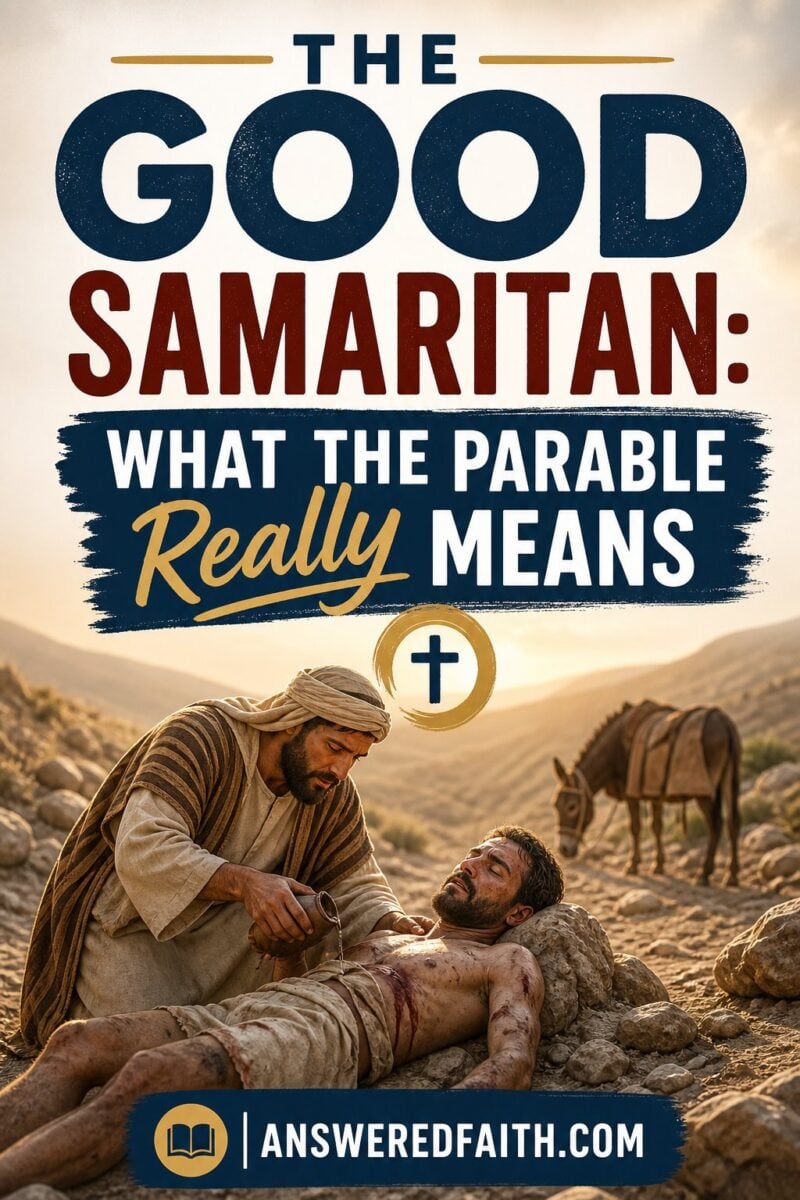
So he went to him and bandaged his wounds, pouring on oil and wine; and he set him on his own animal, brought him to an inn, and took care of him. On the next day, when he departed, he took out two denarii, gave them to the innkeeper, and said to him, “Take care of him; and whatever more you spend, when I come again, I will repay you.” — Luke 10:34-35 (NKJV)
Count the cost. The Samaritan uses his own oil and wine to treat the wounds. He gives up his own animal and walks so the injured man can ride. He spends his own night caring for a stranger at the inn. He pays the innkeeper two denarii, roughly two days’ wages, and then signs a blank check, promising to cover whatever else the recovery requires.
This is the detail that exposes how shallow our usual version of the story is. We tend to reduce the parable to a single nice gesture, a moment of kindness on the road. The actual Samaritan binds himself to this man’s whole recovery. He gives time, supplies, money, reputation, and an open-ended commitment to return. Real love in the Bible is almost never a feeling that costs nothing. It is inconvenient, expensive, and ongoing. The Greek word the New Testament reaches for again and again is agape, a love that gives without first asking what it will get back. If you want to know what agape and the other words for love actually demand of us, this Samaritan is the picture.
The Question Jesus Refused to Answer

Now watch what Jesus does with the lawyer’s original question. The man had asked, “Who is my neighbor?” Jesus ends by asking something different.
“So which of these three do you think was neighbor to him who fell among the thieves?” And he said, “He who showed mercy on him.” Then Jesus said to him, “Go and do likewise.” — Luke 10:36-37 (NKJV)
The lawyer asked Jesus to define the object of love. Who qualifies as my neighbor, so I know whom I am required to love? Jesus flipped the verb. He did not tell the lawyer who his neighbor was. He asked which man acted like a neighbor. The question is no longer “who deserves my love” but “will I be the kind of person who loves.”
That is a seismic shift. “Who is my neighbor” lets me sit in judgment, sorting people into those I owe and those I do not. “Am I being a neighbor” puts me on trial instead. Jesus refuses to give the lawyer a boundary line, because love that looks for boundary lines is not the love the law was ever asking for. The command was always to love your neighbor as yourself, with no fine print attached.
There is one more quiet detail. When Jesus asks who proved to be a neighbor, the lawyer cannot bring himself to say the word “Samaritan.” He answers, “He who showed mercy on him.” Even cornered by the truth, the prejudice still has a grip on his tongue. Jesus lets it stand and simply says, go and do the same.
The Mirror We Would Rather Not Look Into

It is tempting to read this parable and quietly assume we are the Samaritan. Most of us are not, at least not most of the time. We are far more often the priest and the Levite, and we have the same reasons they did. We are busy. We are running late. We have somewhere to be and someone is counting on us.
In 1973, two researchers at Princeton ran an experiment that should haunt every believer. They gathered seminary students, people training for ministry, and asked each one to walk to another building to give a short talk. Some were assigned to speak on the parable of the Good Samaritan. On the way, every student passed a man slumped in a doorway, coughing and groaning in obvious distress. The single factor that predicted whether they stopped to help was not their religious convictions but whether they had been told they were running late. Some who were in a hurry literally stepped over the suffering man on their way to preach about the Good Samaritan.
I have been in ministry for more than thirty years, and that study lands on me because I have lived it. I have driven past need with a sermon outline on the seat beside me. The uncomfortable truth is that holiness on paper and hardness in practice can live in the very same person. The priest knew the law. The Levite served the temple. The seminary students could exegete the parable. None of that moved a hand toward the man in the ditch. Compassion is not what we know. It is what we do when knowing would be enough for everyone else.
Go and Do Likewise

Jesus did not end the parable with a principle to admire. He ended it with a command to obey. Go and do likewise. The whole weight of the story leans on those four words.
So who is the man in your ditch? It may be a literal stranger in obvious trouble. More often it is someone closer and less dramatic. The neighbor whose marriage is quietly falling apart. The coworker eating lunch alone. The family member you have written off because helping them would cost more than you want to spend. The person whose politics or background or past makes them, in your private accounting, a Samaritan. Jesus has a way of putting the person we are most inclined to step around right in the center of the road.
The mercy this parable calls for is not sentiment. It is the willingness to be inconvenienced, to spend something real, and to stay involved until the recovery is finished. John said it plainly years later.
My little children, let us not love in word or in tongue, but in deed and in truth. — 1 John 3:18 (NKJV)
That is the parable in one verse. Not love that talks. Love that bandages, lifts, pays, and comes back to check.
The Good Samaritan is not finally a story about a kind stranger on an ancient road. It is a mirror, a command, and an invitation. It asks whether we will keep drawing lines around our compassion, or whether we will let mercy decide who our neighbor is. The lawyer wanted a definition. Jesus gave him a direction. He gives us the same one still. Go and do likewise.
A Word Before You Go

If this parable has put its finger on something in you, do not rush past the conviction. Sit with it for a moment. Ask the Lord to show you the person you have been passing on the other side of the road, and ask for the compassion to cross over. You do not have to fix everything. You only have to stop.
A few simple steps can help you live this out:
- Name one person in your life right now who is in a ditch, and decide on one concrete thing you will do for them this week.
- Build margin into your schedule so that hurry stops making your decisions for you.
- Ask God to soften any prejudice that quietly disqualifies certain people from your mercy.
- Read the parable slowly once more, this time placing yourself in each role, including the man who needed saving.
If you want to go deeper into this story and the others Jesus told, our study on the parables of Jesus walks through them lesson by lesson for personal study or a small group.
Keep loving your neighbor, one crossing of the road at a time. — Duke
Resources
- The Parable of the Good Samaritan, Luke 10:25-37 commentary — Background on the road, geography, and Jewish-Samaritan tensions.
- A New Look at the Good Samaritan — Historical detail on the “Way of Blood” and the temple roles of the priest and Levite.
- Revisiting the Parable of the Good Samaritan — A scholarly look at why the purity explanation falls short.
- Take Time to Be a Good Samaritan (Stanford SPARQ) — The 1973 Darley and Batson study on hurry and helping behavior.
- Understanding the Good Samaritan Parable (Biblical Archaeology Society) — Scholarly perspectives on interpreting the story.
- Parable of the Good Samaritan (overview) — A summary of the history behind Jewish and Samaritan estrangement.

Pastor Duke has been preaching and teaching the Bible since 1988. He has shared his knowledge online since 2011.


 By
By