

Have you ever had one of those mornings where it’s just you, your Bible, and a quiet cup of coffee—and God’s presence feels so tangible you wonder why you’d ever need anything else? Then Sunday rolls around, and you’re standing shoulder to shoulder with your church family, voices rising together in praise, and you think, This is what heaven must sound like. The tension between personal vs. communal worship is something nearly every believer wrestles with at some point. And here’s the beautiful truth: it’s not actually a competition. Both are indispensable threads in the tapestry of a vibrant faith life.
In 2026, this conversation matters more than ever. About 40% of U.S. adults participate in religious services at least monthly—whether in person, online, or both [3]. Churches are still recovering from pandemic disruptions, sitting at roughly 85% of pre-pandemic attendance levels [2]. Meanwhile, private devotional habits have surged. So where should you invest your worship energy? Let me walk you through what Scripture says, what the data reveals, and how you can cultivate a rhythm that transforms your walk with God.

Key Takeaways 📌
- Personal worship builds your private foundation with God—it’s where intimacy, honesty, and deep listening happen.
- Communal worship strengthens accountability, unity, and corporate anointing that you simply cannot replicate alone.
- Scripture commands both, and neither is optional for a healthy spiritual life.
- Younger generations are returning to church at record rates, with Gen Z and Millennials nearly doubling their attendance since 2020 [2].
- The healthiest believers practice a rhythm of consistent private devotion and faithful corporate gathering.
What Is Personal Worship? The Secret Place That Shapes You
When Jesus taught about prayer, He didn’t start with the temple. He started with a closet.
“But you, when you pray, go into your room, and when you have shut your door, pray to your Father who is in the secret place; and your Father who sees in secret will reward you openly.” — Matthew 6:6 (NKJV)
Personal worship is your one-on-one encounter with God. It’s the unscripted, unfiltered conversation between your soul and your Creator. No worship team. No sermon outline. Just you and Him.

What Personal Worship Looks Like in Practice
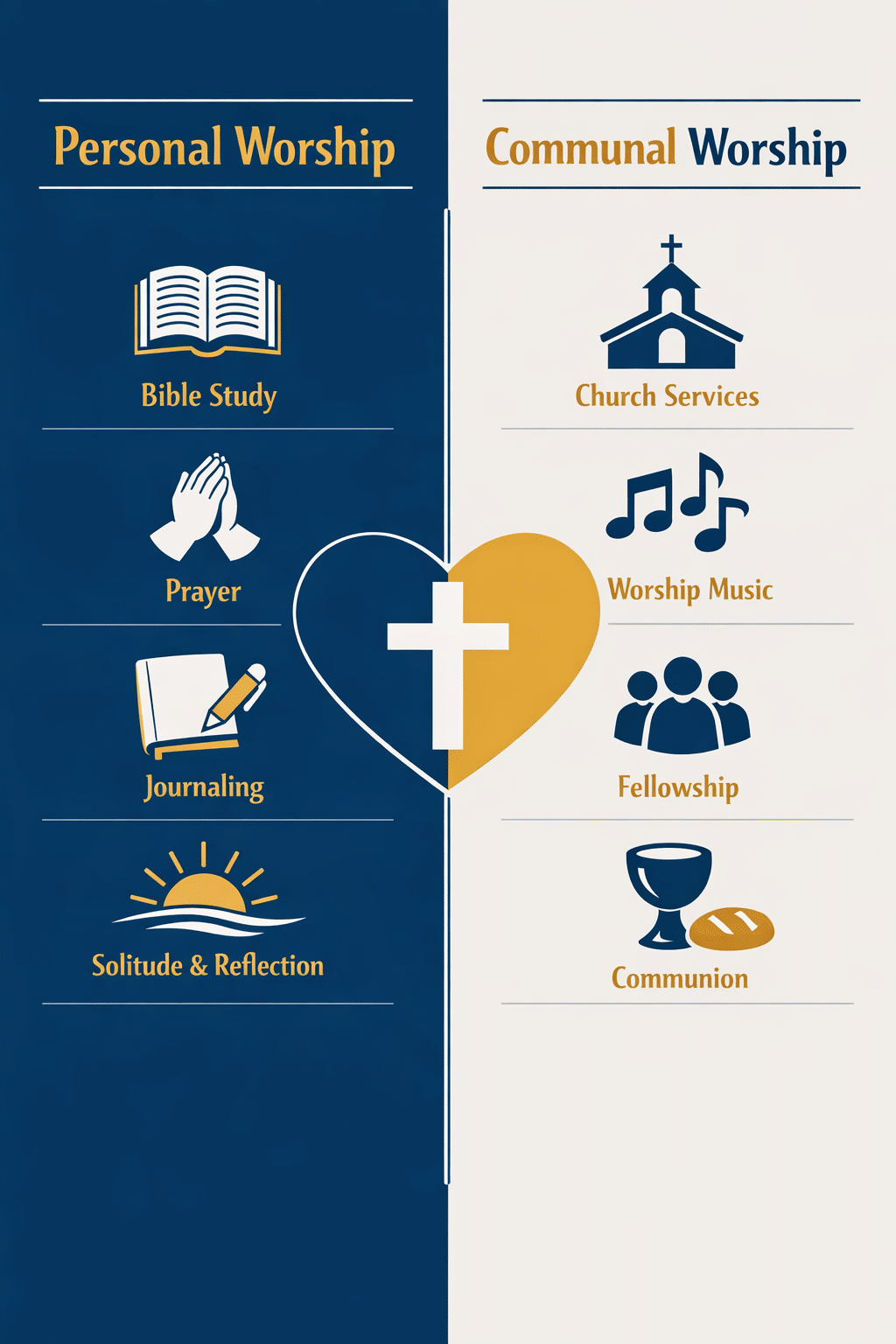
Personal worship isn’t monolithic—it takes many forms:
- Prayer — Talking to God honestly about your fears, gratitude, and needs. Learning to pray through Scripture can revolutionize this practice.
- Bible reading and study — Systematically feeding on God’s Word. A solid Bible reading plan helps you stay consistent.
- Journaling — Writing down what God is speaking to your heart.
- Singing and praise — Yes, even alone in your car counts!
- Meditation on Scripture — Chewing on a verse until it becomes part of you.
- Fasting — A deeply personal act of surrender and hunger for God.
The hallmark of personal worship is intimacy. It’s where you can be completely vulnerable. You don’t have to perform. You don’t have to hold it together. You can weep, confess, question, and listen without any audience but the Almighty.
Why Personal Worship Is Non-Negotiable
Here’s what I’ve seen in over three decades of pastoral ministry: believers who neglect their private devotional life eventually run dry in public. You can sing all the right songs on Sunday and still be spiritually parched if you haven’t met with God during the week.
David understood this. The psalms weren’t written in committee meetings—they poured out of a man who knew God in the wilderness, in the cave, in the lonely watches of the night. Personal worship is where your daily devotions become sustainable and where real transformation begins.
What Is Communal Worship? The Power of Gathering Together
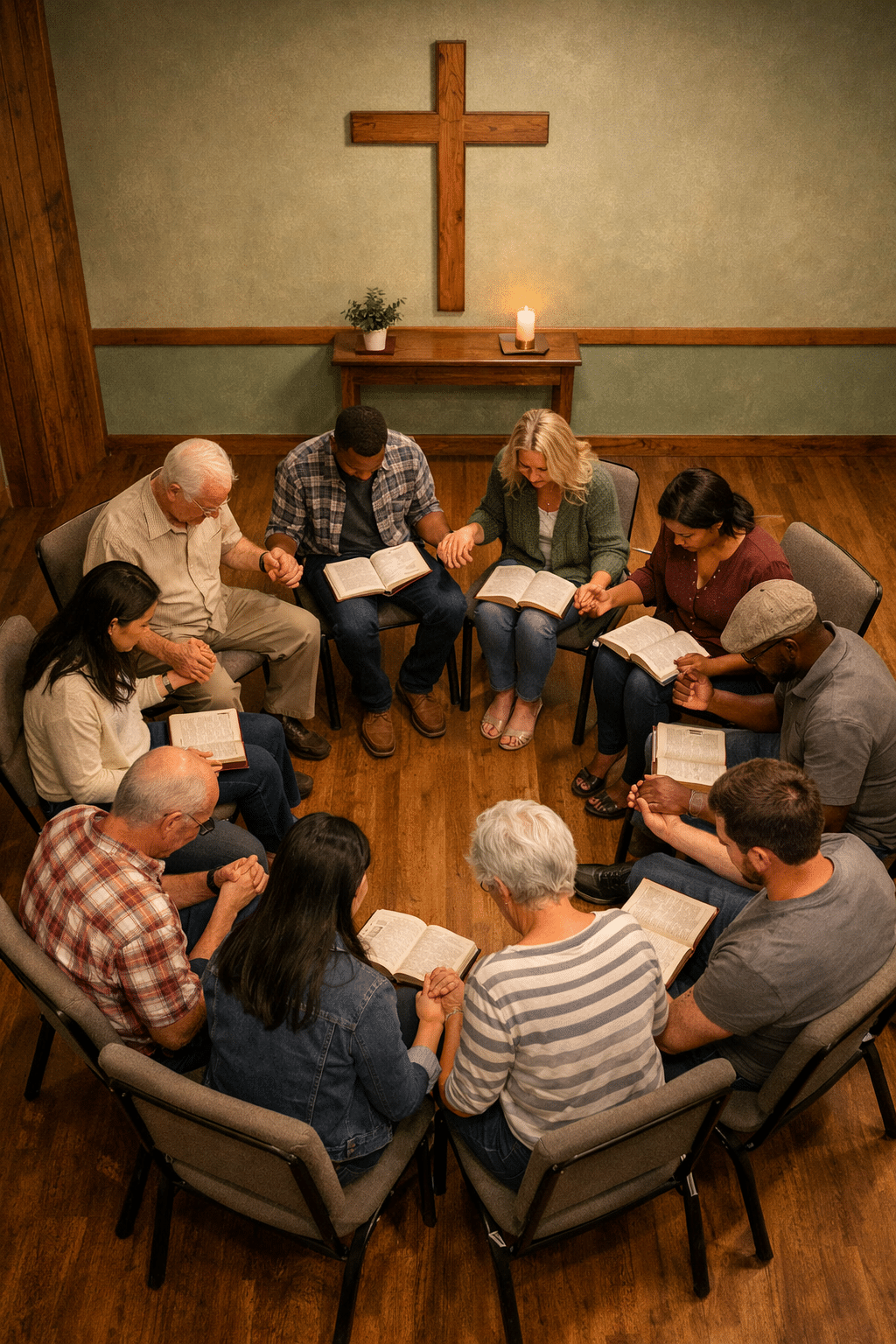
Now let’s talk about the other side of personal vs. communal worship—the corporate gathering.
“Not forsaking the assembling of ourselves together, as is the manner of some, but exhorting one another, and so much the more as you see the Day approaching.” — Hebrews 10:25 (NKJV)
That verse isn’t a suggestion. It’s a command with urgency baked right in—“so much the more.” The writer of Hebrews saw people drifting away from gathering, and the Holy Spirit inspired a direct corrective.
What Makes Communal Worship Unique
Communal worship offers something personal worship simply cannot:
| Element | Personal Worship | Communal Worship |
|---|---|---|
| Accountability | Self-directed | Others see and encourage you |
| Teaching | Self-study | Gifted teachers expound the Word |
| Spiritual gifts | Limited expression | Full-body ministry (1 Cor. 12) |
| Encouragement | God speaks directly | God speaks through others |
| Sacraments | N/A | Communion, baptism, laying on of hands |
| Corporate anointing | Individual presence | Multiplied presence of God |
There’s a synergistic power when believers gather. Jesus promised it plainly:
“For where two or three are gathered together in My name, I am there in the midst of them.” — Matthew 18:20 (NKJV)
God is omnipresent, yes. He’s with you in your prayer closet. But there is a manifest presence—a particular demonstration of His Spirit—that shows up when the Body assembles. Understanding the Holy Spirit’s role in worship helps us appreciate why corporate gatherings carry such weight.
The Current State of Communal Worship in 2026
The data paints a fascinating picture. 68% of churches now have congregations of fewer than 100 people, and 31% have fewer than 50 [2]. Worship communities are getting smaller and more intimate—which isn’t necessarily bad. Smaller settings often foster deeper connection and authentic fellowship.
What’s truly encouraging? Gen Z and Millennials are showing up. Their church attendance has nearly doubled since 2020, rising to approximately 1.9 and 1.8 weekends per month respectively [2]. After years of handwringing about young people leaving the church, we’re seeing a remarkable reversal. Young adults are hungry for real community, and they’re finding it in communal worship.
Meanwhile, 16% of Americans engage in both in-person and online services monthly [3], showing that many believers are blending personal and communal formats in creative ways.
Personal vs. Communal Worship: What Does the Bible Actually Teach?
Let’s settle this with Scripture, because that’s where every answer ultimately lives.
The Biblical Case for Personal Worship
The Bible is brimming with examples of private devotion:
- Daniel prayed three times daily in his upper room (Daniel 6:10).
- Jesus regularly withdrew to lonely places to pray (Luke 5:16).
- David cried out to God alone in the wilderness (Psalm 63:1).
- Hannah prayed silently in the temple, her lips moving but her voice unheard (1 Samuel 1:13).
These weren’t people who lacked access to corporate worship. They were leaders, prophets, and the Son of God Himself. Yet they prioritized the secret place because they understood that public power flows from private devotion.
Studying these living examples of faithfulness in the Bible reveals a consistent pattern: the men and women God used most mightily were those who cultivated deep personal worship habits.
The Biblical Case for Communal Worship
Scripture is equally emphatic about gathering:
- The early church devoted themselves to fellowship, breaking of bread, and prayers together (Acts 2:42-47).
- Paul instructed the Corinthians on orderly corporate worship, including prophecy, tongues, and teaching (1 Corinthians 14:26).
- The Psalms of Ascent (Psalms 120-134) were sung by pilgrims traveling together to worship at the temple.
- Nehemiah led corporate worship and reading of the Law that brought an entire nation to repentance (Nehemiah 8).
The prayer of agreement is a powerful biblical concept that only functions in community. When believers unite their faith, something extraordinary happens in the spiritual realm.
The Verdict: Both Are Essential
Here’s the bottom line—and I want you to hear this with pastoral care:
🗣️ “Personal worship without communal worship breeds isolation. Communal worship without personal worship breeds superficiality. You need both.”
The Christian life was never designed to be a solo endeavor. But it was also never designed to be only a group activity. You are both an individual before God and a member of His Body. Those two realities must coexist.
How to Build a Healthy Rhythm of Personal vs. Communal Worship

Alright, let’s get practical. Knowing you need both is one thing. Actually building a sustainable rhythm is another. Here are actionable steps you can start this week.
5 Ways to Strengthen Your Personal Worship 🙏
- Set a consistent time and place. Your prayer closet doesn’t have to be literal, but it should be intentional. Same chair. Same time. Build the habit.
- Follow a reading plan. Don’t just open your Bible randomly. A structured approach to studying the Bible keeps you moving through Scripture with purpose.
- Pray out loud. It keeps your mind from wandering and engages your whole being.
- Worship with music. Put on a worship song before you open your Bible. It shifts your atmosphere.
- Journal one thing God shows you. Even a single sentence. Over time, you’ll have a written record of God’s faithfulness that strengthens your faith during hard seasons.
5 Ways to Deepen Your Communal Worship 🤝
- Commit to consistent attendance. Not when it’s convenient—when it’s covenantal. Treat your church gathering like a sacred appointment.
- Arrive prepared. Spend time in personal worship before Sunday. You’ll be amazed how differently you experience the service when you come already warmed up spiritually.
- Serve, don’t just sit. Communal worship isn’t a spectator sport. Volunteer. Greet. Pray for others. Use your gifts.
- Join a small group. The large Sunday gathering is important, but deep community happens in smaller settings. If you lead one, here’s how to lead a small group Bible study with confidence.
- Practice the “one anothers.” Encourage one another. Bear one another’s burdens. Confess to one another. These commands require proximity and presence.
A Sample Weekly Worship Rhythm
Here’s a simple framework that balances both dimensions:
| Day | Personal Worship | Communal Worship |
|---|---|---|
| Monday | 20 min Bible reading + prayer | — |
| Tuesday | 15 min journaling + worship music | — |
| Wednesday | 20 min Scripture meditation | Midweek service or small group |
| Thursday | 15 min prayer walk | — |
| Friday | 20 min Bible study | — |
| Saturday | Extended prayer/fasting (optional) | — |
| Sunday | Brief morning devotion | Corporate worship service |
This isn’t legalistic. It’s a scaffold. Adjust it to your life, your season, and what the Holy Spirit leads you into. The point is intentionality, not perfection.
Addressing Common Objections
Let me speak to a few things I hear regularly.
“I can worship God just fine on my own. I don’t need church.”
Can you worship God alone? Absolutely. But the New Testament knows nothing of a churchless Christian. Every letter Paul wrote was addressed to communities, not isolated individuals. The spiritual gifts listed in 1 Corinthians 12 only function within the Body. You need the church, and—here’s what people forget—the church needs you.
“Church has hurt me. Corporate worship feels unsafe.”
I hear you, and that pain is real. Sadly, spiritual abuse exists and has wounded many believers. But the answer isn’t permanent isolation—it’s finding a healthy, Bible-believing community where you can heal. Start small. Try a home group. Let trust rebuild gradually.
“I watch church online. Doesn’t that count?”
Online services have value—23% of Americans watch religious services online or on TV at least monthly [3]. But watching a screen cannot replace the laying on of hands, the shared communion table, the hug from a brother or sister who sees your tears. Digital worship is a supplement, not a substitute.
Conclusion: Walk in the Fullness of Both
The question of personal vs. communal worship isn’t really an either/or. It’s a glorious both/and. Your private devotion fuels your public praise. Your corporate gathering strengthens your private faith. They are two lungs of the same spiritual body—and you need both to breathe deeply.
Here’s what I’d encourage you to do this week:
✅ Evaluate honestly. Which side are you neglecting? Are you strong in private devotion but inconsistent in church attendance? Or are you faithful on Sundays but starving during the week?
✅ Take one step. If your personal worship is weak, commit to 15 minutes tomorrow morning with God. If your communal worship has slipped, text your pastor and tell them you’ll be there Sunday.
✅ Share this with someone. Worship was never meant to be a private topic. Talk about it with a friend, a spouse, or your small group. Iron sharpens iron.
God designed you for relationship—with Him and with His people. Don’t settle for half the blessing when the full inheritance is waiting.
“Behold, how good and how pleasant it is for brethren to dwell together in unity!” — Psalm 133:1 (NKJV)
Now go worship—in your closet and in your congregation. 🙌
References
[1] 2024statisticalreport.vf – https://www.ucc.org/wp-content/uploads/2026/01/2024statisticalreport.VF_.pdf
[2] Church Statistics 2026 – https://reachrightstudios.com/blog/church-statistics-2026/
[3] Religious Attendance And Congregational Involvement – https://www.pewresearch.org/religion/2025/02/26/religious-attendance-and-congregational-involvement/
Share On Pinterest



Pastor Duke has been preaching and teaching the Bible since 1988. He has shared his knowledge online since 2011.

 By
By