By Duke Taber
There is a moment in the Gospels that stops me every time I read it. Jesus is praying in the Garden of Gethsemane, and He addresses God as Abba — the Aramaic word a child used for his father, something like “Papa” or “Daddy.” In that single word, something staggering is happening. A man is calling out to the Creator of the universe in the most intimate terms imaginable — not from behind a veil, not through a priest, not after days of ritual preparation, but as a son speaking to his father in the dark.
That moment is the New Testament in miniature. And if you want to understand what changed between Old Testament prayer and New Testament prayer, that’s where to start.
This isn’t just a theological curiosity. If you’ve ever wondered whether your prayers are somehow less valid because you haven’t fasted long enough, or whether you need a special spiritual formula to get God’s attention, or why prayer sometimes feels like shouting into a void — the answer is rooted in understanding what Jesus actually accomplished for us. What changed at the cross changed everything about prayer. And most of us haven’t fully grasped it.
The World the Old Testament Believers Prayed In
To understand the shift, you have to feel the weight of what came before.
In the Old Testament, God was not distant or uncaring — far from it. Abraham walked and talked with God. Moses spoke with Him face to face, as a man speaks to his friend (Exodus 33:11). David wrote some of the most emotionally raw, intimate prayers in all of literature. Hannah wept before the Lord so fervently that the priest thought she was drunk.
But even for these giants of faith, there were barriers. Real, physical, structural barriers.
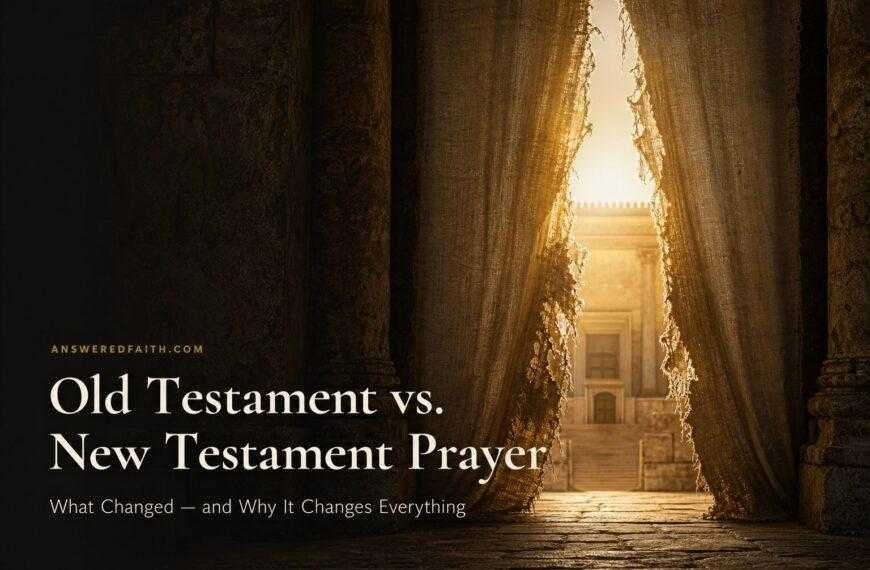
The Tabernacle and later the Temple were organized around a central truth: a holy God cannot be approached casually by sinful people. The architecture said so. There was the outer court, then the inner court, then the Holy Place, and finally — behind a thick curtain, the parokhet — the Holy of Holies. That innermost room, where the Ark of the Covenant rested, was so charged with the presence of God that only one man, the High Priest, could enter it. Only once a year. And only with blood.
“But into the second part the high priest went alone once a year, not without blood, which he offered for himself and for the people’s sins committed in ignorance.” — Hebrews 9:7 (NKJV)
The veil was not decoration. It was a theological statement: You cannot come here. The sin of humanity made intimate access to God impossible. Even the best, most faithful Old Testament believer lived with that veil standing between them and the full presence of God.
Old Testament prayer also tended to be shaped by location and schedule. The faithful in Israel largely prayed facing Jerusalem, at the Temple, at appointed hours. Prayer was woven into a system — a righteous and God-given system, but a system nonetheless. The sacrificial cycle continued because no single offering was enough. The Day of Atonement came every year because the sins of the previous year required fresh atonement. The veil remained in place. The way in was still, technically, closed.
This doesn’t diminish those prayers. The Psalms alone are enough to show that genuine intimacy was possible within that framework. But the framework itself was telling the whole story: something more was coming. Something better was needed. The sacrifices and rituals were, as Hebrews puts it, “a shadow of the good things to come” — not the reality itself, but the trailer before the main feature.
The Moment Everything Broke Open

Then Jesus died.
Matthew 27:51 records the detail that changed the world: at the moment of Christ’s death, “the veil of the temple was torn in two from top to bottom.” Not from bottom to top — as though a human hand had reached up to tear it. From top to bottom. Heaven initiated this. God Himself ripped that curtain in half, and with it, the entire system it represented.
The theological weight of this is almost too heavy to hold. That veil was, according to Josephus, about sixty feet high. It was thick enough to withstand ordinary human effort. When it tore, the Holy of Holies — the room where God’s manifest presence had dwelt — was suddenly, irreversibly, visibly open.
The writer of Hebrews spends chapters working through what this means. His conclusion is breathtaking:
“Therefore, brethren, having boldness to enter the Holiest by the blood of Jesus, by a new and living way which He consecrated for us, through the veil, that is, His flesh — and having a High Priest over the house of God, let us draw near with a true heart in full assurance of faith.” — Hebrews 10:19–22 (NKJV)
The veil was His flesh. When Christ’s body was torn on the cross, the curtain was torn in the temple. The connection is not incidental — it’s the entire point. The barrier between God and humanity was not merely moved aside temporarily. It was destroyed. Permanently. The way that once only a single priest could walk once a year is now open — to every believer, every day, at every hour.
That is the single most important thing to understand about New Testament prayer: the structural barriers are gone.
What Changed and Why It Matters

From Distance to Direct Access
The most fundamental shift is this: in the Old Testament, access to God was mediated through priests, sacrifices, and sacred spaces. In the New Testament, access is direct — through Christ alone, but through Christ means fully through, all the way in.
Jesus makes this explicit in John 14:6: “I am the way, the truth, and the life. No one comes to the Father except through Me.” But notice what He does not say. He does not say, “I am the checkpoint.” He says He is the way — and a way, by definition, is something you walk through to arrive somewhere. Jesus doesn’t point toward God. He brings us to God.
The New Testament word used for this access is parresia — often translated “boldness” or “confidence.” It carries the sense of speaking freely, openly, without holding back. It is the opposite of trembling before a distant deity hoping not to be struck down. It is a child speaking to a father. That access is not something we earn by spiritual performance; it is something Jesus won for us.
“Let us therefore come boldly to the throne of grace, that we may obtain mercy and find grace to help in time of need.” — Hebrews 4:16 (NKJV)
I have met many believers who treat prayer like they’re sneaking up to a courthouse with bad paperwork, hoping no one notices them. That is the theology of the old covenant — and even that’s a caricature of the old covenant, which had genuine intimacy for the faithful. How much more should we come boldly? We carry the righteousness of Christ. We come in His name. The door is open.
Praying in Jesus’ Name
One of the most distinctive marks of New Testament prayer is something Jesus introduced in John 14–16: praying in His name.
“And whatever you ask in My name, that I will do, that the Father may be glorified in the Son. If you ask anything in My name, I will do it.” — John 14:13–14 (NKJV)
Old Testament believers didn’t have this. They came before God in their own names, relying on covenant relationship and faith, but they could not pray in the name of Jesus because He had not yet come. The full weight of His redemptive work, His resurrection, His ascension, His present intercession — none of that was available to them.
Praying in Jesus’ name is not a magic formula tacked on to the end of a request. It means praying on the basis of His authority and merit — aligning ourselves with His character and purposes, and presenting our requests as those who stand before God in His righteousness rather than our own. It is the difference between writing a check with no funds in your account and writing a check from a trust fund established by someone who will never run dry.
The Old Testament saints prayed with great faith. But they did not have this. We do.
The Indwelling Holy Spirit
There is a third seismic shift that transforms New Testament prayer from the inside out: the permanent, indwelling presence of the Holy Spirit.
In the Old Testament, the Spirit of God came upon people — prophets, kings, craftsmen — for specific purposes and seasons. He could depart. Saul lost the Spirit. David pleaded, “Do not take Your Holy Spirit from me” (Psalm 51:11), and he meant it as a real possibility.
At Pentecost, that changed forever. The Spirit came to dwell inside believers. Not visiting. Not temporarily anointing. Living within.
This has everything to do with how we pray:
“Likewise the Spirit also helps in our weaknesses. For we do not know what we should pray for as we ought, but the Spirit Himself makes intercession for us with groanings which cannot be uttered.” — Romans 8:26 (NKJV)
The Spirit not only helps us pray — He prays through us when we don’t know what to say. He intercedes according to the will of God in ways that go beyond our language. Old Testament believers experienced the Spirit at work around them and sometimes through them; New Testament believers have the Spirit living in them as a permanent resident and prayer partner.
This is why Paul can tell believers to “pray without ceasing” (1 Thessalonians 5:17). In the Old Testament framework, that would have been structurally impossible — there were designated times, places, and forms. But with the Spirit resident within, prayer becomes something more like breathing than scheduling. It becomes a continuous, living dialogue with the God who is already closer to us than we are to ourselves.
From Law-Based to Grace-Based Prayer
There is also a subtle but important shift in the basis on which prayers are offered and answered.
Old Testament prayer was offered within a covenant framework — a framework that included both promises and obligations. God had bound Himself to bless obedience and discipline disobedience. This is why so many Old Testament prayers include extensive statements of God’s covenant faithfulness, reminders of His promises, and sometimes even appeals based on the honor of His name. The prayers of Moses, Daniel, and Nehemiah are masterclasses in this approach: they are essentially saying, “God, You made commitments. We are in trouble. Act for Your own glory.”
That approach was completely right and deeply faithful. But it operated within a system where the worshiper’s standing before God was always, at some level, connected to performance — the nation’s obedience or disobedience, the individual’s ritual purity, the regularity of sacrifices.
New Testament prayer operates on a different basis entirely. It is rooted in grace — in what Christ has already accomplished, not in what we are currently managing to do. Paul writes in Ephesians 3 that we have “boldness and access with confidence through faith in Him.” Not through our faithfulness. Not through our consistency in devotions. Through faith in Him.
This matters enormously on your worst days. When you have failed. When your prayer life has been inconsistent. When you feel unworthy to come before God. The New Testament answer is not “clean yourself up first.” It is “come as you are, through Christ.” The throne of grace is always open.
What Didn’t Change

It is worth pausing here to say clearly: not everything changed.
The God who answers prayer in the New Testament is the same God who answered Abraham, Moses, Hannah, and David. The need for faith did not change. The importance of humility and repentance did not change. The reality that God hears and responds to sincere prayer did not change. The Psalms remain the greatest prayer book ever written, and praying through Scripture is as powerful today as it was three thousand years ago.
What changed was not God’s willingness. What changed was the basis of access and the fullness of the relationship made available to us.
There is also tremendous continuity in the content of prayer. Old Testament believers prayed for forgiveness, guidance, provision, healing, and the purposes of God to advance in the world. New Testament believers pray for exactly the same things. The emotional range of prayer — grief, joy, lament, praise, confession, thanksgiving — is the same across both testaments. The Sermon on the Mount’s teaching on prayer (Matthew 6:5–15) builds on and fulfills Old Testament patterns rather than abolishing them.
The difference is not in the heart posture God desires. It is in the door through which we walk.
The Privileges We Neglect

Let me be direct with you about something pastoral: most of us live well below the New Testament standard for prayer — not because we pray too boldly, but because we don’t pray boldly enough.
I spent years in ministry watching people approach God with a kind of low-grade spiritual guilt, as though they were permitted in the building but not really welcome in the executive offices. They prayed carefully, hedging their requests, apologizing their way through confessions, always a little surprised if something actually happened. I did it myself.
But the New Testament consistently invites us into something more. “Ask, and you will receive, that your joy may be full” (John 16:24). “Draw near to God and He will draw near to you” (James 4:8). “Call to Me, and I will answer you, and show you great and mighty things, which you do not know” (Jeremiah 33:3 — yes, that’s Old Testament, and it applies to us with even greater force on this side of the cross).
The types of prayer available to us — adoration, confession, thanksgiving, supplication, intercession, spiritual warfare — are all available now without the elaborate ritual apparatus that once accompanied them. This doesn’t mean prayer is casual. Standing before a holy God should produce reverence. But reverence and boldness are not opposites. A child can come to their father both with deep respect and without fear of being turned away.
Praying With Everything Available to You

Here is what I want you to take away from this: you have privileges in prayer that Abraham would have wept to receive. You have access that Moses, for all his face-to-face encounters with God, did not have in the way you do. The veil is gone. The way is open. The Spirit lives inside you and intercedes when you don’t know what to say. You stand before the Father in the righteousness of Jesus Christ.
Don’t live like the veil is still up.
“Therefore we also, since we are surrounded by so great a cloud of witnesses, let us lay aside every weight, and the sin which so easily ensnares us, and let us run with endurance the race that is set before us, looking unto Jesus, the author and finisher of our faith.” — Hebrews 12:1–2 (NKJV)
The author of Hebrews, having just catalogued the great Old Testament men and women of faith in chapter 11, turns and says: they were looking forward to what you now have. They ran their race toward a promise. You live inside the fulfillment of it.
Pray accordingly.
A Simple Next Step
If this article has clarified something — or stirred something — here’s an invitation:
- Set aside ten minutes this week to re-read Hebrews 10:19–22 slowly and let it sink in.
- Ask the Holy Spirit to show you one area where you’ve been praying with “veil thinking” — approaching God with unnecessary distance, guilt, or formality.
- Spend time with one of the Psalms as a prayer template — letting David’s raw, honest engagement with God show you what access actually looks like.
- Consider building a prayer strategy that incorporates both the emotional honesty of Old Testament prayer and the bold, Spirit-led confidence of New Testament prayer.
- Bring someone else into the conversation — praying for others is one of the New Testament’s great gifts to the church.
You have more than you’ve been using. The door is open. Come in.
Duke Taber
Resources
- Understanding Prayer: Why and How We Should Pray — AnsweredFaith.com
- The Lord’s Prayer as a Model — AnsweredFaith.com
- The Meaning of the Torn Temple Veil — GotQuestions.org
- Prayer Shift in the New Testament — Heralds of Revival
- Why Jesus’ Body Is Called the Veil — ScottLaPierre.org
- The Curtain Torn in Two — The Gospel Coalition

Pastor Duke has been preaching and teaching the Bible since 1988. He has shared his knowledge online since 2011.

 By
By