


I’ll never forget the first time I attempted a fast. I thought it would be easy—just skip a few meals and pray more, right? By lunchtime, I was hangry, distracted, and wondering if God really cared whether I ate or not. But as I pressed through and discovered what Scripture actually teaches about fasting, everything changed. This Bible study about fasting transformed not just my understanding, but my entire spiritual walk.
Fasting isn’t about impressing God with our willpower or earning spiritual brownie points. It’s about creating space for God to work in our hearts in ways that nothing else can. When we set aside our physical appetites, we make room for spiritual hunger that only He can satisfy.
Key Takeaways
- Fasting is biblical: From Moses to Jesus, Scripture shows fasting as a normal part of spiritual life, not an extreme practice
- Purpose matters more than method: God looks at our hearts during a fast, not just our empty stomachs
- Fasting creates spiritual breakthrough: Combined with prayer, fasting opens doors that nothing else can
- It’s accessible to everyone: You don’t need to be a spiritual giant to fast—just willing and obedient
- Practical application is essential: Understanding biblical fasting helps us avoid legalism and embrace freedom

What the Bible Teaches About Fasting
The Biblical Foundation for Fasting
Fasting appears throughout Scripture as a consistent spiritual practice. It’s not a New Testament invention or an Old Testament relic—it’s woven into the fabric of how God’s people seek Him.
Moses fasted for forty days and nights when he received the Ten Commandments:
“So he was there with the Lord forty days and forty nights; he neither ate bread nor drank water. And He wrote on the tablets the words of the covenant, the Ten Commandments.” (Exodus 34:28, NKJV)
David fasted when seeking God’s mercy for his sick child:
“David therefore pleaded with God for the child, and David fasted and went in and lay all night on the ground.” (2 Samuel 12:16, NKJV)
Esther called for a corporate fast before approaching the king to save her people:
“Go, gather all the Jews who are present in Shushan, and fast for me; neither eat nor drink for three days, night or day. My maids and I will fast likewise.” (Esther 4:16, NKJV)
These weren’t isolated incidents. Fasting was the natural response when God’s people faced crisis, needed direction, or sought deeper intimacy with Him.
Jesus’s Teaching on Fasting
Notice that Jesus said “when you fast,” not “if you fast”:
“Moreover, when you fast, do not be like the hypocrites, with a sad countenance. For they disfigure their faces that they may appear to men to be fasting. Assuredly, I say to you, they have their reward. But you, when you fast, anoint your head and wash your face, so that you do not appear to men to be fasting, but to your Father who is in the secret place; and your Father who sees in secret will reward you openly.” (Matthew 6:16-18, NKJV)
Jesus assumed His followers would fast. His concern wasn’t whether they fasted, but how and why they did it. He warned against:
- Fasting for show – Making sure everyone knows you’re fasting
- Fasting for pride – Using it to feel spiritually superior
- Fasting without sincerity – Going through motions without heart engagement
Instead, Jesus taught that fasting should be:
- Private – Between you and God
- Genuine – From a sincere heart
- Rewarded – God sees and responds
Just as we explore deeper spiritual truths in studies like 1 Corinthians 13, understanding fasting requires looking beyond the surface to the heart of God’s intention.
Why Biblical Fasting Matters in Your Spiritual Life
Fasting Creates Spiritual Hunger
When we deny our physical appetites, something remarkable happens. Our spiritual appetite awakens. I’ve experienced this personally—when my stomach growls, it becomes a reminder to pray. Every hunger pang turns into a call to seek God.
Fasting shifts our focus from the temporary to the eternal. It reminds us that:
“Man shall not live by bread alone, but by every word that proceeds from the mouth of God.” (Matthew 4:4, NKJV)
Fasting Brings Breakthrough
Some spiritual battles require fasting. Jesus made this clear when His disciples couldn’t cast out a demon:
“However, this kind does not go out except by prayer and fasting.” (Matthew 17:21, NKJV)
There are situations where prayer alone isn’t enough. Fasting adds intensity and focus to our prayers. It demonstrates to God—and to ourselves—that we’re serious about seeking His intervention.
Fasting Humbles Us
When we fast, we acknowledge our complete dependence on God. We’re saying, “Lord, I need You more than I need food. You’re my sustenance.”
This humility opens doors. God resists the proud but gives grace to the humble (James 4:6). Fasting is a physical expression of spiritual humility.
Types of Biblical Fasting: A Practical Bible Study About Fasting
Not all fasts are the same. Scripture shows us different approaches, and understanding these helps us choose what’s right for our situation.
Normal Fast
A normal fast means abstaining from food but drinking water. This is the most common type of fast in Scripture.
Jesus fasted this way in the wilderness:
“And when He had fasted forty days and forty nights, afterward He was hungry.” (Matthew 4:2, NKJV)
Duration: Can range from one meal to multiple days
Purpose: Seeking God’s direction, breakthrough, or deeper intimacy
Practical tip: Start with shorter fasts (one day) before attempting longer ones
Partial Fast
A partial fast restricts certain foods rather than eliminating all food. Daniel practiced this:
“I ate no pleasant food, no meat or wine came into my mouth, nor did I anoint myself at all, till three whole weeks were fulfilled.” (Daniel 10:3, NKJV)
Earlier, Daniel chose only vegetables and water:
“Please test your servants for ten days, and let them give us vegetables to eat and water to drink.” (Daniel 1:12, NKJV)
Duration: Often longer periods (21 days is common, based on Daniel)
Purpose: Extended seasons of seeking God while maintaining strength
Practical tip: This works well for those with health conditions that prevent complete fasting
Absolute Fast
An absolute fast means no food or water. This is rare and should be short-term only (our bodies need water).
Esther called for this type of fast:
“Neither eat nor drink for three days, night or day.” (Esther 4:16, NKJV)
Paul fasted this way after his Damascus Road encounter:
“And he was three days without sight, and neither ate nor drank.” (Acts 9:9, NKJV)
Duration: Typically 1-3 days maximum
Purpose: Extreme crisis or seeking God in desperate situations
Warning: Don’t attempt this without medical clearance and spiritual guidance
Corporate Fast
Sometimes God calls groups to fast together. This creates powerful spiritual unity.
The church at Antioch fasted corporately:
“As they ministered to the Lord and fasted, the Holy Spirit said, ‘Now separate to Me Barnabas and Saul for the work to which I have called them.'” (Acts 13:2, NKJV)
Benefits of corporate fasting:
- Unified spiritual focus
- Increased spiritual power
- Shared accountability
- Community breakthrough
Similar to how the early church united in purpose as we see in 1 Corinthians chapter 1, corporate fasting brings believers together in powerful ways.
How to Prepare for Your Bible Study About Fasting

Spiritual Preparation
Don’t just jump into a fast. Prepare your heart first.
Examine your motives:
- Am I fasting to manipulate God?
- Am I fasting to impress others?
- Am I genuinely seeking God’s face?
Confess known sin:
“If I regard iniquity in my heart, the Lord will not hear.” (Psalm 66:18, NKJV)
Fasting doesn’t work if we’re harboring unconfessed sin. Come clean with God first.
Set clear intentions:
- What are you fasting for?
- What do you hope God will do?
- How long will you fast?
Write these down. It helps maintain focus when hunger kicks in.
Physical Preparation
Your body needs preparation too, especially for longer fasts.
Before the fast:
- Reduce caffeine intake gradually (avoid withdrawal headaches)
- Eat lighter meals the day before
- Increase water intake
- Get adequate rest
During the fast:
- Drink plenty of water (unless doing an absolute fast)
- Rest more than usual
- Avoid strenuous exercise
- Listen to your body
Breaking the fast:
- Start with light foods (fruits, broth)
- Eat small portions
- Gradually return to normal eating
- Don’t binge afterward
Mental Preparation
Fasting challenges our minds as much as our bodies.
Prepare for:
- Hunger pangs (they pass)
- Food thoughts (redirect to prayer)
- Irritability (ask God for grace)
- Weakness (it’s normal)
I remember my first three-day fast. Day two was brutal. Every commercial seemed to be about food. Every conversation somehow turned to restaurants. But I learned to use those moments as prayer triggers. Each time I thought about food, I prayed instead.
Practical Steps for Your Bible Study About Fasting
Step 1: Choose Your Fast Type
Based on what we’ve covered, decide which fast fits your situation:
- First-time faster? Start with a one-meal or one-day normal fast
- Seeking long-term breakthrough? Consider a 21-day partial fast
- Facing crisis? A 3-day normal fast might be appropriate
- Part of a church initiative? Join the corporate fast
Step 2: Set Your Schedule
Pick specific dates:
- Start date and time
- End date and time
- Daily prayer times during the fast
Block out distractions:
- Clear your calendar when possible
- Limit social obligations
- Create space for extended prayer
Step 3: Create a Prayer Plan
Don’t just skip meals and hope for the best. Have a plan for what you’ll do with the time you’d normally spend eating.
Prayer focus areas:
- Worship – Begin with praise and thanksgiving
- Confession – Come clean before God
- Intercession – Pray for others
- Petition – Bring your requests to God
- Listening – Wait quietly for God to speak
Scripture reading:
- Choose passages related to your fast’s purpose
- Meditate on God’s promises
- Journal what God reveals
Just as we dig deep into Scripture in studies like 1 Peter, use your fast to go deeper into God’s Word.
Step 4: Stay Accountable
Tell someone you trust about your fast. This isn’t about showing off—it’s about having support.
Benefits of accountability:
- Someone to pray with you
- Encouragement when it gets hard
- Wisdom if you face challenges
- Celebration when you complete it
Step 5: Journal Your Journey
Keep a fasting journal. Record:
- Daily experiences – How you feel physically and spiritually
- God’s revelations – What He’s showing you
- Prayers – What you’re asking for
- Answers – How God responds
Looking back on these journals years later is incredibly encouraging. You’ll see patterns of God’s faithfulness.
Common Mistakes to Avoid in Your Bible Study About Fasting
Mistake #1: Fasting to Earn God’s Favor
God already loves you completely. Fasting doesn’t make Him love you more. It positions you to receive what He already wants to give.
“For by grace you have been saved through faith, and that not of yourselves; it is the gift of God, not of works, lest anyone should boast.” (Ephesians 2:8-9, NKJV)
Mistake #2: Broadcasting Your Fast
Remember Jesus’s words—don’t fast to be seen by others. The moment you start telling everyone about your fast, you’ve lost the spiritual benefit.
Exception: Corporate fasts or when someone needs to know for practical reasons (like declining a dinner invitation graciously).
Mistake #3: Neglecting Wisdom
Fasting isn’t for everyone in every situation:
- Pregnant or nursing mothers – Don’t fast
- People with diabetes or other medical conditions – Consult your doctor first
- Children – Not appropriate for young children
- Those recovering from eating disorders – Seek pastoral counsel first
God gave us wisdom for a reason. Use it.
Mistake #4: Fasting Without Prayer
Fasting without prayer is just dieting. The power isn’t in the empty stomach—it’s in seeking God with your whole heart.
“So we fasted and entreated our God for this, and He answered our prayer.” (Ezra 8:23, NKJV)
Notice the combination: fasting AND prayer.
Mistake #5: Giving Up Too Soon
The first day is often the hardest. Your body protests. Your mind rebels. But breakthrough often comes when you push through.
I’ve seen people quit fasts on day two, only to miss what God had planned for day three. Unless there’s a genuine health concern, finish what you started.
Biblical Examples to Inspire Your Bible Study About Fasting

Moses: Fasting for God’s Presence
Moses fasted forty days—twice—to receive God’s law and restore relationship with Him after Israel’s sin.
What we learn:
- Fasting prepares us to receive from God
- God’s presence is worth any sacrifice
- Extended fasts can bring extraordinary revelation
Esther: Fasting for Deliverance
Facing genocide, Esther called for a three-day absolute fast before approaching the king.
What we learn:
- Corporate fasting multiplies power
- Desperate situations call for desperate measures
- God responds to unified, humble seeking
Daniel: Fasting for Understanding
Daniel fasted for three weeks seeking understanding of a vision.
What we learn:
- Partial fasts work for extended periods
- Fasting breaks through spiritual opposition
- Persistence in fasting brings breakthrough
Jesus: Fasting for Preparation
Before beginning His ministry, Jesus fasted forty days in the wilderness.
What we learn:
- Fasting prepares us for spiritual warfare
- God’s Word sustains us more than food
- Victory comes through dependence on God
The spiritual principles we see in 1 Timothy about godly discipline apply directly to fasting—it’s training for spiritual strength.
The Early Church: Fasting for Direction
The church at Antioch fasted when seeking God’s direction for missions.
What we learn:
- Fasting clarifies God’s voice
- Major decisions deserve fasting and prayer
- The Holy Spirit speaks clearly to those who seek Him
What to Expect During Your Fast
Physical Effects
Days 1-2:
- Hunger pangs (they come in waves)
- Headaches (especially if you’re caffeine-dependent)
- Irritability
- Food thoughts
Days 3-5:
- Hunger often decreases
- Increased mental clarity
- Possible weakness
- Bad breath (totally normal)
Days 6+:
- Body adjusts to fasting state
- Spiritual sensitivity increases
- Energy may stabilize
- Deeper prayer experiences
Spiritual Effects
Increased awareness of God’s presence: When physical distractions decrease, spiritual sensitivity increases.
Clearer discernment: Many people report hearing God’s voice more clearly during fasts.
Breakthrough in prayer: Persistent issues often resolve during extended fasting and prayer.
Spiritual warfare: Don’t be surprised if you face increased spiritual opposition. The enemy doesn’t want you seeking God this intensely.
Emotional Effects
Fasting can bring emotions to the surface. You might experience:
- Unexpected tears – God’s touching deep places
- Frustration – Old issues resurfacing
- Joy – Breakthrough moments
- Peace – God’s presence overwhelming you
Don’t be alarmed by emotional responses. God often uses fasting to heal deep wounds.
How to Break Your Fast Properly
Breaking a fast correctly is crucial. Don’t undo the spiritual and physical benefits by binging afterward.
For Short Fasts (1-3 days)
First meal:
- Fresh fruit or vegetable broth
- Small portions
- Eat slowly
Second meal:
- Light proteins (fish, chicken)
- Steamed vegetables
- Still moderate portions
Return to normal:
- Gradually over 24 hours
- Avoid heavy, greasy foods initially
For Extended Fasts (7+ days)
Take it slower:
- Day 1: Fruit and vegetable juices only
- Day 2: Add raw fruits and vegetables
- Day 3: Add cooked vegetables and light proteins
- Day 4+: Gradually return to normal diet
Your digestive system needs time to restart. Rushing this can cause serious discomfort or illness.
Spiritual Conclusion
Don’t just end abruptly. Close your fast with:
- Thanksgiving – Thank God for what He’s done
- Reflection – Review what you’ve learned
- Commitment – How will you apply what God showed you?
- Celebration – Acknowledge the spiritual victory
Incorporating Fasting Into Regular Spiritual Practice
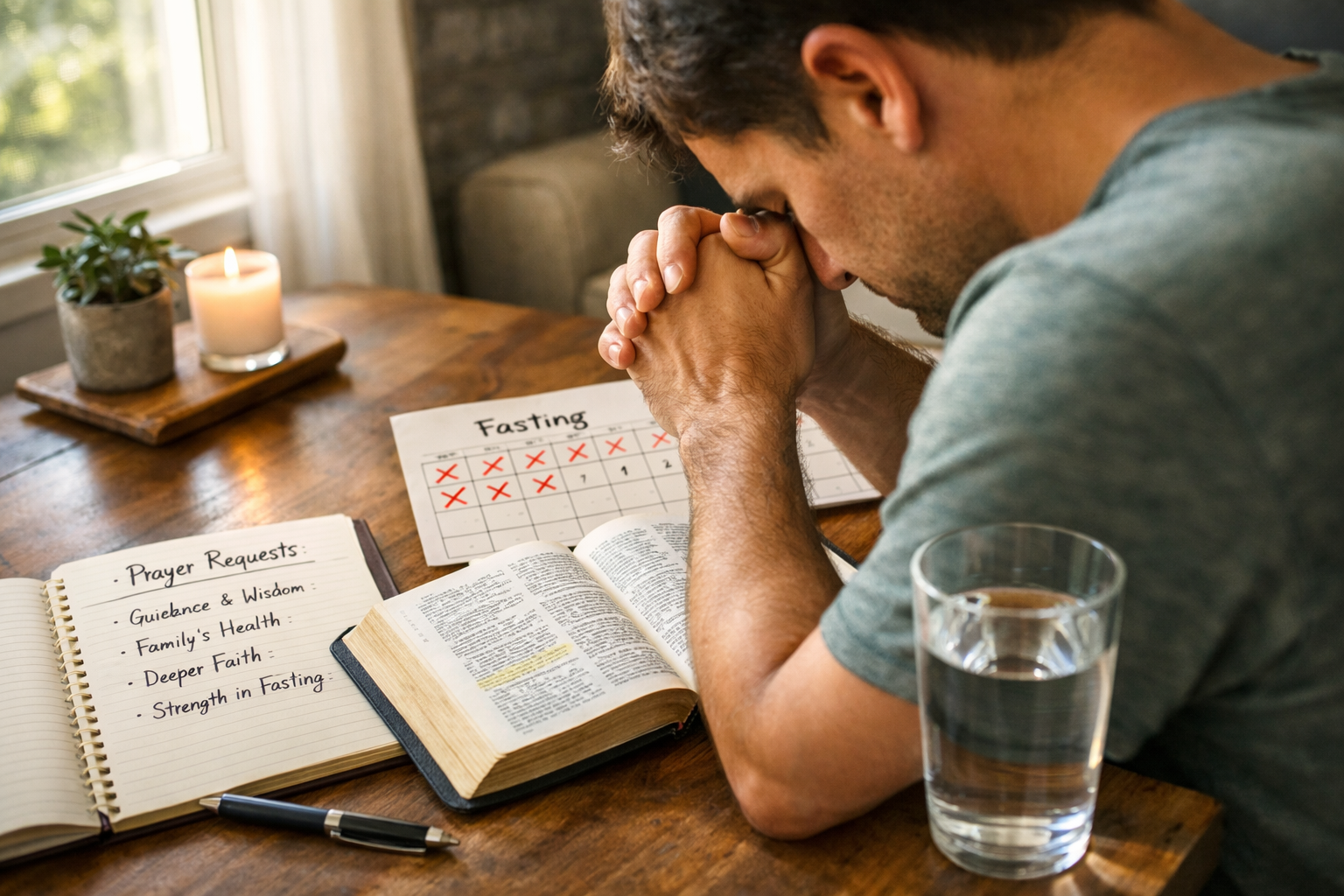
Fasting doesn’t have to be a once-in-a-lifetime event. Many believers incorporate regular fasting into their spiritual rhythm.
Weekly Fasting
Some Christians fast one day per week (often Wednesdays or Fridays, following early church tradition).
Benefits:
- Builds spiritual discipline
- Creates regular time for focused prayer
- Maintains spiritual sensitivity
Monthly Fasting
Others fast the first few days of each month or one weekend monthly.
Benefits:
- Starts each month seeking God’s direction
- Less demanding than weekly fasting
- Still maintains regular practice
Seasonal Fasting
Many believers fast during specific seasons:
- Lent – 40 days before Easter
- New Year – Starting the year with God
- Before major decisions – Seeking specific guidance
- During crisis – Responding to urgent needs
The key is finding a rhythm that works for you. As we see throughout Scripture, including passages like 2 Timothy, spiritual discipline should be sustainable, not sporadic.
Fasting and Prayer: The Powerful Combination
Fasting without prayer is just hunger. Prayer without fasting can lack intensity. Together, they create spiritual breakthrough.
How to Maximize Prayer During Your Fast
Use meal times for prayer:
- When you’d normally eat breakfast, pray instead
- Lunch break becomes prayer break
- Dinner time becomes extended worship time
Pray Scripture:
- Find promises related to your fast’s purpose
- Declare them back to God
- Stand on His Word
Listen more than you talk:
- Fasting quiets our spirits
- We hear God better when we’re not distracted
- Wait in His presence
Intercede for others:
- Don’t make it all about you
- Pray for your church, community, nation
- Stand in the gap for those who can’t fast
Prayer Focus Ideas
Depending on your fast’s purpose, focus your prayers on:
Personal breakthrough:
- Freedom from addiction or sin patterns
- Healing (physical, emotional, spiritual)
- Financial provision
- Relationship restoration
Spiritual growth:
- Deeper intimacy with God
- Increased faith
- Greater discernment
- Spiritual gifts activation
Direction and guidance:
- Career decisions
- Relationship decisions
- Ministry direction
- Major life changes
Others’ needs:
- Salvation of loved ones
- Healing for the sick
- Revival in the church
- National and global issues
Conclusion: Taking Your Next Steps in Biblical Fasting
This Bible study about fasting has covered a lot of ground, but knowledge without application changes nothing. Here’s how to move forward:
Your Action Plan
Step 1: Start Small
If you’ve never fasted before, don’t attempt a 40-day fast. Start with one meal or one day. Build from there.
Step 2: Set a Date
Right now, pull out your calendar and schedule your first fast. Putting it on the calendar makes it real.
Step 3: Prepare Your Heart
Spend time in prayer asking God what He wants to accomplish through your fast. Listen for His direction.
Step 4: Find Support
Share your plans with a trusted friend, mentor, or small group leader. Ask them to pray for you.
Step 5: Commit to Complete It
Make a commitment before God to finish what you start (unless health issues arise). Don’t quit when it gets uncomfortable.
Final Encouragement
Fasting isn’t about perfection—it’s about seeking God with your whole heart. You might get hungry. You might struggle. You might feel like you’re not doing it “right.” That’s okay.
God sees your heart. He honors your sacrifice. He responds to your seeking.
“And you will seek Me and find Me, when you search for Me with all your heart.” (Jeremiah 29:13, NKJV)
I’ve seen God do incredible things through fasting. Marriages restored. Addictions broken. Prodigals returned home. Ministries launched. Lives transformed.
But more than any specific answer to prayer, fasting has drawn me closer to God. It’s taught me that He truly is enough. That His presence satisfies more than any meal ever could. That seeking Him is worth every sacrifice.
As you explore resources at Answered Faith, you’ll find more tools to deepen your walk with God. But nothing replaces the personal encounter that comes through fasting and prayer.
Your next fast could change everything. Not because of the fasting itself, but because of the God you’ll encounter when you seek Him with your whole heart.
Are you ready to take that step?
References
[1] Biblical references taken from the New King James Version (NKJV)
[2] Historical fasting practices referenced from early church writings and biblical commentary
Share On Pinterest


Pastor Duke has been preaching and teaching the Bible since 1988. He has shared his knowledge online since 2011.


 By
By


