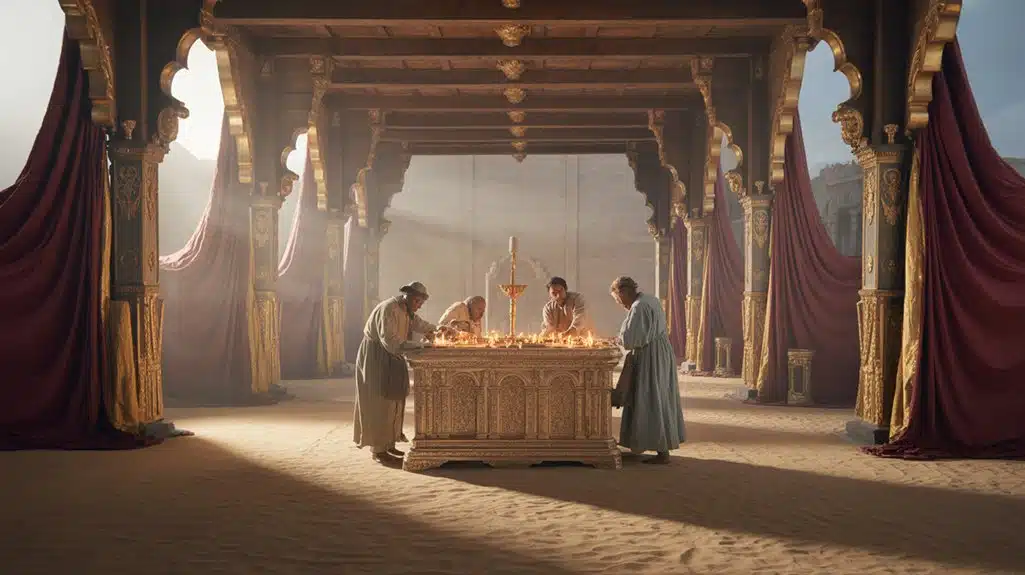

You’ve probably never thought about how a construction project could reveal God’s character, but Exodus 38 does exactly that. Every bronze socket, linen curtain, and ounce of donated metal tells a story about approaching a holy God—and it’s far more relevant to your daily life than you might expect. These ancient building details aren’t just historical records; they’re showing you something profound about worship, community, and how grace makes sacred encounters possible.
Key Takeaways
- The bronze altar of burnt offering and bronze basin for washing were constructed as the first sacred objects encountered in the tabernacle courtyard.
- The courtyard was enclosed by fine linen curtains spanning 100 by 50 cubits, supported by sixty bronze pillars with silver hooks.
- Detailed inventory recorded materials used: approximately 2,193 pounds of gold, 7,544 pounds of silver, and 5,310 pounds of bronze.
- Silver collected from census half-shekels was crafted into 100 bases, hooks, and bands, symbolizing each redeemed life among God’s people.
- Bezalel and Oholiab, filled with God’s Spirit, led the craftsmanship with divinely granted wisdom, skill, and ability to teach others.
The Bronze Altar of Burnt Offering

As the tabernacle’s construction nears completion, Bezalel turns his attention to crafting the bronze altar—the first sacred object worshipers would encounter when entering God’s dwelling place.
This wasn’t just functional furniture. The bronze altar significance runs deep—it’s where heaven and earth met through sacrifice. Standing seven and a half feet square and four and a half feet high, it dominated the courtyard.
You’d smell the smoke, hear the crackling fire, and witness blood poured out for sin’s covering. The sacrificial practices conducted here pointed forward to Christ’s ultimate sacrifice. Every morning and evening, offerings ascended as fragrant worship.
When you approach God today, you’re coming through a better sacrifice—Jesus himself. He’s your altar, your offering, and your priest rolled into one.
The bronze altar reminds you: access to God has always required sacrifice, but now that sacrifice is complete.
The Bronze Basin for Washing

Between the altar and the tent of meeting stood another crucial piece of bronze furniture—the basin where priests washed before serving God. This bronze basin served a fundamental purpose in ritual cleansing, ensuring priests approached worship with clean hands and feet.
What’s remarkable is that this basin was crafted from the bronze mirrors of serving women who gathered at the tabernacle entrance. They sacrificed personal items for God’s purposes, demonstrating true devotion.
You’ll notice the emphasis on cleansing before service. It wasn’t about earning God’s favor but about reverence and preparation. The priests couldn’t approach holy things casually or carelessly.
Today, you’re called to similar preparation—not through ritual cleansing but through confession and heart examination. Before serving God or gathering with believers, take time to address sin and approach Him with humility.
Clean hands and a pure heart still matter in your worship and service.
The Courtyard Enclosure and Its Dimensions

The tabernacle furniture sat within a precisely measured courtyard that defined sacred space.
You’ll find the courtyard dimensions were intentionally specific: 100 cubits long and 50 cubits wide, creating a rectangular boundary around God’s dwelling place. This wasn’t arbitrary—the measurements established clear parameters for approaching the holy.
The enclosure materials consisted of fine linen curtains suspended from bronze posts and silver hooks.
These hangings stood as a visible reminder that you couldn’t casually wander into God’s presence. The courtyard created a passage zone between the ordinary world and the sacred.
Here’s what matters for you: God doesn’t blur boundaries, but He does provide access.
The courtyard wasn’t designed to keep you permanently out—it was structured to guide you in properly. Through Christ, you’re now invited beyond even these carefully measured spaces.
The dimensions that once defined separation now point you toward the limitless access you have through grace.
The Pillars, Hangings, and Gate of the Court

Sixty pillars formed the structural backbone of the courtyard, standing as bronze sentinels that held the boundary curtains in place. These posts, positioned every five cubits, created rhythm around the perimeter while supporting the fine linen hangings that defined sacred space.
| Element | Material | Purpose |
|---|---|---|
| Pillars | Bronze bases | Structural support |
| Hangings | Fine linen | Visual boundary |
| Gate | Embroidered fabric | Controlled access |
The court dimensions reveal God’s intentional design—100 cubits long, 50 cubits wide. You’ll notice the eastern gate design stood twenty cubits wide, adorned with blue, purple, and scarlet embroidery. This entrance wasn’t merely functional; it welcomed worshipers while maintaining holiness.
These specifications weren’t arbitrary. They demonstrate how God invites you into His presence through designated means. The accessible yet dignified entrance reflects His character—approachable yet holy, welcoming yet worthy of reverence.
Inventory of Materials: Gold, Silver, and Bronze

You’ll find Moses providing a detailed accounting of every ounce of precious metal used in constructing the tabernacle—gold from voluntary offerings, silver from the census tax, and bronze from donated items.
This inventory wasn’t about bureaucratic paperwork; it demonstrated faithful stewardship of what God’s people generously gave for His dwelling place.
When you handle resources entrusted to you for God’s work, you’re following this same pattern of transparency and careful management that honors both the givers and the Lord.
Quantities of Each Metal
After completing the physical construction, Moses received a detailed accounting of every precious metal used in the Tabernacle’s creation.
You’ll find that the metal usage was staggering: 29 talents and 730 shekels of gold (approximately 2,193 pounds), 100 talents and 1,775 shekels of silver (about 7,544 pounds), and 70 talents and 2,400 shekels of bronze (roughly 5,310 pounds).
This meticulous record-keeping reveals God’s concern for transparency and stewardship. The silver came from the census tax, with each Israelite contributing a half-shekel.
These quantities supported various crafting techniques throughout the sanctuary—from the intricate goldwork on the ark’s mercy seat to the sturdy bronze bases supporting the courtyard.
God’s grace meets your practical needs through careful planning and generous giving.
Sources of the Materials
The massive quantities of precious metals didn’t appear out of nowhere—they came directly from the Israelites’ own treasuries.
Understanding these material origins reveals something profound about worship: it requires personal investment.
You’ll notice the gold came from freewill offerings—people willingly giving their valuables for God’s dwelling place. The silver originated from the census tax, with each man contributing equally regardless of wealth.
Bronze came from donated mirrors and various offerings. These artisan contributions weren’t just about metal and craftsmanship; they represented hearts surrendered to God’s purposes.
When you give sacrificially today, you’re following this ancient pattern of worship. Your contributions, whatever they are, become part of something eternally significant when offered with genuine devotion.
The Sacred Census Tax and Silver Contributions

You’ll find that every Israelite man aged twenty and above contributed exactly half a shekel of silver—a sacred census tax that guaranteed everyone participated equally in God’s work, regardless of wealth or status.
This silver wasn’t just metal; it became the foundation for the tabernacle’s socket system, literally supporting the place where God would meet His people.
When you give to God’s purposes today, you’re following this ancient pattern where your contribution—no matter the size—plays an essential role in supporting His kingdom work.
Census Tax: Half Shekel
Every Israelite man aged twenty and older contributed exactly half a shekel toward the construction of the tabernacle—no more for the wealthy, no less for the poor.
This equal offering reveals the census significance: before God, you’re valued not by your wealth or status but by your identity as His redeemed child. The half shekel represented atonement money, acknowledging that God owns everything and you’re dependent on His grace.
You’ll notice this wasn’t a voluntary donation but a commanded contribution. It reminds you that worship involves tangible sacrifice, not just good intentions.
The uniformity of the gift teaches you that God’s community functions when everyone participates equally. Your worth isn’t measured by what you give—it’s already established through God’s redemptive love for you.
Silver’s Sacred Purpose
Over 100 talents of silver—more than 3¾ tons—came from those census half-shekels, and Bezalel didn’t let a single ounce go to waste. He transformed this massive collection into 100 bases anchoring the tabernacle’s framework, plus hooks and bands for the pillars.
The silver symbolism here runs deep—each contribution represented a redeemed life counted among God’s people.
What’s striking is how these sacred offerings became the foundation’s literal building blocks. Your half-shekel, identical to everyone else’s, merged with others to create something far greater than individual parts.
This wasn’t about wealth or status; it was about belonging. Every person mattered equally in God’s dwelling place, and their combined contributions held up the structure where heaven met earth.
Bezalel and Oholiab: The Master Craftsmen

When God calls someone to a task, He equips them with the skills they need to accomplish it. Bezalel and Oholiab exemplify this truth perfectly. God didn’t just assign them work—He filled them with His Spirit, giving them extraordinary craftsmanship skills and artistic vision to build the tabernacle exactly as He designed it.
You’ll notice God’s grace in how He prepared these craftsmen:
- He gave them wisdom and understanding for complex metalwork, weaving, and engraving.
- He provided them with ability to teach others, multiplying their impact.
- He matched their natural talents with divine inspiration for sacred work.
Their story reminds you that God doesn’t call the equipped—He equips the called. When you’re facing a task that seems beyond your abilities, remember Bezalel and Oholiab.
God’s assignments come with His enabling. He’ll provide the skills, insight, and resources you need to fulfill what He’s asked of you.
Frequently Asked Questions
Why Did God Require Such Specific Measurements for the Tabernacle Furnishings?
God’s divine instructions with precise measurements guaranteed the tabernacle’s symbolic significance pointed directly to His holiness and perfection. You’ll discover these details weren’t arbitrary—they revealed His character and taught Israel how to approach Him reverently with intentionality.
How Long Did It Take to Construct All the Items in Exodus 38?
Ironically, Exodus 38 doesn’t specify the construction timeline for item assembly—you’d think such detailed measurements would include that! Scholars estimate the tabernacle’s completion took several months, though Scripture emphasizes obedience over speed in God’s work.
What Happened to the Tabernacle Items After the Temple Was Built?
You’ll find the tabernacle legacy continued as many items shifted into Solomon’s temple. The Ark of the Covenant was placed inside, while other furnishings were preserved, demonstrating God’s faithfulness through the temple shift and His continuous presence with His people.
Why Was Bronze Chosen for the Altar Instead of Gold?
Bronze wasn’t the “lesser choice”—it perfectly symbolized judgment and endurance. You’ll find the altar’s significance in its durability for daily sacrifices. Bronze withstood fire’s intensity, practically demonstrating God’s provision for your atonement through persistent, grace-filled worship.
How Did the Israelites Obtain so Much Precious Metal in the Wilderness?
You’ll find the answer in Exodus 12:35-36—the Israelites received golden jewelry and precious items as Egyptian plunder when they left Egypt. God guaranteed they’d have everything needed for building His tabernacle before entering the wilderness.
Final Thoughts
You’ve witnessed something breathtaking—a million details coming together to create space for God’s presence among His people. Every bronze basin, every linen curtain, every ounce of silver reminds you that approaching God requires preparation, yet He’s provided everything you need. Through Christ, you’re no longer building altars; you’re becoming His temple. Let this truth transform how you steward your gifts, knowing God equips you for every good work He’s prepared.
Share On Pinterest


Test Your Knowledge!
Answer all 10 questions, then submit to see your score.
Related Posts

Faith vs. Works: What Does the Bible Teach?
Last updated: May 2026 Faith vs. works — does the Bible contradict itself? Discover what Paul, James, and the whole of Scripture actually teach about how faith and works relate in the Christian life.
 May 18, 2026
The Hebrews 11 'Hall of Faith' — A Deep Dive
Last updated: May 2026 Explore Hebrews 11's hall of faith and discover how biblical heroes like Abel, Noah, and Abraham trusted God against impossible odds. Read our deep dive analysis.
May 15, 2026
Ella Langley Goes Viral with Passionate Christian Faith Comments
Last updated: June 2026 In an era where celebrity endorsements of faith can be rare, country singer Ella Langley has captured significant attention, going viral for…
Jun 11, 2026
The 9 Fruit of the Spirit Explained
Last updated: June 2026 By Duke Taber Most of us first met the fruit of the Spirit on a Sunday school poster. Nine words arranged in…
Jun 11, 2026


 By
By


