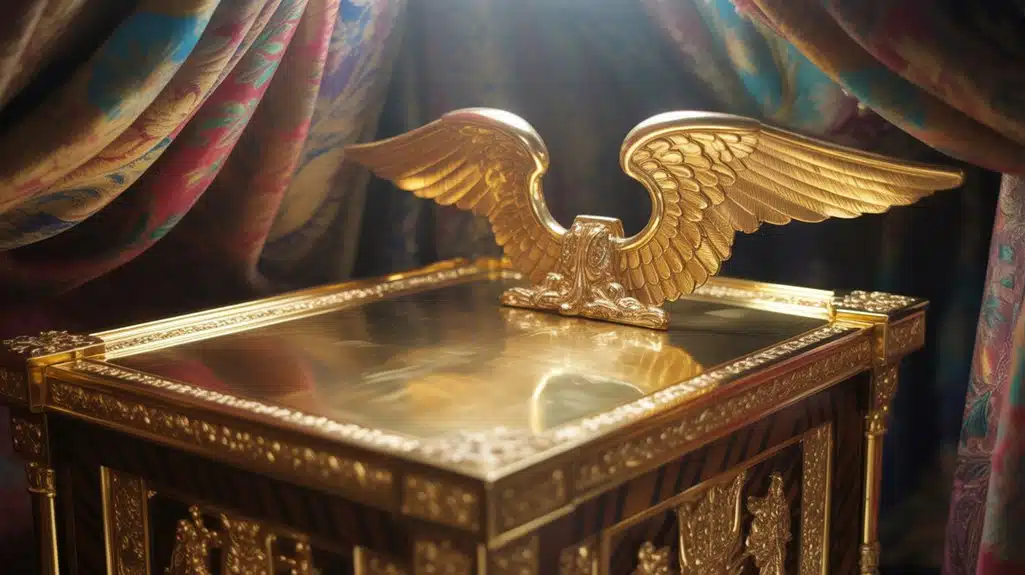

You’ll notice the phrase “as the LORD commanded Moses” appears five times in Exodus 37—a striking repetition that reveals something essential about how God works through human hands. When Bezalel crafted the Ark, the Table, and the Lampstand, he wasn’t expressing artistic freedom; he was embodying exact obedience. This chapter shows you what happens when skilled craftsmanship meets divine instruction, and why the details of your faithfulness matter more than you might think.
Key Takeaways
- Bezalel constructs the Ark of the Covenant from acacia wood overlaid with gold, housing the Ten Commandments tablets.
- The mercy seat features two gold cherubim facing each other, symbolizing God’s presence and redemptive atonement for sin.
- The Table of Showbread, Golden Lampstand, and Altar of Incense are crafted with gold, representing provision, illumination, and prayer.
- Bezalel, filled with God’s Spirit, demonstrates excellence in craftsmanship by following precise divine specifications for sacred furnishings.
- Repeated obedience to God’s commands emphasizes faithful adherence to divine instructions without personal adaptation or negotiation.
The Ark of the Covenant: Crafted in Gold and Acacia Wood

Bezalel begins the sacred work by constructing the Ark of the Covenant, the most holy object in Israel’s worship. You’ll notice he follows God’s specifications exactly, using acacia wood overlaid with pure gold inside and out. This chest measures approximately 3.75 feet long and 2.25 feet wide and high.
The ark’s significance goes beyond its beautiful craftsmanship. It’s designed to house the tablets of the Ten Commandments, making it the throne of God’s law. The gold overlay represents God’s glory and purity, while the durable acacia wood symbolizes the lasting nature of His covenant with you.
Bezalel fashions a gold molding around the rim and creates four gold rings to hold carrying poles. He hammers out the mercy seat from pure gold, complete with two cherubim facing each other.
This lid becomes the meeting place for the divine presence, where God promises to commune with His people.
The Mercy Seat and Cherubim: God’s Throne of Grace

You’ll notice the mercy seat was crafted from pure gold—a deliberate choice that points to God’s divine glory and holiness covering the place where sin is atoned.
The cherubim weren’t just decorative; their wings stretched forward and their faces looked down toward the mercy seat, as if they’re perpetually gazing at the site of God’s redemptive work.
This watchful posture reminds you that even the angels long to understand the mystery of God’s grace extended to humanity.
Symbolic Meaning of Gold
Gold’s abundance throughout the mercy seat reveals something stunning about God’s character—He doesn’t approach you with bargain-bin materials when it comes to redemption.
The gold symbolism here speaks to divine purity and incorruptibility. Unlike silver or bronze that tarnish, gold maintains its brilliance, reflecting God’s unchanging holiness and the eternal nature of His mercy.
When you consider that the place where blood would be sprinkled for your atonement was crafted from pure gold, you’re seeing God’s declaration that your redemption isn’t cheap or temporary.
He values you enough to meet you at a throne fashioned from the most precious material available. The gold doesn’t make God’s mercy more effective—it reveals how precious that mercy already is to Him.
Cherubim’s Watchful Posture
The cherubim didn’t simply decorate the mercy seat—they bent low over it, their wings stretched forward and their faces turned downward toward the place of atonement.
This posture reveals profound cherubim symbolism. These watchful guardians weren’t looking away or standing at attention—they gazed intently at where blood would be sprinkled on the Day of Atonement.
Their watchful stance reminds you that heaven itself observes God’s mercy meeting His justice. Where you might expect judgment, you find grace.
The cherubim’s lowered gaze teaches you to approach God’s presence with reverence and wonder. They model the posture you’re called to maintain—attentive, humble, and focused on God’s provision for sin.
You’re invited to join them in marveling at divine mercy.
Bezalel’s Spirit-Filled Craftsmanship and Divine Calling

You’ll notice something remarkable about Bezalel—he didn’t just have natural talent; God filled him with His Spirit specifically for this sacred work.
This wasn’t about human ability alone; the Lord handpicked and supernaturally equipped him to craft the tabernacle furnishings with excellence.
When God calls you to a task, He doesn’t leave you to figure it out on your own—He empowers you with what you need to fulfill His assignment.
Spirit-Empowered Artistic Ability
Creativity becomes sacred when God’s Spirit fills the artist. You’ll notice that Bezalel’s craftsmanship wasn’t merely natural talent—it was Spirit-empowered ability. God specifically filled him with His Spirit to create the tabernacle furnishings, demonstrating that spiritual creativity flows from divine empowerment, not just human skill.
This transforms how you view artistic expression. When God calls you to create, He equips you supernaturally. Your abilities aren’t accidents; they’re gifts meant for Kingdom purposes.
Bezalel’s work shows that God cares deeply about beauty and excellence in worship.
You’re invited to offer your creative gifts back to God. Whether you’re building, designing, or crafting, the Spirit can work through you. Surrender your talents to Him, and watch how He multiplies them for His glory.
God’s Specific Assignment
God doesn’t just give general gifts—He assigns specific tasks. Bezalel received divine instructions to build exactly what God envisioned for the tabernacle.
You’ll notice he didn’t freelance or improvise—he followed the pattern shown to Moses on the mountain. This reveals something crucial: your abilities aren’t random; they’re connected to a sacred purpose.
Consider how God works through you:
- Your talents match His assignments for kingdom work
- Obedience to divine instructions reveals your fullest potential
- Detailed work matters when you’re building something for God’s glory
When you embrace God’s specific calling, you’re not just working—you’re partnering with Him.
Bezalel’s craftsmanship wasn’t about personal expression; it was about faithful execution of heaven’s blueprint.
What’s your assigned task today?
Excellence Through Divine Enablement
Empowerment from heaven transforms ordinary skill into extraordinary worship. Bezalel didn’t rely solely on natural talent—God’s Spirit filled him with wisdom, understanding, and knowledge (Exodus 31:3). This divine empowerment elevated his craftsmanship beyond human capability, producing artistic excellence that honored God’s dwelling place.
You’ll notice how God equips those He calls:
| Human Element | Divine Addition | Result |
|---|---|---|
| Natural skill | Spirit’s wisdom | Sacred artistry |
| Technical ability | Supernatural insight | Perfect execution |
| Creative talent | God’s presence | Worshipful beauty |
| Learned craft | Divine enabling | Excellence beyond measure |
| Personal effort | Heavenly anointing | Lasting significance |
When God assigns you tasks, He provides the divine empowerment you need. Your abilities, surrendered to Him, become instruments of His glory.
The Table of Showbread: A Place for Sacred Bread

Bezalel’s skilled hands next fashioned the table of showbread, following the divine blueprint with the same meticulous care he’d shown in crafting the ark. This wasn’t just furniture—it was where sacred bread would rest continually before God’s presence, symbolizing His faithful provision for His people.
You’ll notice the table’s construction reveals profound spiritual truths:
- Pure gold overlay reminded Israel that God’s divine provision comes from His perfect character, not their merit.
- Border and molding kept the sacred bread secure, showing how God protects what He provides.
- Poles for carrying emphasized that God’s provision travels with His people wherever they go.
When you consider this table, you’re witnessing more than ancient craftsmanship. You’re seeing God’s commitment to sustain you.
Just as He provided bread for Israel’s priests weekly, He promises to meet your needs. The showbread declared then—and declares now—that God faithfully nourishes those who draw near to Him.
The Golden Lampstand: Light in the Holy Place

The lampstand emerged from Bezalel’s workshop as perhaps the most artistically complex piece in the entire tabernacle—a single talent of pure gold hammered into a central shaft with six branches, each adorned with almond blossoms, buds, and flowers.
This wasn’t merely decorative art; it provided sacred illumination for the priests ministering before God’s presence.
You’ll notice the golden symbolism here points directly to Christ, who declared Himself “the light of the world.” Just as this lampstand required constant tending to keep its flames burning, you’re called to maintain your spiritual light through consistent communion with God.
The almond design reminds you of Aaron’s budded rod—a symbol of resurrection life.
Consider how this lampstand stood opposite the showbread table, creating a complete picture: you need both God’s word (bread) and His illuminating Spirit (light) to walk faithfully.
Without sacred illumination, you’ll stumble in darkness, unable to discern His path forward.
The Altar of Incense: Rising Prayers Before God

You’ll notice the altar of incense was crafted entirely from acacia wood overlaid with pure gold, featuring horns on its corners and a crown molding around its top—a design that emphasized both its holiness and its role as a meeting point between earth and heaven.
The priests burned fragrant incense on this altar every morning and evening, creating a continuous aromatic offering that rose before God’s presence in the Most Holy Place.
This daily ritual wasn’t just about pleasant smells; it powerfully symbolized your prayers ascending to God, reminding you that your communion with Him through prayer is as precious and pleasing to Him as that sweet-smelling incense.
Gold Construction and Design
Standing three feet tall with eighteen-inch sides, this golden altar served a purpose far different from its bronze counterpart outside. The gold symbolism here speaks volumes about what God values. While bronze represented judgment, gold pointed to divine craftsmanship and God’s very presence.
You’ll notice the divine craftsmanship in every detail:
- Pure gold overlay covering the acacia wood frame
- Intricate molding encircling the altar’s top edge
- Golden rings attached for transporting God’s presence
This wasn’t mere decoration. The gold construction reminded Israel that their prayers ascended to a holy God who dwelt among them.
When you pray today, you’re approaching that same golden throne. Your intercessions matter because they rise before the God who designed this very altar to receive them.
Priest’s Daily Incense Ritual
Twice daily, Aaron entered the Holy Place to burn fragrant incense on this golden altar—once at dawn when he tended the lamps, and again at twilight.
This consistent rhythm established a perpetual offering before God’s presence, demonstrating that worship isn’t occasional but continuous.
The incense significance points directly to your prayers rising before God’s throne. Just as the fragrant smoke ascended heavenward, your petitions reach Him constantly.
The ritual symbolism teaches you that approaching God requires intentionality and reverence—Aaron couldn’t enter casually or carelessly.
Notice the timing: morning and evening bookended each day with prayer.
You’re called to maintain this same devotional pattern, beginning and ending your days in God’s presence, making prayer as regular as breathing itself.
Symbolic Meaning of Ascension
As the incense smoke spiraled upward through the Holy Place, it revealed a profound truth: your prayers don’t dissolve into emptiness but ascend directly to God’s throne.
This visual representation of spiritual elevation transformed how Israel understood communion with the Almighty.
The ascending incense symbolized divine transformation in three powerful ways:
- Your requests rise as sweet fragrance — God delights in hearing your heart’s petitions
- Your worship penetrates heaven — No barrier separates your praise from His presence
- Your intercession reaches the Father — Every prayer matters and finds its destination
This ancient altar declares that you’re never praying into a void.
Just as incense couldn’t be contained within earthly walls, your prayers transcend physical limitations, moving from your lips to God’s attentive ear.
Exact Obedience to Divine Specifications

When you read through Exodus 37, you’ll notice something remarkable: the phrase “just as the LORD commanded Moses” appears repeatedly, creating a drumbeat of faithful obedience.
Bezalel doesn’t improvise or add his own creative touches to God’s design. He follows the specifications exactly.
This pattern teaches you something crucial about obedient faith. God’s instructions weren’t suggestions or rough guidelines—they were precise blueprints requiring careful attention.
Bezalel’s meticulous work demonstrates that true worship involves submitting your creativity and skills to divine guidance.
You might wonder why such exactness mattered. The tabernacle wasn’t just furniture; it represented God’s dwelling among His people.
Every measurement, every detail pointed to something greater. When you approach God on His terms rather than yours, you honor His holiness and acknowledge His wisdom surpasses your own understanding.
Bezalel’s example challenges you: Are you following God’s Word carefully, or adapting it to fit your preferences?
Precious Materials Transformed for Holy Purposes

Bezalel’s obedience extended beyond following instructions—it involved consecrating the finest materials Israel possessed. Through holy craftsmanship, he transformed gold, silver, and acacia wood into vessels for God’s presence. This sacred transformation reminds you that God doesn’t just want your leftovers—He deserves your best.
Consider what materials meant for God’s tabernacle:
- Gold represented supreme value – beaten, hammered, and shaped into instruments of worship
- Acacia wood symbolized durability – overlaid with precious metals to create lasting beauty
- Pure oil and fragrant spices – combined to anoint what was ordinary into something extraordinary
You’re called to this same sacred transformation. What you offer to God—your time, talents, resources—becomes sanctified through dedication to His purposes.
Bezalel’s holy craftsmanship demonstrates that your service isn’t merely functional; it’s worship. When you present your best to God, ordinary materials become vessels of His glory, reflecting His worthiness in everything you create and consecrate.
Foreshadowing Christ’s Mediatorial Work

Every piece of furniture Bezalel constructed in Exodus 37 points forward to Christ’s work as your mediator between God and humanity. The ark of the covenant, with its mercy seat where God’s presence met sacrificial blood, reveals Christ’s fulfillment as the place where divine holiness and human redemption intersect.
You’ll find mediatorial symbolism throughout: the table of showbread represents Christ as the bread of life sustaining God’s people, while the lampstand illuminates His role as the light of the world.
The altar of incense, positioned before the veil, foreshadows Christ’s continual intercession for you. These furnishings weren’t merely religious artifacts—they were prophetic pictures of your coming Savior.
When you read Exodus 37, you’re witnessing God’s intentional design to prepare His people for the ultimate mediator. Christ didn’t replace these symbols arbitrarily; He fulfilled their deepest meaning, becoming everything they represented and accomplishing what they could only picture.
The Significance of “As the LORD Commanded Moses”

Throughout Exodus 37, you’ll notice a recurring phrase that appears almost monotonous at first glance: “as the LORD commanded Moses.” This repetition isn’t literary filler—it’s theological gold.
Each mention reinforces the pattern of divine authority met with faithful obedience. Bezalel didn’t innovate or improve God’s design—he executed it precisely. This matters because worship isn’t about our creativity; it’s about God’s revelation.
Consider what this phrase teaches you:
- Submission precedes blessing – God’s instructions weren’t suggestions to modify but commands to follow.
- Details matter to God – Every cubit, color, and construction method reflected His character.
- Obedience demonstrates love – Faithful execution wasn’t legalism but devotion.
You’re called to the same posture today. When Scripture speaks clearly, your response shouldn’t be negotiation but implementation.
The tabernacle workers show you that true worship begins with humble surrender to God’s Word, not personal preferences.
Frequently Asked Questions
How Long Did It Take Bezalel to Complete All the Tabernacle Furnishings?
The Bible doesn’t specify Bezalel’s timeline for completing the Tabernacle construction and furnishings. However, you’ll find that God equipped him with supernatural skill and wisdom to accomplish this sacred work efficiently for Israel’s worship.
What Happened to the Original Ark of the Covenant in Later History?
Unlike Indiana Jones’s adventures, you’ll find the lost ark’s fate remains uncertain. Historical theories suggest Babylonian destruction, Ethiopian preservation, or Temple Mount concealment, but Scripture doesn’t reveal what happened after Jerusalem’s fall.
Why Was Acacia Wood Specifically Chosen for the Tabernacle Furniture?
Acacia wood was chosen for its remarkable durability reasons—it’s incredibly hard, resistant to decay, and insect-proof. The acacia symbolism also matters: this desert tree represented endurance and incorruptibility, perfectly reflecting God’s eternal, unchanging nature you’re meant to worship.
Did Other Craftsmen Besides Bezalel Work on These Sacred Items?
Yes, Bezalel didn’t work alone. Exodus mentions Oholiab and other skilled artisans joined this sacred artistry project. You’ll notice God’s work often involves craftsmanship collaboration—He values community and shared gifts in building His kingdom, not isolated effort.
How Do These Furnishings Compare to Solomon’s Later Temple Furniture?
Picture upgrading from a camping tent to a mansion—that’s Solomon’s Temple compared to the Tabernacle! You’ll find the same Tabernacle symbolism amplified: Temple significance grew through grander scale and permanent materials, yet both pointed hearts toward God’s holy presence dwelling among His people.
Final Thoughts
You’ve seen how Bezalel’s faithful obedience transformed wood and gold into sacred vessels. Remember, “the devil’s in the details”—God cared deeply about every measurement and material. He’s calling you to the same Spirit-filled excellence in whatever work He’s placed before you. Your obedience matters, whether you’re building furniture or building faith. Like Bezalel, you’re crafting something eternal when you follow God’s design with wholehearted devotion. Will you answer that call today?
Share On Pinterest


Test Your Knowledge!
Answer all 10 questions, then submit to see your score.
Related Posts

The 4 Greek Words for Love in the Bible (And Why They Matter)
Last updated: May 2026 By Duke Taber Most of us have grown up hearing the word "love" used for everything from pizza to marriage to God.…
 May 27, 2026
Faith in the Old Testament vs. New Testament — Key Differences
Last updated: May 2026 Discover how old testament vs new testament faith evolved from covenant obedience to personal relationship with Christ. Learn the key differences today.
May 13, 2026
The Best Bible Study on Worship for Small Groups: What to Look For
Last updated: May 2026 By Duke Taber There is a moment I have seen play out in small groups more times than I can count. Someone…
May 30, 2026
The Hebrews 11 'Hall of Faith' — A Deep Dive
Last updated: May 2026 Explore Hebrews 11's hall of faith and discover how biblical heroes like Abel, Noah, and Abraham trusted God against impossible odds. Read our deep dive analysis.
May 15, 2026


 By
By


