

Conflict is as old as humanity itself, and the Bible doesn’t shy away from portraying it. From the very first brothers to the early Christian church, Scripture is filled with examples of disagreements and clashes.
I’ve always been fascinated by how these biblical conflicts mirror our own struggles today. Whether it’s family disputes, leadership challenges, or ideological differences, the Word of God offers profound insights into human nature and conflict resolution.
In this text, I’ll explore some of the most significant examples of conflict in the Bible. We’ll see how these ancient stories can provide wisdom for managing our own disagreements and fostering healthier relationships in our modern world.
Types of Conflict in the Bible

The Bible showcases various types of conflicts that mirror our daily struggles. These conflicts can be categorized into three main types: internal, interpersonal, and spiritual.
Internal Conflicts
Internal conflicts in the Bible reveal the inner turmoil of characters as they grapple with their beliefs, desires, and moral choices. Jacob’s wrestling with God exemplifies this type of conflict. Before reuniting with his brother Esau, Jacob physically and spiritually wrestled with God, symbolizing his internal struggle for divine guidance and forgiveness.
Another striking example is Peter’s denial of Jesus. Even though his earlier declarations of loyalty, Peter found himself in an internal battle when faced with the pressure of identifying as Jesus’ follower. This led to his threefold denial, as recorded in Matthew 26:69-75:
“Now Peter sat outside in the courtyard. And a servant girl came to him, saying, ‘You also were with Jesus of Galilee.’ But he denied it before them all, saying, ‘I do not know what you are saying.'”
Peter’s subsequent remorse and repentance highlight the profound impact of internal conflicts on one’s faith journey.
Interpersonal Conflicts
Interpersonal conflicts in the Bible often arise from disagreements, rivalries, or misunderstandings between individuals or groups. These conflicts test relationships and require resolution strategies. The dispute between Abraham’s and Lot’s herdsmen in Genesis 13 illustrates this type of conflict:
“And there was strife between the herdsmen of Abram’s livestock and the herdsmen of Lot’s livestock.” (Genesis 13:7)
Abraham’s peaceful resolution of this conflict demonstrates wisdom in managing interpersonal disputes:
- He took initiative to address the issue
- Offered Lot first choice of land
- Prioritized family peace over personal gain
Another example is the conflict between Paul and Barnabas over John Mark’s participation in their missionary journey (Acts 15:36-41). This disagreement led to their separation but eventually resulted in two missionary teams spreading the gospel.
Spiritual Conflicts
Spiritual conflicts in the Bible involve battles against evil forces, temptations, or challenges to one’s faith. These conflicts often require spiritual warfare and reliance on God’s strength. Jesus’ temptation in the wilderness exemplifies this type of conflict:
“Then Jesus was led up by the Spirit into the wilderness to be tempted by the devil.” (Matthew 4:1)
Jesus faced three temptations:
- Turn stones into bread
- Jump from the temple pinnacle
- Worship Satan for worldly power
He overcame each temptation by relying on God’s Word and rejecting the devil’s offers.
Another example of spiritual conflict is Paul’s struggle with his “thorn in the flesh” (2 Corinthians 12:7-10). This mysterious affliction taught Paul to rely on God’s grace and find strength in weakness, illustrating how spiritual conflicts can deepen one’s faith and dependence on God.
Notable Examples of Biblical Conflict
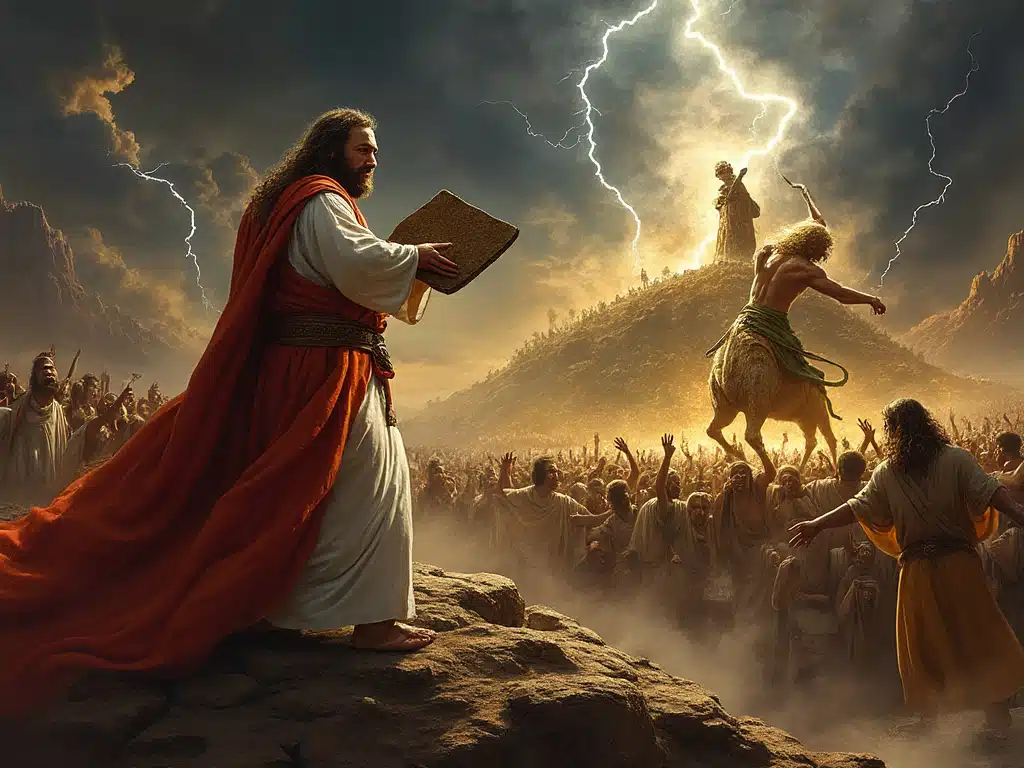
The Bible is replete with instances of conflict that offer profound insights into human nature and relationships. These stories provide valuable lessons on handling disagreements and resolving disputes.
Adam and Eve’s Disobedience
The first conflict in the Bible occurs in the Garden of Eden. God commands Adam and Eve not to eat from the tree of knowledge of good and evil. Yet, they succumb to temptation and disobey.
“But of the tree of the knowledge of good and evil you shall not eat, for in the day that you eat of it you shall surely die.” (Genesis 2:17, NKJV)
This act of disobedience creates a rift between humanity and God. It introduces sin and conflict into the world, setting the stage for future struggles.
The consequences are severe:
- Expulsion from the Garden of Eden
- Introduction of physical death
- Strained relationship with God
Cain and Abel’s Rivalry
The story of Cain and Abel presents the first instance of sibling rivalry. Both brothers offer sacrifices to God, but only Abel’s is accepted.
Cain’s jealousy and anger lead to a tragic outcome:
- God rejects Cain’s offering
- Cain becomes envious of Abel
- Cain murders Abel in a fit of rage
“Now Cain talked with Abel his brother; and it came to pass, when they were in the field, that Cain rose up against Abel his brother and killed him.” (Genesis 4:8, NKJV)
This conflict highlights the destructive power of unchecked emotions and the introduction of violence into human society.
Abraham and Lot’s Separation
Abraham and Lot face conflict due to their growing wealth and limited resources. Their herdsmen quarrel over grazing land, causing tension between the two families.
Abraham takes the initiative to resolve the conflict:
“Please let there be no strife between you and me, and between my herdsmen and your herdsmen; for we are brethren.” (Genesis 13:8, NKJV)
He offers Lot the choice of land, demonstrating selflessness and wisdom. This approach leads to a peaceful resolution and separation.
Jacob and Esau’s Struggle
The conflict between Jacob and Esau begins in the womb and continues throughout their lives. Their rivalry stems from:
- Competing for their father’s blessing
- Jacob’s deception to obtain the birthright
- Esau’s resentment and desire for revenge
“So Esau hated Jacob because of the blessing with which his father blessed him, and Esau said in his heart, ‘The days of mourning for my father are at hand; then I will kill my brother Jacob.'” (Genesis 27:41, NKJV)
This conflict illustrates the long-lasting effects of family discord and the power of forgiveness in eventual reconciliation.
Joseph and His Brothers
The story of Joseph and his brothers is a complex tale of jealousy, betrayal, and ultimate reconciliation. Key events include:
- Joseph’s favored status with their father
- His brothers’ plot to kill him
- His sale into slavery
- Joseph’s rise to power in Egypt
- The brothers’ reunion and reconciliation
“But now, do not hence be grieved or angry with yourselves because you sold me here; for God sent me before you to preserve life.” (Genesis 45:5, NKJV)
This conflict showcases the transformative power of forgiveness and God’s ability to work good out of difficult circumstances.
Conflicts Involving Biblical Leaders
Biblical leaders often faced significant conflicts that tested their faith and leadership abilities. These struggles provide valuable lessons for us today.
Moses and Pharaoh
The conflict between Moses and Pharaoh is one of the most dramatic in the Bible. It’s a clash between God’s chosen leader and a powerful ruler.
Moses, guided by God, demanded the release of the Israelites from slavery. Pharaoh repeatedly refused, leading to a series of divine plagues.
The tension escalated with each plague:
- Water turned to blood
- Frogs
- Lice
- Flies
- Livestock diseased
- Boils
- Hail
- Locusts
- Darkness
- Death of firstborn
“So says the Lord: ‘Let My people go, that they may serve Me.'” (Exodus 8:1, NKJV)
This conflict showcases God’s power and Moses’ perseverance in the face of opposition.
David and Saul
The conflict between David and Saul is a complex tale of jealousy and betrayal. It began when David’s popularity surpassed Saul’s after defeating Goliath.
Saul’s envy led to multiple attempts on David’s life:
- Throwing a spear at him
- Sending him into dangerous battles
- Hunting him in the wilderness
Even though Saul’s actions, David remained loyal:
“The Lord forbid that I should do this thing to my master, the Lord’s anointed, to stretch out my hand against him, seeing he is the anointed of the Lord.” (1 Samuel 24:6, NKJV)
This conflict teaches us about integrity and respect for authority, even in difficult circumstances.
Solomon’s Wisdom in Conflict Resolution
Solomon’s wisdom in resolving conflicts is legendary. The most famous example is his judgment between two women claiming the same baby.
Solomon’s method:
- Listen to both sides
- Propose an unexpected solution
- Observe reactions
- Make a just decision
“The king said, ‘Divide the living child in two, and give half to one, and half to the other.'” (1 Kings 3:25, NKJV)
This approach revealed the true mother’s love and care for the child.
Solomon’s wisdom teaches us to look beyond surface-level arguments and seek creative solutions to complex problems.
Jesus and His Opponents
Jesus faced numerous conflicts during His ministry. These confrontations reveal His divine nature and the opposition He encountered from various groups.
Conflicts with Religious Leaders
Jesus often clashed with religious authorities of His time. The Pharisees, Sadducees, and scribes frequently challenged His teachings and actions.
One notable conflict arose when Jesus healed on the Sabbath. In Matthew 12:9-14, He healed a man with a withered hand, angering the Pharisees who saw it as a violation of Sabbath laws.
Jesus also confronted the money changers in the Temple. John 2:15-16 recounts:
“When He had made a whip of cords, He drove them all out of the temple, with the sheep and the oxen, and poured out the changers’ money and overturned the tables. And He said to those who sold doves, ‘Take these things away! Do not make My Father’s house a house of merchandise!'”
This bold action challenged the religious leaders’ authority and corrupt practices.
Jesus often used parables to expose the hypocrisy of religious leaders. The Parable of the Wicked Vinedressers in Matthew 21:33-46 is a prime example.
Betrayal by Judas
Judas Iscariot’s betrayal marks one of the most heart-wrenching conflicts in Jesus’ life. As one of the twelve disciples, Judas’ actions cut deep.
Matthew 26:14-16 describes Judas’ agreement with the chief priests:
“Then one of the twelve, called Judas Iscariot, went to the chief priests and said, ‘What are you willing to give me if I deliver Him to you?’ And they counted out to him thirty pieces of silver. So from that time he sought opportunity to betray Him.”
Even though knowing Judas’ intentions, Jesus shared the Last Supper with him. This act of love contrasts sharply with Judas’ betrayal.
Jesus’ response to Judas in the Garden of Gethsemane is particularly poignant. Luke 22:48 records:
“But Jesus said to him, ‘Judas, are you betraying the Son of Man with a kiss?'”
Peter’s Denial
Peter’s denial of Jesus presents another significant conflict. Even though his earlier declarations of loyalty, Peter faltered when tested.
Mark 14:29-31 highlights Peter’s confident assertion:
“Peter said to Him, ‘Even if all are made to stumble, yet I will not be.’ Jesus said to him, ‘Assuredly, I say to you that today, even this night, before the rooster crows twice, you will deny Me three times.’ But he spoke more vehemently, ‘If I have to die with You, I will not deny You!’ And they all said likewise.”
Yet, when confronted, Peter denied knowing Jesus three times. Luke 22:61-62 describes the aftermath:
“And the Lord turned and looked at Peter. Then Peter remembered the word of the Lord, how He had said to him, ‘Before the rooster crows, you will deny Me three times.’ So Peter went out and wept bitterly.”
This conflict illustrates human weakness and the need for God’s grace and forgiveness.
Conflicts in the Early Church
The early Christian church faced numerous conflicts as it grew and spread. These disputes shaped the church’s doctrines and practices, influencing its development for centuries to come.
Jew and Gentile Christians
The inclusion of Gentiles in the church sparked a major conflict. Jewish Christians insisted that Gentile converts follow Mosaic law, including circumcision.
This dispute threatened to divide the church. Acts 15:1-2 describes the conflict:
“And certain men came down from Judea and taught the brethren, ‘Unless you are circumcised according to the custom of Moses, you cannot be saved.’ Hence, when Paul and Barnabas had no small dissension and dispute with them, they determined that Paul and Barnabas and certain others of them should go up to Jerusalem, to the apostles and elders, about this question.”
The Jerusalem Council addressed this issue. They decided not to burden Gentile believers with Jewish laws.
This resolution promoted unity between Jewish and Gentile Christians. It affirmed salvation by grace through faith, not by works of the law.
Paul’s Disagreements with Fellow Apostles
Paul had several disagreements with other apostles. These conflicts often centered on doctrinal issues or ministry approaches.
One notable dispute was between Paul and Peter in Antioch. Paul confronted Peter for withdrawing from Gentile believers:
“Now when Peter had come to Antioch, I withstood him to his face, because he was to be blamed” (Galatians 2:11).
Paul also disagreed with Barnabas over John Mark. This led to their separation:
“Then the contention became so sharp that they parted from one another. And so Barnabas took Mark and sailed to Cyprus; but Paul chose Silas and departed” (Acts 15:39-40).
These conflicts show that even apostles faced disagreements. They highlight the importance of standing firm for truth while maintaining unity in essential doctrines.
Lessons from Biblical Conflicts
Biblical conflicts offer profound insights into human nature and divine intervention. These ancient stories provide timeless wisdom for resolving disputes and fostering relationships.
God’s Role in Conflict Resolution
God plays a central role in resolving conflicts throughout the Bible. He often intervenes directly or guides individuals towards peaceful solutions.
In the story of Joseph, God used a series of events to reconcile Joseph with his brothers. Joseph recognized this divine intervention, saying:
“But as for you, you meant evil against me; but God meant it for good, to bring it about as it is this day, to save many people alive.” (Genesis 50:20, NKJV)
God’s wisdom also guided Solomon in resolving the dispute between two women claiming the same child. This divine insight led to a just resolution.
Key ways God assists in conflict resolution:
- Providing wisdom
- Changing hearts
- Orchestrating circumstances
- Revealing truth
God’s involvement in conflicts reminds us to seek His guidance in our own disputes.
Forgiveness and Reconciliation
Forgiveness and reconciliation are central themes in biblical conflict resolution. These principles are powerful tools for healing relationships and restoring peace.
Jesus emphasized the importance of forgiveness in His teachings:
“For if you forgive men their trespasses, your heavenly Father will also forgive you.” (Matthew 6:14, NKJV)
The story of the Prodigal Son illustrates the transformative power of forgiveness and reconciliation. The father’s unconditional love and forgiveness restored his relationship with his wayward son.
Steps towards forgiveness and reconciliation:
- Acknowledge the hurt
- Choose to forgive
- Seek reconciliation
- Rebuild trust
By embracing these biblical principles, we can resolve conflicts and strengthen our relationships with others and with God.
Conclusion
Biblical conflicts offer timeless wisdom for exploring our own struggles. From internal battles to interpersonal disputes and spiritual warfare these ancient stories resonate with modern challenges. They teach us about human nature forgiveness and the power of reconciliation.
By studying these examples we can gain valuable insights into resolving conflicts in our lives. Whether it’s family disagreements leadership challenges or personal temptations the Bible provides guidance. It reminds us of God’s role in conflict resolution and the importance of seeking His wisdom.
Eventually these narratives encourage us to approach conflicts with grace understanding and a willingness to forgive. They inspire us to grow in our relationships with others and deepen our faith in God’s transformative power.
How Does Biblical Compromise Relate to the Conflicts Presented in the Bible?
In the Bible, conflicts often arise from differing values and beliefs. Exploring biblical compromise examples reveals how characters navigate these tensions, finding a balance between faithfulness and practicality. Such compromises highlight the importance of understanding human nature and divine guidance in resolving disputes within the scriptural narrative.
Share On Pinterest!


Pastor Duke has been preaching and teaching the Bible since 1988. He has shared his knowledge online since 2011.


 By
By


