

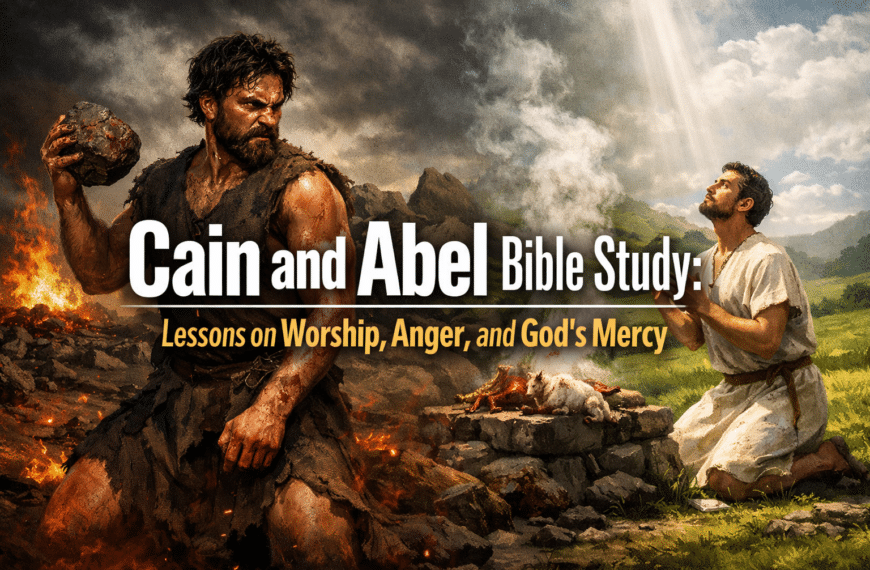
Have you ever wondered why some worship is accepted and other worship is rejected? The story of Cain and Abel isn’t just an ancient tale—it’s a mirror held up to our own hearts. When I first led a Cain and Abel Bible Study with my small group, I expected a simple story about two brothers. What I discovered was a profound lesson about the condition of our hearts when we come before God.
This narrative from Genesis 4 cuts straight to the core of authentic faith. It reveals how jealousy can poison our souls, how anger opens the door to devastating sin, and how God’s mercy extends even to those who fail spectacularly.
Key Takeaways

- Heart posture matters more than religious performance – God looks at our motivations, not just our actions
- Unmanaged anger becomes a doorway for sin – We must address negative emotions before they control us
- God’s mercy extends even to murderers – His grace is greater than our worst failures
- Authentic worship flows from faith – Our offerings to God must be rooted in genuine trust and obedience
- Sin’s consequences are real, but God still protects – Judgment and mercy can coexist in God’s character
The Story of Cain and Abel: What Really Happened?
Setting the Scene
Genesis 4 introduces us to the first children born to humanity. Cain, the firstborn, became a farmer. Abel, his younger brother, became a shepherd. This detail isn’t random—their occupations would directly impact the offerings they brought to God.
“Now Abel was a keeper of sheep, but Cain was a tiller of the ground. And in the process of time it came to pass that Cain brought an offering of the fruit of the ground to the Lord. Abel also brought of the firstborn of his flock and of their fat. And the Lord respected Abel and his offering, but He did not respect Cain and his offering.” (Genesis 4:2-5, NKJV)
Why Was Abel’s Offering Accepted?
This question has puzzled Bible students for centuries. The text gives us clues:
Abel brought the firstborn and the fat portions. This wasn’t leftovers—it was the best he had. The firstborn represented the choicest of his flock, and the fat was considered the premium portion in ancient times [1].
Abel offered in faith. Hebrews 11:4 tells us, “By faith Abel offered to God a more excellent sacrifice than Cain, through which he obtained witness that he was righteous, God testifying of his gifts” (NKJV).
The offering required blood. While the text doesn’t explicitly state this, the pattern throughout Scripture shows that “without shedding of blood there is no remission” (Hebrews 9:22, NKJV). Abel’s lamb foreshadowed the ultimate Lamb of God.
Why Was Cain’s Offering Rejected?
Cain brought “an offering of the fruit of the ground”—notice it doesn’t say the first fruits or the best of his harvest. The language suggests a casual, obligatory offering rather than a sacrificial one.
More importantly, Cain’s heart wasn’t right. God’s response reveals this:
“So the Lord said to Cain, ‘Why are you angry? And why has your countenance fallen? If you do well, will you not be accepted? And if you do not do well, sin lies at the door. And its desire is for you, but you should rule over it.'” (Genesis 4:6-7, NKJV)
God didn’t reject Cain—He rejected Cain’s offering because it reflected a heart problem. This is a crucial distinction for any Cain and Abel Bible Study.
Understanding Worship Through the Cain and Abel Bible Study
What Makes Worship Acceptable?
When I teach this passage, I always emphasize that God isn’t interested in religious performance. He wants authentic worship that flows from transformed hearts.
Here’s what acceptable worship looks like:
- It’s sacrificial – We give our best, not our leftovers
- It’s faith-driven – We trust God’s way, not our own preferences
- It’s heart-centered – Our motivations matter as much as our actions
- It’s obedient – We follow God’s instructions, not our assumptions
The apostle Paul later wrote about this principle: “I beseech you therefore, brethren, by the mercies of God, that you present your bodies a living sacrifice, holy, acceptable to God, which is your reasonable service” (Romans 12:1, NKJV).
The Danger of Going Through the Motions
Cain shows us what happens when we approach God with the wrong attitude. He performed a religious act—bringing an offering—but his heart wasn’t in it.
This is a warning for us today. How often do we:
- Attend church out of habit rather than hunger for God?
- Give financially but resent the amount?
- Serve in ministry but complain about the sacrifice?
- Pray words without engaging our hearts?
God sees through hollow religion. He always has.
Practical Application: Examining Our Own Worship
Take a moment to evaluate your worship:
✅ Do I give God my first and best, or my leftovers?
✅ Am I worshiping out of obligation or genuine love?
✅ Do I follow God’s way or insist on my own preferences?
✅ Is my heart engaged when I pray, sing, and serve?
These questions aren’t meant to condemn but to refine. God desires worshipers who worship “in spirit and truth” (John 4:24, NKJV).
The Deadly Progression: From Anger to Murder

God’s Warning to Cain
One of the most powerful moments in this Cain and Abel Bible Study is God’s direct warning to Cain. Before the murder happened, God intervened:
“If you do well, will you not be accepted? And if you do not do well, sin lies at the door. And its desire is for you, but you should rule over it.” (Genesis 4:7, NKJV)
This verse reveals several truths:
Sin is personified as a predator. It “lies at the door” like a wild animal waiting to pounce. Sin isn’t passive—it’s aggressive and opportunistic.
We have a choice. God told Cain he “should rule over it.” We’re not helpless victims of our emotions or circumstances. We have the power, through God’s strength, to master sin.
Unaddressed anger is dangerous. Cain’s anger wasn’t sinful in itself—it was his response to that anger that led to tragedy.
How Anger Opens the Door to Sin
James 1:19-20 teaches us: “Let every man be swift to hear, slow to speak, slow to wrath; for the wrath of man does not produce the righteousness of God” (NKJV).
Cain’s progression shows us the deadly path:
- Disappointment – His offering was rejected
- Anger – He became furious at the perceived injustice
- Jealousy – He resented his brother’s acceptance
- Premeditation – “Cain talked with Abel his brother” (Genesis 4:8)
- Murder – “And it came to pass, when they were in the field, that Cain rose up against Abel his brother and killed him” (Genesis 4:8, NKJV)
Practical Steps to Manage Anger
The Cain and Abel story isn’t just history—it’s a warning. Here’s how to prevent anger from controlling you:
1. Acknowledge your anger quickly
Don’t suppress it or pretend it doesn’t exist. Name it before God.
2. Identify the root cause
Often, anger is a secondary emotion masking hurt, fear, or insecurity.
3. Bring it to God in prayer
Psalm 62:8 says, “Pour out your heart before Him; God is a refuge for us” (NKJV).
4. Address it before it escalates
Ephesians 4:26 warns, “Do not let the sun go down on your wrath” (NKJV).
5. Seek reconciliation when possible
Matthew 5:23-24 instructs us to make things right with others before offering worship.
For deeper insight into managing emotions and relationships, explore our study on love and unity in 1 Corinthians 13.
God’s Response: Justice and Mercy Combined
The Confrontation
After Cain murdered Abel, God confronted him with a question:
“Then the Lord said to Cain, ‘Where is Abel your brother?’ He said, ‘I do not know. Am I my brother’s keeper?'” (Genesis 4:9, NKJV)
Cain’s response reveals his hardened heart. He lied to God and showed no remorse. Yet God, in His patience, continued the conversation.
The Curse and Consequences
God pronounced judgment on Cain:
“So now you are cursed from the earth, which has opened its mouth to receive your brother’s blood from your hand. When you till the ground, it shall no longer yield its strength to you. A fugitive and a vagabond you shall be on the earth.” (Genesis 4:11-12, NKJV)
The consequences were severe:
- Separation from productive work – The ground would no longer yield crops for him
- Restlessness and wandering – He would have no settled home
- Spiritual separation – He would be driven “from the presence of the Lord” (Genesis 4:14, NKJV)
The Mark of Protection
Here’s where God’s mercy shines through. When Cain expressed fear that others would kill him, God responded with grace:
“And the Lord said to him, ‘Therefore, whoever kills Cain, vengeance shall be taken on him sevenfold.’ And the Lord set a mark on Cain, lest anyone finding him should kill him.” (Genesis 4:15, NKJV)
God protected the murderer. This is staggering. Cain deserved death, yet God extended mercy. The mark wasn’t a curse—it was a sign of divine protection [2].
This foreshadows the gospel message: We all deserve judgment, yet God offers grace through Jesus Christ.
What This Teaches Us About God’s Character
The Cain and Abel Bible Study reveals a God who is:
Just – He doesn’t overlook sin or pretend it didn’t happen
Merciful – He extends protection even to those who deserve punishment
Patient – He gave Cain multiple opportunities to repent
Redemptive – He continued to work with humanity despite this horrific sin
As 1 John 1:9 reminds us: “If we confess our sins, He is faithful and just to forgive us our sins and to cleanse us from all unrighteousness” (NKJV).
Applying the Cain and Abel Bible Study to Your Life Today

For Small Group Leaders and Teachers
When you lead a Cain and Abel Bible Study, focus on these discussion questions:
📖 What does this passage teach us about the heart behind our worship?
📖 How can we identify when anger is beginning to control us?
📖 What does God’s protection of Cain reveal about His character?
📖 In what ways do we sometimes bring “Cain-like” offerings to God?
📖 How does this story point us toward our need for Jesus?
For Personal Application
Here are five practical ways to apply this study:
1. Audit Your Worship
This week, before you pray, give, or serve, pause and ask: “Is my heart fully engaged, or am I just going through the motions?”
2. Address Anger Immediately
If you’re harboring anger toward someone, don’t let it fester. Take it to God in prayer, then take steps toward reconciliation.
3. Give Your Best to God
Identify one area where you’ve been giving God your leftovers—your time, money, energy, or attention. Make a commitment to give Him your first and best.
4. Remember God’s Mercy
If you’re carrying guilt over past failures, remember that God’s mercy is greater than your sin. Confess, receive forgiveness, and move forward.
5. Be Your Brother’s Keeper
Cain asked, “Am I my brother’s keeper?” The answer is yes. Look for opportunities to care for, encourage, and support others in your community.
For more practical biblical teaching, visit Answered Faith for resources designed to equip you for deeper spiritual growth.
Connecting to the Gospel
The ultimate lesson of the Cain and Abel Bible Study points us to Jesus. Abel’s innocent blood cried out from the ground for justice (Genesis 4:10). But Jesus’ blood speaks a better word—it cries out for mercy.
Hebrews 12:24 says we have come “to Jesus the Mediator of the new covenant, and to the blood of sprinkling that speaks better things than that of Abel” (NKJV).
Abel’s blood demanded vengeance. Jesus’ blood offers forgiveness.
This is the heart of the gospel. We’re all like Cain—we’ve all sinned and fall short of God’s glory (Romans 3:23). We all deserve judgment. But God, in His mercy, sent Jesus to be the acceptable sacrifice on our behalf.
When we come to God through faith in Jesus, our worship is accepted—not because we’re perfect, but because Jesus is perfect. His righteousness covers our inadequacy.
For Those Struggling with Guilt
If you identify with Cain—if you’ve done something you believe is unforgivable—hear this truth: God’s grace is greater than your worst sin.
Cain murdered his brother, yet God still protected him. David committed adultery and murder, yet God called him a man after His own heart. Peter denied Jesus three times, yet Jesus restored him and used him powerfully.
Your past doesn’t define your future. God’s mercy is available to you right now.
As 1 John 1:7 promises: “The blood of Jesus Christ His Son cleanses us from all sin” (NKJV).
Conclusion: Walking in Authentic Worship
The Cain and Abel Bible Study challenges us to examine the condition of our hearts. It’s not enough to perform religious activities—God wants authentic worshipers who approach Him with faith, humility, and sincerity.
This ancient story teaches us:
- Worship is about the heart, not just the act
- Unmanaged anger leads to devastating consequences
- God’s mercy is available even when we fail
- We must rule over sin before it rules over us
- Jesus is the ultimate acceptable offering
Here’s what I encourage you to do this week:
Your Next Steps

✝️ Spend time in prayer asking God to reveal any areas where your worship has become routine or insincere
✝️ Confess any anger or bitterness you’ve been harboring and ask God for the strength to forgive
✝️ Identify one specific way you can give God your best this week—whether in time, resources, or service
✝️ Share this study with your small group or use it as a teaching resource in your ministry
✝️ Memorize Genesis 4:7 as a reminder that you have the power, through Christ, to rule over sin
At Answered Faith, we’re committed to providing accessible, practical Bible study resources that equip you to grow in your faith and lead others effectively. The story of Cain and Abel isn’t just ancient history—it’s a living word that speaks directly to our lives today.
May your worship be authentic, your heart be pure, and your faith be strong as you walk with the God who extends both justice and mercy in perfect measure.
References
[1] Wenham, G. J. (1987). Genesis 1-15, Word Biblical Commentary. Dallas: Word, Incorporated.
[2] Hamilton, V. P. (1990). The Book of Genesis, Chapters 1-17. Grand Rapids: Wm. B. Eerdmans Publishing.
Share On Pinterest



Pastor Duke has been preaching and teaching the Bible since 1988. He has shared his knowledge online since 2011.








 By
By






Thank you! This has been very helpful for me… it’s so important to unpack the accounts in the Bible, their spiritual lessons, and what they mean for us believers today.
God bless you, your family, and the work you continue to do for Him.