
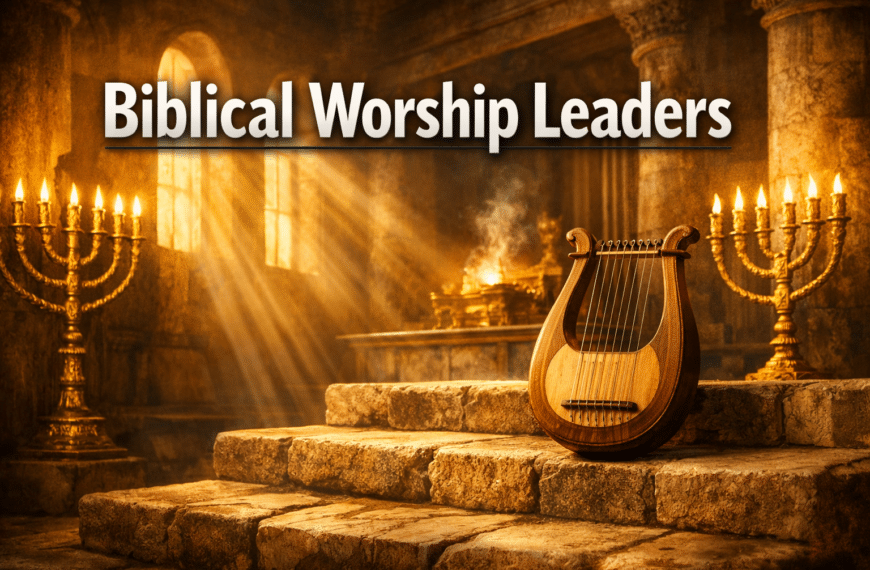
Have you ever stood in a worship service and felt the atmosphere shift? One moment, the room is full of distracted minds. The next, something luminous breaks through—hearts open, tears fall, and God’s presence becomes almost tangible. That transformation rarely happens by accident. Behind it, there’s usually a worship leader who understands something deeper than music. The biblical worship leaders we find in Scripture didn’t just sing songs. They modeled a lifestyle of surrender, courage, and wholehearted devotion that still speaks to us in 2026.
I’ve been studying these men and women for years, and every time I revisit their stories, I discover something fresh. Whether you lead worship on a Sunday morning, facilitate a small group, or simply want to deepen your personal praise, these biblical examples offer a roadmap you can follow today.
And here’s the thing—worship is still under pressure around the world. Just this past March, Israeli police prevented Catholic leaders, including Cardinal Pierbattista Pizzaballa, from entering the Church of the Holy Sepulchre for Palm Sunday services [4]. Yet even amid restrictions, the global church keeps worshiping. The underground church in Iran is growing rapidly, with estimates of believers ranging from 117,700 to 800,000 [1]. Worship cannot be stopped. It never could.
Let’s look at seven biblical worship leaders whose lives can reshape how we approach God.

Key Takeaways
- 🎵 Biblical worship leaders were not just musicians—they were people of deep character, courage, and consecration.
- ❤️ True worship starts with the heart, not the talent. David, Miriam, and others show us that authenticity matters most.
- 📖 Scripture gives us practical patterns for leading worship that apply directly to our churches and personal lives today.
- 🙏 The Holy Spirit is the ultimate worship leader—every human leader in the Bible depended on God’s empowerment.
- ✅ You don’t need a stage to be a worship leader. Everyday obedience is the highest form of praise.
David: The Blueprint for Biblical Worship Leaders

If there’s one name synonymous with worship in Scripture, it’s David. He’s the gold standard—the archetype every worship leader since has been measured against. But what made David so remarkable wasn’t his voice or his skill on the harp. It was his unguarded heart before God.
A Shepherd’s Song Before a King’s Stage
David didn’t start leading worship in the temple. He started in a field, surrounded by sheep, singing to an audience of One. That’s where his worship was forged—in obscurity, in danger, in loneliness. By the time he played for King Saul to soothe his troubled spirit (1 Samuel 16:23), David had already built a deep well of intimacy with God.
“I will praise You, O Lord, with my whole heart; I will tell of all Your marvelous works.” — Psalm 9:1 (NKJV)
David wrote roughly half the Psalms. These weren’t polished performance pieces. They were raw, honest, sometimes desperate prayers set to music. He cried out in fear. He confessed sin. He celebrated victory. He questioned God’s timing. That’s what made him a worship leader worth following.
What We Can Learn from David
- Worship in the wilderness. Don’t wait for a platform. Start where you are.
- Be honest with God. The Psalms give us permission to bring our real emotions into worship.
- Prioritize God’s presence. When David brought the Ark to Jerusalem, he danced with abandon (2 Samuel 6:14). He valued God’s nearness above his own dignity.
If you’re looking for examples of self-control and character among biblical heroes, David’s life—both his triumphs and failures—offers profound lessons.
The Levites: An Organized Army of Biblical Worship Leaders

Worship in the Old Testament wasn’t a casual affair. God established an entire tribe—the Levites—to steward worship in Israel. These were consecrated men and women set apart for sacred service, and their structure teaches us something vital about worship leadership.
How the Levites Were Organized
King David didn’t just write psalms. He organized worship on a scale that’s almost staggering. First Chronicles 25 tells us he appointed 4,000 Levites as musicians, divided into 24 divisions, each led by skilled worship leaders like Asaph, Heman, and Jeduthun.
| Worship Leader | Role | Key Scripture |
|---|---|---|
| Asaph | Chief musician, psalmist | 1 Chronicles 16:5 |
| Heman | Singer, seer | 1 Chronicles 25:5 |
| Jeduthun | Musician, prophet | 2 Chronicles 5:12 |
| Chenaniah | Director of music | 1 Chronicles 15:22 |
These leaders didn’t wing it. They rehearsed. They trained. They served in rotation so that worship before the Lord was continuous—day and night.
Practical Takeaways for Today
- Structure serves spontaneity. The Levites’ organization didn’t quench the Spirit. It created space for Him to move.
- Consecration matters. You can explore more about what consecration looks like in Scripture and how it applies to your own ministry.
- Teamwork is biblical. Worship was never a solo act. It took an entire community working in harmony.
Understanding the Holy Spirit’s role in worship helps us see that even the most organized worship team needs divine empowerment to truly lead people into God’s presence.
Miriam, Deborah, and the Women Who Led Worship

One of the most resplendent aspects of biblical worship is that God never limited it to men alone. Women played pivotal roles as worship leaders throughout Scripture, and their stories deserve our attention.
Miriam: The First Worship Leader After Deliverance
After God parted the Red Sea and destroyed Pharaoh’s army, it was Miriam who grabbed a tambourine and led the women of Israel in a victory song:
“Sing to the Lord, for He has triumphed gloriously! The horse and its rider He has thrown into the sea!” — Exodus 15:21 (NKJV)
Miriam didn’t wait for permission. She responded to God’s deliverance with immediate, exuberant praise. She understood something essential: worship is the natural response to what God has done.
Deborah: A Judge Who Sang
Deborah wasn’t just a military leader and judge. After the defeat of Sisera’s army, she composed one of the most powerful worship songs in the Bible (Judges 5). Her song recounts God’s faithfulness, calls out those who failed to act, and celebrates those who risked everything for God’s cause.
Hannah: Worship Born from Pain
Hannah’s prayer in 1 Samuel 2 is a masterpiece of worship that emerged from years of barrenness and heartbreak. Her song of praise after God answered her prayer became a template that Mary herself echoed centuries later in the Magnificat (Luke 1:46-55).
These women remind us that worship leadership isn’t about a title—it’s about a response. If you’re involved in mentoring and discipleship in women’s ministry, these examples are powerful teaching tools.
Lessons from Biblical Worship Leaders You Can Apply Today

So what do all these ancient worship leaders have in common? And more importantly, how do their examples translate into your life right now—whether you’re leading a congregation of 500 or worshiping alone in your living room?
5 Timeless Principles from Biblical Worship Leaders
- Worship starts with the heart, not the instrument. God told Samuel, “The Lord does not see as man sees; for man looks at the outward appearance, but the Lord looks at the heart” (1 Samuel 16:7, NKJV). Before you worry about your voice or your guitar skills, check your heart.
- Obedience is worship. Romans 12:1 calls us to present our bodies as “a living sacrifice, holy, acceptable to God, which is your reasonable service.” The Hebrew word for worship, shachah, literally means to bow down. Every act of obedience is an act of worship.
- Worship requires courage. David danced when his wife mocked him. Miriam sang on the banks of a sea that had just closed. The early church worshiped in homes under threat of persecution. Even today, believers in Iran are worshiping underground at great personal risk [1]. True worship has always demanded bravery.
- Preparation honors God. The Levites trained for years. Chenaniah was chosen specifically because he was “skillful” (1 Chronicles 15:22). Excellence in preparation isn’t about performance—it’s about stewardship.
- Community amplifies worship. The Bible consistently shows worship as a corporate act. When Solomon dedicated the temple, 120 priests blew trumpets in unison, and God’s glory filled the house (2 Chronicles 5:13-14). There’s something that happens when we worship together that doesn’t happen alone.
How to Grow as a Worship Leader This Week
Here are some practical steps you can take starting today:
- 📖 Read one psalm a day and pray it back to God. Start with Psalm 145.
- 🎶 Worship before you lead. Spend time in personal praise before any public ministry.
- 🤝 Invest in your team. If you lead others, pour into them spiritually, not just musically. Learn how to lead a small group Bible study with confidence and apply those principles to your worship team.
- 🙏 Ask for the Holy Spirit’s help. Every biblical worship leader operated under God’s anointing. Discover more about the baptism of the Holy Spirit and how it empowers your ministry.
- ✍️ Write your own songs of praise. You don’t have to be a professional songwriter. Hannah’s prayer was simply a mother pouring out her gratitude. Find examples of encouragement in the Bible to inspire your own words of worship.
A Word About Motives
Not every worship leader in the Bible got it right. Nadab and Abihu offered “strange fire” before the Lord and paid with their lives (Leviticus 10:1-2). Their story is a sobering reminder that how we worship matters as much as that we worship. God isn’t looking for impressive performances. He’s looking for pure hearts.
“God is Spirit, and those who worship Him must worship in spirit and truth.” — John 4:24 (NKJV)
Why Biblical Worship Leaders Still Matter in 2026
We live in a time when worship is both more accessible and more contested than ever. You can stream worship music 24/7 from your phone. But in some parts of the world, gathering to worship publicly can get you arrested—or worse.
The Bible Society recently reported growing evidence that young people are newly coming to faith, particularly in the UK [2]. That’s encouraging. But these new believers need models of worship that go deeper than catchy melodies and fog machines. They need the kind of worship David modeled—raw, honest, and anchored in Scripture.
Israeli President Isaac Herzog recently expressed “great sorrow” after worship leaders were temporarily blocked from holding Palm Sunday services in Jerusalem [2]. The incident was resolved quickly, but it reminded the global church of something important: the freedom to worship is precious, and it should never be taken for granted.
Whether you’re in a megachurch in Texas or a house church in Tehran, the principles of biblical worship leadership remain the same. Heart before skill. Obedience before performance. Spirit and truth, always.
Conclusion
The biblical worship leaders we’ve explored—David, the Levites, Miriam, Deborah, Hannah, and others—weren’t perfect people. They were flawed, sometimes fearful, often overlooked. But they shared one unshakable quality: they were willing to give God everything they had.
That’s the invitation for you today. You don’t need a seminary degree or a record deal to lead worship. You need a heart that’s turned toward God and a willingness to respond to His goodness with your whole life.
Here’s your next step: Pick one biblical worship leader from this article and spend a week studying their life. Read their songs. Pray their prayers. Let their example reshape how you approach God—whether on a stage, in a small group, or in the quiet of your prayer closet.
Worship isn’t something we do on Sundays. It’s who we are, every single day.
References
[1] Saturday March 21 2026 Biblical Christian Worldview News Stories – https://bcworldview.org/saturday-march-21-2026-biblical-christian-worldview-news-stories/
[2] Religion News 30 March 2026 – https://religionmediacentre.org.uk/morning-news-bulletin/religion-news-30-march-2026/
[4] Israel Prevents Catholic Leaders From Celebrating Palm Sunday Mass At Jerusalem Church 00849810 – https://www.politico.com/news/2026/03/29/israel-prevents-catholic-leaders-from-celebrating-palm-sunday-mass-at-jerusalem-church-00849810
Share On Pinterest



Pastor Duke has been preaching and teaching the Bible since 1988. He has shared his knowledge online since 2011.

 By
By