


The Bible brims with timeless tales of compassion, where strangers metamorphose into neighbors and the broken find solace. From the Good Samaritan, who binds wounds with alacrity, to Ruth’s unwavering fidelity cradling Naomi through bereavement, these narratives unveil God’s heart for selfless care. Each account beckons deeper contemplation—what might they elucidate about our own imperative to serve?
Takeaways
- Good Samaritan shows mercy by aiding and paying for an injured stranger’s care.
- Ruth loyally gleans food to support her widowed mother-in-law Naomi.
- Boaz protects and provides abundantly for hardworking Ruth.
- Dorcas sews clothes for widows, sparking community grief and her resurrection.
- Jesus humbly washes disciples’ feet, modeling selfless servant leadership.
Good Samaritan Aids Injured Stranger

The Good Samaritan: A Lesson in Love
One day, a kind Samaritan found a traveler who had been badly beaten and left for dead on the dangerous road from Jerusalem to Jericho. The man had been attacked by robbers who stripped him of his belongings and left him in great pain. Filled with compassion, the Samaritan bandaged his wounds using oil and wine, showing us what it means to love our neighbor as ourselves.
He then placed the injured man on his own donkey and took him to an inn, where he cared for him. This act of kindness crossed the divide between Samaritans and Jews, illustrating that love knows no boundaries. The Samaritan even paid the innkeeper and promised to cover any additional costs, demonstrating true generosity.
While priests and Levites passed by without helping, the Samaritan’s actions taught us an important lesson: being a neighbor is about showing mercy in action, not just talking about it.
As it says in Luke 10:36-37 (NKJV), Jesus asked, “Which of these three do you think was neighbor to him who fell among the thieves?” The answer was clear: “He who showed mercy on him.”
Through this parable, Jesus shows us that God’s kingdom is built on selfless love. We are called to embody these lessons in our daily lives, being a source of healing and hope in a broken world.
Ruth’s Loyal Care for Naomi

Ruth’s unwavering loyalty shines brightly in her care for Naomi, her mother-in-law, after both women lose their husbands in a foreign land. In the Book of Ruth, this Moabite woman shows selfless love by refusing to leave Naomi, even though they face cultural challenges and deep sorrow. “Your people shall be my people, and your God, my God,” Ruth boldly says (Ruth 1:16, NKJV), tying her fate to Naomi’s with a strong commitment.
Ruth’s loyalty is clear as she works in the fields to provide food for Naomi, offering both nourishment and companionship during their time of grief and poverty. Her gentle persistence helps to comfort Naomi, turning her bitterness into hope.
This story shows how God’s providence works through the faithfulness of people, reminding us that true care goes beyond family ties. Ruth’s actions encourage us to put others first, reflecting the wisdom of Proverbs 17:17: “A friend loves at all times” (NKJV).
Boaz Provides for Ruth

In the fields of Bethlehem, Boaz notices Ruth as she gleans among the sheaves. His heart is moved by her hard work and care for Naomi.
Boaz generously shares from his abundant harvest, inviting Ruth to eat with the workers and ensuring she gathers plenty. This reflects God’s gracious abundance in our lives.
As Ruth’s kinsman-redeemer, Boaz shows faithful protection and care, foreshadowing Jesus, our ultimate Redeemer, who loves and cares for His people.
As it says in Ruth 2:12 (NKJV), “The LORD repay your work, and a full reward be given you by the LORD God of Israel, under whose wings you have come for refuge.”
Boaz Notices Ruth
Boaz, seeing Ruth, asks about her and learns how devoted she is to Naomi. This encounter highlights the importance of community and kindness. In the Bible, those who have much are encouraged to help those in need. Boaz’s actions reflect the principle found in Proverbs 19:17 (NKJV), which says, “He who has pity on the poor lends to the Lord.”
As the harvest celebrations continue, Boaz’s protection of Ruth hints at a deeper connection forming between them. This story teaches us valuable lessons about noticing and caring for others in our daily lives, just as God calls us to do.
Book Recommendations


Generous Harvest Provision
Boaz’s generosity shines brightly as he tells his harvesters to leave extra grain for Ruth and invites her to eat with his workers. This act shows the blessings of the harvest and the spirit of generosity during the season, reflecting God’s law in action. By giving thoughtfully and sharing food, Boaz teaches us how to care for those in need, making sure the vulnerable can gather from the abundance.
| Biblical Act | Modern Echo |
|---|---|
| Leave extra grain | Community sharing programs |
| Invite to eat | Mutual support meals |
| Harvest blessings | Bounty appreciation drives |
Ruth’s inclusion in this community highlights the importance of sharing and grace. Boaz’s example encourages us to practice generosity, turning our fields into places of support for everyone. Let us follow his lead by embracing the call to care for one another and to share our blessings today.
As it says in Leviticus 19:9-10 (NKJV), “When you reap the harvest of your land, you shall not wholly reap the corners of your field, nor shall you gather the gleanings of your harvest. And you shall not glean your vineyard, nor shall you gather every grape of your vineyard; you shall leave them for the poor and the stranger.” Let us remember this call in our own lives!
Kinsman-Redeemer Role
Ruth’s story shows how Boaz stepped up as the kinsman-redeemer, providing protection and care according to God’s ancient law (Ruth 4:1-10, NKJV). As a kinsman-redeemer, he fulfilled family duties to keep Naomi’s family line alive and to ensure Ruth’s safety, all within the customs of Israel (Leviticus 25; Deuteronomy 25).
This role had deep cultural meaning and legal importance. Boaz publicly redeemed the family land at the town gate, which helped secure support from the community and showed justice for vulnerable widows and foreigners.
Examples like Boaz remind us of God’s love for those in need, teaching us about selfless love, divine provision, and faithfulness in our everyday actions.
Job’s Friends Comfort Him
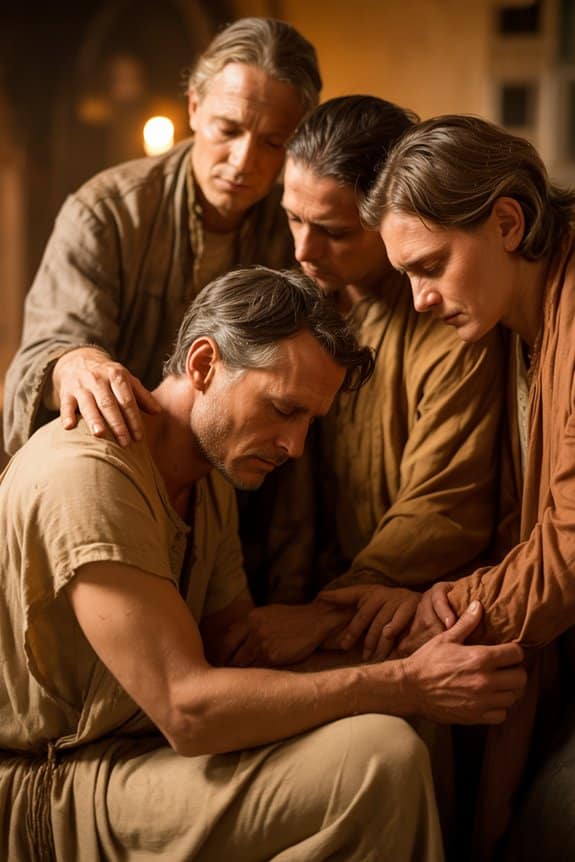
When calamity struck Job—he lost his wealth, children, and health—three friends came to mourn and comfort him. They sat with him in silence for seven days and nights, showing the importance of listening during Job’s deep sorrow.
This powerful support highlights the strength of friendship and teaches us about empathy through their quiet presence. Their companionship demonstrated how to comfort others by understanding grief and valuing community over quick words.
By sharing Job’s burdens without judgment, they offered healing just by being there, reminding us of Proverbs 17:17 (NKJV), “A friend loves at all times, and a brother is born for adversity.”
Though later they debated, their initial silence shows us biblical wisdom: sometimes, the best way to help is simply to be present and let someone feel their pain.
Job’s story encourages us to build such compassionate friendships, helping each other grow stronger during tough times. (151 words)
Hagar Receives Care in Wilderness

In the dry wilderness, Hagar experiences God’s amazing care when He opens her eyes to a well of water. This provision sustains both her and her son Ishmael, showing God’s tender mercy.
An angel of the Lord then comes to comfort her, assuring her that Ishmael will have a great future (Genesis 21:18).
This moment in the Bible beautifully illustrates how God’s compassion reaches those who feel abandoned, offering hope even when it seems like there is none.
Divine Water Provision
In the harsh wilderness, Hagar and her young son Ishmael faced despair. They were desperate and in need of help. But God heard their cries and provided a miraculous well of water (Genesis 21:14-19, NKJV). This amazing gift of water turned their certain death into hope, giving them the thirst-quenching relief they needed.
The life-giving water not only sustained them but also symbolized how God can bring life and renewal even in the most barren places. This act of divine provision shows that God cares for our physical needs and our spiritual thirst.
When we face times of drought in our lives, God can transform our dry situations into sources of renewal. Hagar’s story reminds us that just as God cared for her and Ishmael, He offers living water to all who cry out to Him. He nurtures our bodies and souls with His unwavering compassion.
Angelic Comfort Assurance
In Hagar’s time of deep struggle, God sent an angel to comfort her. The angel spoke tenderly, saying, “Do not fear; God has heard the voice of the lad where he is” (Genesis 21:17, NKJV). This moment shows us that God uses His angels to bring hope and reassurance, especially in our darkest times.
Hagar’s story teaches us about God’s comforting presence through His heavenly messengers:
- Angelic reassurance helped Hagar overcome her fear, showing that God cares for those in need.
- Spiritual support gave Hagar strength, reminding us that God encourages us to keep our faith during tough times.
- Heavenly messengers guided her to a well and revealed a promise for the future, reminding us that God provides for us.
- Protective angels represented God’s intervention, ensuring that both Hagar and her child would survive.
This beautiful narrative encourages us and teaches that God’s love reaches us through supernatural means, inviting us to trust Him more fully in His provision.
Joseph Forgives His Brothers

In Egypt, Joseph’s brothers came before him, bowing low, not knowing that the powerful ruler they faced was their long-lost brother whom they had betrayed. Years earlier, out of jealousy, they had sold Joseph into slavery. But God had a plan; Joseph rose to a position of authority during a terrible famine.
Now, his brothers were there to buy grain, unknowingly fulfilling the dreams Joseph had shared with them long ago.
As tears filled his eyes, Joseph revealed his true identity. “I am Joseph,” he said, his voice shaking with emotion. He embraced them, showing love despite their past wrongs. In this touching moment, the power of forgiveness was clear.
Joseph understood that God had used his suffering to bring about a greater good, saying, “Do not fear, for God sent me before you to preserve life” (Genesis 45:5, NKJV).
After this emotional reunion, Joseph’s brothers returned home with wagons full of supplies. Joseph provided generously, bringing his family to live in Goshen, where he could care for their father, Jacob, in his old age.
This story teaches us about the power of mercy and how God can turn betrayal into strong family bonds, reflecting the healing grace He offers to all.
Elisha Revives Shunammite’s Son

A wealthy woman from Shunem showed great kindness to the prophet Elisha by building a room for him in her home. She offered him rest and hospitality whenever he passed by.
In return for her generosity, God blessed her with a son, filling her home with joy and hope. But tragedy struck when the boy suddenly died in his mother’s arms. Her heart broke with grief, and she set out to find Elisha.
Elisha felt compassion for her and hurried to her home. He prayed earnestly and stretched himself over the lifeless boy. Through God’s power, the boy’s breath returned, and he was miraculously healed.
This amazing event showed how God works through His prophets and the power of prayer.
This story from 2 Kings 4 teaches us that selfless acts of kindness can invite God’s blessings. It encourages us to show hospitality and trust in God’s faithfulness.
Zarephath Widow Shares Last Meal

In the midst of a great famine, the widow of Zarephath shows her faithful obedience by preparing her last meal for the prophet Elijah. She trusts God’s promise even when she feels hopeless.
This selfless act leads to a miracle: her supply of flour and oil never runs out, allowing them to survive during the hard times. Her story beautifully illustrates how obeying God’s guidance can provide for others in need.
As it says in 1 Kings 17:15-16 (NKJV), “So she went away and did according to the word of Elijah; and she and he and her household ate for many days.”
Widow’s Faithful Obedience
During a terrible famine, a widow from Zarephath met the prophet Elijah, who asked her to share her last meal with him. This widow showed incredible strength and faith as she prepared to obey Elijah’s request, trusting in God’s word.
Her faithful obedience serves as an inspiring example of sacrificial love, teaching us important lessons:
- Resilience in Faith: The widow’s faith helped her keep going in her time of need. She chose to trust God’s provision rather than focusing on her own lack. As it says in 1 Kings 17:15 (NKJV), “So she went away and did according to the word of Elijah; and she and he and her household ate for many days.”
- Generosity and Service: Despite her own struggles, the widow showed kindness by helping a stranger in need. This reminds us of Jesus’ teaching in Luke 6:38 (NKJV), “Give, and it will be given to you.”
- Trust in God’s Guidance: Her willingness to listen to Elijah demonstrated her faith in God’s plan, showing how we can support each other within our community. Proverbs 3:5-6 (NKJV) tells us, “Trust in the LORD with all your heart, and lean not on your own understanding.”
- Sacrificial Love: By sharing her last food, the widow invited God’s blessings into her life. This highlights how obedience can lead to transformation and blessings, as seen in James 1:22 (NKJV), “But be doers of the word, and not hearers only.”
This story warms our hearts and reminds us that even small, humble acts can show great love and care for others.
Miracle of Endless Flour
Elijah’s words revealed a powerful miracle when the widow chose to obey God. She used her last handful of flour and jug of oil to bake bread for him. Through her selfless act, the jar of oil never ran dry, providing food day after day. This story shows us the importance of faith during hard times and hope when things seem hopeless.
This divine miracle also emphasizes the strength of community. The widow’s willingness to share what little she had not only sustained Elijah but also her own family during a terrible famine. Her obedience created strong relationships and turned her lack into abundance.
In her gratitude, they experienced God’s faithfulness, reminding us that when we give selflessly, we open the door to God’s blessings. This story encourages believers to trust in God’s care and to help others, even when we are in need ourselves.
It teaches us valuable lessons about generosity and relying on the Almighty. As it says in 2 Corinthians 9:7 (NKJV), “So let each one give as he purposes in his heart, not grudgingly or of necessity; for God loves a cheerful giver.”
Noah Saves Family From Flood

Noah’s unwavering obedience to God showed his deep love and care as he built the ark to save his family from the coming flood. In a corrupt world facing God’s judgment, Noah’s faithful obedience stood out as he carefully followed God’s instructions for building the ark. This act ensured his family’s safety amid rising waters, and it preserved life by bringing animal pairs aboard.
- Faithful Obedience: Noah’s trust in God’s direction demonstrated his selfless love for his family.
- Ark Construction: Spending years working on the huge ark showed his strong commitment to his loved ones.
- Family Salvation: Eight souls were saved, highlighting how love can bring redemption in the face of destruction.
- Covenant Promise: After the flood, God made a promise sealed with a rainbow (Genesis 9:13), showing His lasting mercy.
Through Noah’s story, we see God’s compassion intertwined with human faithfulness. It calls us to love and protect our families, reminding us of the Covenant Promise. His story teaches us that true care is the result of our obedience to God.
Dorcas Sews for the Needy

In Acts 9, Dorcas shows us what it means to sew with love. She makes clothes for those in need, especially for widows, using her skills to help them feel cared for.
Her sewing is not just about fabric; it’s about bringing hope and comfort to those around her. When she passes away, Peter prays, and God brings her back to life, showing us the incredible power of God even in acts of kindness.
As it says in Acts 9:39 (NKJV), “Peter arose and went with them. When he had come, they brought him to the upper room. And all the widows stood by him weeping, showing the tunics and garments which Dorcas had made while she was with them.”
Dorcas reminds us that our actions can reflect God’s love in powerful ways.
Dorcas’s Compassionate Sewing
Dorcas showed selfless love through her skilled hands by sewing clothes for the widows and the poor in Joppa. Her sewing turned simple fabrics into lifelines of warmth and dignity, reflecting Christ’s call to “clothe the naked” (Matthew 25:36).
Through her compassionate giving, she wove threads of hope into the community, proving how heartfelt actions can uplift those who are forgotten.
- Handmade gifts: Each garment was made with care, mending both the fabric and the spirits of those in need.
- Service projects: Her needlework became ongoing acts of devotion, supporting the vulnerable in her community.
- Charity events: Widows wore her creations, sharing stories of God’s provision.
- Creative outreach: Her stitching brought people together, making a positive impact in the community.
Tabitha, as Dorcas was also called, inspires us to use our talents for God’s kingdom, turning everyday skills into blessings that last forever.
Serving Widows Selflessly
Dorcas lived a life of selfless service in Joppa, sewing garments for widows and those in need. She truly followed Jesus’ command in Matthew 25:36, which says, “I was naked, and you clothed Me.” Through her love and kindness, she helped widows find strength and hope during tough times. Her acts of generosity brought empowerment to their fragile lives.
Dorcas’s caring actions built a strong community, creating bonds that offered spiritual support. She didn’t just make clothing; she left behind a legacy of love. In her close-knit fellowship in Joppa, her selfless spirit reflected the teaching of Galatians 6:2: “Bear one another’s burdens, and so fulfill the law of Christ.”
This shows us that true devotion shines brightest through quiet, ongoing generosity. Though the widows mourned her loss, they continued to honor her example. Their lives were uplifted by her unwavering faith and gentle acts of service.
Miracle of Resurrection
Tragedy struck when Dorcas fell ill and died, leaving the widows of Joppa in deep sorrow. They showed Peter the beautiful garments she had made with love for those in need, pleading for his help. In faith, Peter prayed, and God’s resurrection power brought Dorcas back to life. This miracle sparked a spiritual awakening and new beginnings for many.
This miracle reveals important truths:
- Resurrection significance: God’s compassion overcomes death, affirming the promise of eternal life (John 11:25).
- Hope through resurrection: The widows’ despair turned to joy, reflecting Christ’s victory over the grave (1 Corinthians 15:55).
- Transformative faith: Dorcas’s return inspired a deeper commitment to caring for others (Galatians 6:2).
- Resurrection power: This event demonstrates God’s authority and calls us to pray boldly (James 5:16).
Through Dorcas’s revival, Scripture fills our hearts with hope, reminding us of Christ’s victory over death and inviting us to live out our faith.
Jesus Washes Disciples’ Feet

During the Last Supper, Jesus got up from the meal, wrapped a towel around his waist, and knelt down to wash his disciples’ feet. This surprising act showed great humility (John 13:1-5, NKJV).
When Peter saw this, he protested, thinking it was wrong for his Master to do such a task. But Jesus replied, “If I do not wash you, you have no part with Me” (John 13:8, NKJV). This act of foot-washing was usually done by servants in those dusty times, turning the usual expectations upside down.
Jesus explained why he did this: “For I have given you an example, that you should do as I have done to you” (John 13:15, NKJV). This teaches us important lessons about leadership—true greatness comes from serving others, not being above them.
The King of kings showed us love in action, reminding us that to care for others, we need to lower ourselves.
In this moment, just before his betrayal, we see Jesus’ heart of selfless and sacrificial care. He calls us to follow his example by serving one another with kindness, helping to build unity and compassion in God’s family.
Jesus Feeds the 5,000

A large crowd gathered on a hillside, hungry and far from home. Jesus took five barley loaves and two small fish that a boy offered Him (John 6:1-9, NKJV). With compassion, He blessed this small amount of food, and a miracle happened—the food multiplied to feed thousands. His disciples passed it out, creating a spirit of sharing that satisfied everyone, and there were even twelve baskets of leftovers.
This miracle shows us important lessons:
- Faith in scarcity: Jesus turned what seemed like not enough into plenty, teaching us to trust in God’s provision.
- Inclusive generosity: Everyone ate—men, women, and children—reminding us that God’s care reaches every person.
- Miraculous multiplication: The loaves and fish were enough to feed all, showing that God’s resources are endless.
- Community sharing: The way the food was shared brought people together, teaching us about selfless love and gratitude.
Through this act, Jesus showed His deep compassion. He invites us to trust Him and share with others, just like He did (Matthew 14:13-21).
Prodigal Son’s Father Welcomes Home

The father’s heart was filled with unconditional love when his wayward son came back home, broke and sorry (Luke 15:11-24, NKJV). This parable shows a deep journey of forgiveness. The father’s loving embrace illustrates God’s mercy toward those who have strayed. Ignoring the son’s rehearsed apology, he dressed him in the finest robes, restoring his dignity during their family reunion.
| Son’s Despair | Father’s Response | Emotional Impact |
|---|---|---|
| Hunger & rags | Ran to embrace | Heartfelt welcome |
| Shameful return | Ring & robe given | Second chances |
| Feared rejection | Ordered celebration feast | Joyful reunion |
| Slave’s plea | Restored as son | Unconditional love |
This warm welcome leads to a grand feast, reflecting the joy in heaven over one sinner who repents. The father’s actions teach us to give second chances, creating joyful reunions that mend broken relationships and show God’s loving compassion.
Tabitha’s Miracle Restores Her Helping

This miracle showed a powerful *impact on the community*:
- Acts of kindness through handmade garments that clothed the needy, bringing them dignity. As it says in Proverbs 31:20, “She extends her hand to the poor, yes, she reaches out her hands to the needy.”
- Generosity in action, as widows shared her works, showing their deep compassion for one another.
- Compassionate leadership among *women of influence*, encouraging everyone to care for one another. In Titus 2:3-5, older women are called to teach and encourage younger women in love.
- Healing through love, where God’s intervention not only restored life but also continued the work of ministry.
Tabitha’s revival reminds us that God values selfless hearts.
It urges believers to follow her example of *faithful service* today, weaving care into every part of our lives.
Let us be inspired to love and serve as she did, reflecting Christ’s love in everything we do.
Frequently Asked Questions
What Inspired These Bible Caring Stories?
These Bible caring stories were inspired by compassionate actions modeled after God’s love and the historical context of ancient Israel’s covenant community, urging believers to embody mercy, as Jesus exemplified in parables and healings. (35 words)
Where Else Does Bible Teach Caregiving?
The Bible teaches caregiving beyond parables through compassionate examples like the Good Samaritan and nurturing relationships in Ruth’s loyalty to Naomi. Proverbs urges kind words healing souls, while Jesus’ foot-washing exemplifies servant-hearted love, calling believers to bear one another’s burdens.
Who Wrote These Caring Stories Down?
Biblical authors, inspired by divine Literary influences, penned these caring stories. Moses chronicled early acts in the Torah, prophets like Isaiah amplified compassion’s call, and apostles such as Luke recorded Jesus’ parables, weaving timeless truths for hearts seeking understanding.
Are These Stories Historically Accurate?
These stories possess historical context and narrative reliability, cherished as divinely inspired truths conveying timeless wisdom on compassion. Scholars affirm their core events align with ancient records, inviting believers to embrace their profound, heart-stirring lessons with faith-filled discernment.
How Apply These Lessons Today?
These lessons apply today through compassionate actions like aiding the needy, forgiving enemies, and serving communities. Modern applications include volunteering at shelters, supporting refugees, and showing kindness online, embodying biblical love that transforms lives with warm, selfless care.
Final Thoughts
These timeless Bible stories show us the importance of caring for others. From the Good Samaritan, who showed mercy by binding up wounds (Luke 10:33-34), to Tabitha, whose hands brought charity and help to many (Acts 9:36), we see how ordinary people can reflect God’s love. Just like Ruth, who gleaned in Boaz’s fields to provide for her mother-in-law (Ruth 2:2), or Jesus, who humbled Himself to wash the feet of His disciples (John 13:5), these stories invite us to serve others with warm hearts. Each act of kindness we show is a reflection of God’s endless love for us.
Share On Pinterest



Pastor Duke has been preaching and teaching the Bible since 1988. He has shared his knowledge online since 2011.


 By
By