
Rachel’s story in the Bible has always fascinated me. She’s a woman of beauty, love, and deep faith. Her journey intertwines with themes of patience and divine purpose.
As Jacob’s beloved wife and the mother of Joseph and Benjamin, Rachel holds a special place in biblical history. Her life teaches us about God’s timing and the power of enduring love. Let’s jump into her story to uncover timeless lessons that still resonate today.
Who Was Rachel in the Bible?
Rachel is a significant figure in the Bible, mainly featured in Genesis. She was the younger daughter of Laban and first cousin to Jacob.
Family and Background
Rachel’s father, Laban, was Rebekah’s brother. This made Rachel Jacob’s cousin. Her family’s lineage had deep roots in biblical history.
Meeting and Marriage to Jacob
Jacob met Rachel when he arrived at her father’s house seeking refuge from Esau. He fell for her beauty instantly. Jacob agreed to work for seven years to marry her (“Now Jacob loved Rachel; so he said, ‘I will serve you seven years for Rachel your younger daughter.'” – Genesis 29:18 NKJV). But, on the wedding night, Laban deceived him by giving Leah instead of Rachel.
Jacob had to work another seven years to marry Rachel. His commitment showed his great love for her (“So Jacob served seven years for Rachel, and they seemed only a few days to him because of the love he had for her.” – Genesis 29:20 NKJV).
- Beauty: The Bible describes her as “lovely in form and appearance” (Genesis 29:17 NKJV).
- Faith: Even though struggles with infertility, she remained faithful.
- Motherhood: She bore Joseph and Benjamin after much prayer.
Rachel faced many challenges but always held onto faith. Her life teaches about patience and enduring love under God’s plan.
Rachel’s Early Life
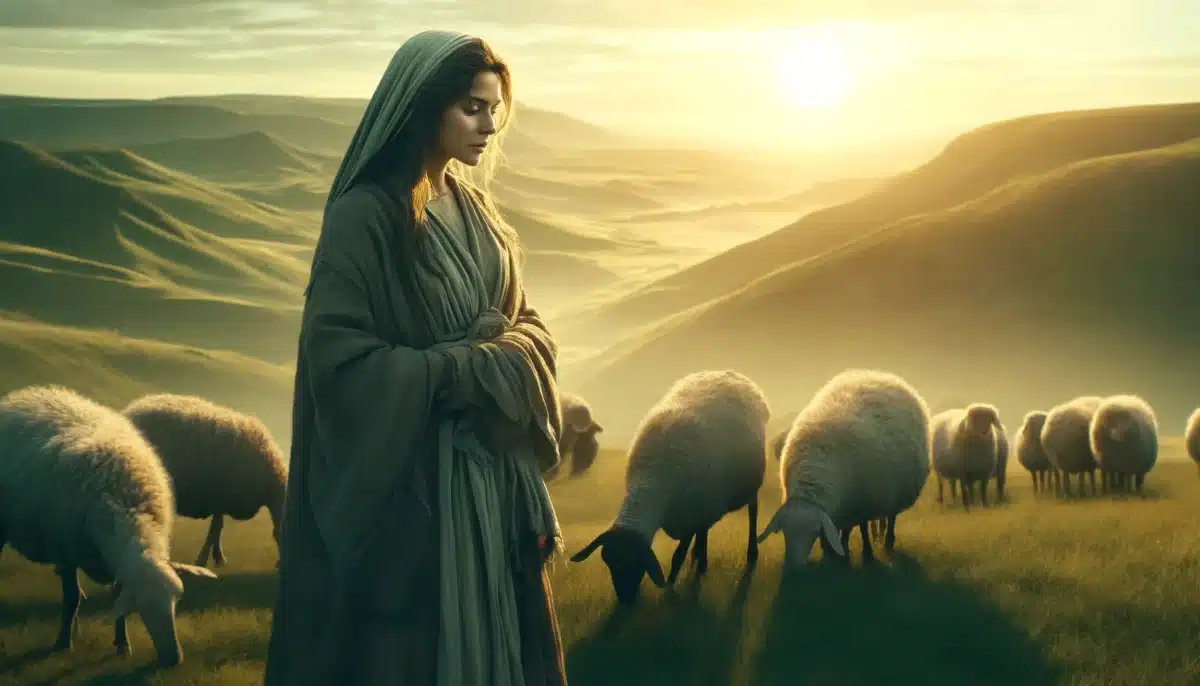
Rachel was the younger daughter of Laban, a wealthy herdsman from Paddan Aram. She had an older sister named Leah.
Family Background
Rachel’s family had deep ties to Jacob’s. Laban, her father, was Jacob’s uncle. This made Rachel and Leah Jacob’s first cousins.
The family dynamics were complex. Deception and rivalry were common themes:
- Laban vs. Jacob: Laban tricked Jacob into marrying Leah before Rachel.
- Rachel vs. Leah: The sisters often competed for Jacob’s affection and attention.
These relationships set the stage for much of Rachel’s life story.
Encounter at the Well
The story of Rachel begins in Genesis 29 when she meets Jacob at a well (“NKJV”).
Jacob travels to Haran to escape his brother Esau and finds Rachel watering her father’s flock there:
- Genesis 29:10 (NKJV): “And it came to pass, when Jacob saw Rachel… he went near and rolled the stone from the well’s mouth.”
Jacob immediately falls in love with her beauty and grace. This meeting marks the beginning of their complex but enduring relationship.
Marriage and Family

Rachel’s life was full of love, struggle, and faith. She experienced a complex marriage arrangement with Jacob.
Marriage to Jacob
Rachel married Jacob under unusual circumstances. When Jacob arrived in Haran, he fell deeply in love with Rachel. He agreed to work seven years for her father Laban to marry her (Genesis 29:18 NKJV). But Laban tricked him by giving Leah instead of Rachel.
Jacob only realized the deception the morning after the wedding (Genesis 29:25 NKJV). Angered but determined, he confronted Laban. Laban then allowed Jacob to marry Rachel immediately on the condition that he completed his week-long wedding obligations to Leah first.
Jacob worked another seven years for Laban after marrying Rachel (Genesis 29:28-30 NKJV). Even though these challenges, Jacob’s love for Rachel remained strong throughout their lives together.
Struggle with Infertility
Rachel faced significant troubles with infertility. This caused great distress and competition between her and Leah. While Leah bore children easily, Rachel struggled for many years without conceiving (Genesis 30:1 NKJV).
Desperate, she cried out to God and also asked Jacob to give her children or she would die (Genesis 30:1-2 NKJV). Her pain deepened as her sister continued having more children.
To cope, she gave her maid Bilhah to Jacob as a surrogate wife who bore two sons Dan and Naphtali on her behalf (Genesis 30:3-8 NKJV). Yet still, Rachel did not lose faith; she continued praying for God’s blessing.
Birth of Joseph and Benjamin
God finally answered Rachel’s prayers. She conceived Joseph after many years of waiting (Genesis 30:22-24 NKJV). His birth brought immense joy as she exclaimed “God has taken away my reproach” (Genesis 30:23 NKJV).
Later in life during their journey from Bethel, God blessed Rachel again with another son named Benjamin even though complications during childbirth which led to her death (Genesis 35:16-19 NKJV).
Her legacy lived through these two sons who played significant roles among the twelve tribes of Israel reflecting God’s faithfulness even amidst human struggles.
Rachel and Leah
Rachel and Leah are central figures in the Bible, particularly in the Book of Genesis. Their relationship is marked by significant events and dynamics.
Rivalry Between the Sisters
Rachel and Leah’s rivalry stemmed from their marriages to Jacob. Laban deceived Jacob by marrying him to Leah first. This act caused tension between the sisters. Rachel, loved more by Jacob, envied Leah for her fertility. Genesis 30:1 (NKJV) states, “Now when Rachel saw that she bore Jacob no children, Rachel envied her sister.”
Leah, feeling unloved even though bearing children for Jacob, sought God’s favor through prayer. In response, God blessed her with more offspring. Such actions heightened their rivalry further.
To compete with Leah’s many sons (Reuben, Simeon), Rachel gave her maid Bilhah to Jacob as a surrogate mother. Bilhah bore two sons: Dan and Naphtali (Genesis 30:3-8). Similarly, Leah offered her maid Zilpah who also bore two sons: Gad and Asher (Genesis 30:9-13).
The constant competition reflects deep familial strife rooted in Laban’s deception and societal pressures on women about childbearing.
Impact on Family Dynamics
The sisters’ rivalry deeply impacted family dynamics. The favoritism shown by Jacob towards Rachel created a divide among the siblings.
Leah’s sons resented Joseph due to his status as Rachel’s firstborn son whom Jacob loved dearly (Genesis 37:4 NKJV): “But when his brothers saw that their father loved him more than all his brothers, they hated him.” This animosity led them to sell Joseph into slavery.
Rachel’s death during Benjamin’s birth added another layer of complexity (Genesis 35:18). Her passing left an emotional void in the family structure.
Jacob’s household experienced ongoing conflict influenced by these relationships but it eventually fulfilled God’s plans through the twelve tribes of Israel formed from these very offspring.
Key Events in Rachel’s Life
Laban’s Deception
Rachel’s story began with Jacob fleeing to Haran. He fell in love with Rachel, Laban’s younger daughter. Jacob agreed to work seven years for her hand in marriage. But, on the wedding night, Laban deceived him by substituting Leah for Rachel.
Laban justified this by citing tradition: “It must not be done so in our country, to give the younger before the firstborn” (Genesis 29:26 NKJV). Jacob was forced to work another seven years to marry Rachel.
The Mandrake Roots Incident
Rachel struggled with barrenness and felt distressed seeing Leah bear children. In desperation, she sought mandrake roots from Leah’s son Reuben. These were believed to aid fertility.
She struck a deal with Leah: “Please give me some of your son’s mandrakes” (Genesis 30:14 NKJV). In exchange, Leah could sleep with Jacob that night. This incident highlighted Rachel’s yearning for motherhood and the complex family dynamics.
The Flight From Laban
Jacob decided it was time to leave Laban and return home. He took his family and possessions without informing Laban. Rachel played a crucial role during this flight.
She stole her father’s household idols, hiding them under her camel’s saddle (Genesis 31:34 NKJV). This act added tension when Laban pursued them but couldn’t find the idols even though searching thoroughly.
Rachel’s Death And Burial
Rachel experienced complications while giving birth to Benjamin. Her labor was difficult and eventually fatal.
As she breathed her last, she named her son Ben-Oni (“son of my sorrow”), but Jacob renamed him Benjamin (“son of my right hand”) (Genesis 35:18 NKJV). She was buried on the way to Ephrath near Bethlehem; Jacob set up a pillar at her grave as a lasting tribute (Genesis 35:19-20 NKJV).
Here’s a summary table:
| Event | Details |
|---|---|
| Laban’s Deception | Switched Leah for Rachel on wedding night; made Jacob work 14 years total |
| Mandrake Roots Incident | Exchanged fertility-aiding mandrakes for permission for Leah sleeping with Jacob |
| The Flight from Laban | Stole father’s idols during family’s secret departure |
| Rachel’s Death and Burial | Died giving birth to Benjamin; buried near Bethlehem; memorialized by pillar |
These key events reflect significant moments that shaped Rachel’s life and legacy within biblical history.
Lessons from Rachel’s Story
Rachel’s story in the Bible offers rich lessons on faith, perseverance, jealousy, and divine timing. Her life reveals how God’s plans unfold even though human struggles.
Faith and Perseverance
Rachel demonstrated unwavering faith and perseverance. She faced barrenness, a significant issue at the time. Even though this struggle, she continued to trust God. The Bible says Rachel’s womb was eventually opened by God: “Then God remembered Rachel, and God listened to her and opened her womb” (Genesis 30:22 NKJV). This shows that even after years of waiting, her faith didn’t waver.
Her acceptance of her circumstances is noteworthy. While childless for many years, she patiently waited for God’s intervention. Her eventual conception of Joseph and Benjamin exemplifies divine blessing after persistent faith.
The Role of Jealousy and Rivalry
Jealousy played a substantial role in Rachel’s life. She envied Leah when Leah bore children while she remained childless. This rivalry impacted their relationship deeply.
The tension between Rachel and Leah grew due to Jacob’s favoritism towards Rachel. Leah felt unloved even though bearing children: “When the Lord saw that Leah was unloved, He opened her womb; but Rachel was barren” (Genesis 29:31 NKJV). This created a competitive dynamic within the family.
Rachel resorted to offering Bilhah as a surrogate mother out of desperation for children. Bilhah bore two sons for Jacob because of this decision. These acts intensified the sibling rivalry but also highlighted human emotions intertwined with divine plans.
Trust in Divine Timing
Trusting in God’s timing is another profound lesson from Rachel’s story. After long years of infertility, she finally conceived Joseph following fervent prayers: “And she conceived and bore a son…and called his name Joseph” (Genesis 30:23-24 NKJV).
Her trust extended beyond just waiting; it included accepting God’s plan without bitterness or loss of hope. Even amid hardship during Benjamin’s birth—which led to her death—her initial naming him Ben-Oni signified sorrow yet transitioned into strength upon Jacob renaming him Benjamin.
These events underscore that trusting divine timing brings about fulfillment even if preceded by prolonged trials or suffering.
Legacy and Significance
Rachel, one of the Bible’s matriarchs, carries deep significance. Her story impacts both Jewish and Christian traditions.
Cultural and Religious Impact
Rachel is the mother of Joseph and Benjamin. These sons founded two of the twelve tribes of Israel. Joseph became Egypt’s vizier, saving many during a famine (Genesis 41:56). Benjamin’s descendants included Saul and Mordecai.
Her life symbolizes love, sorrow, and hope. Rachel’s deep desire for children highlights her emotional investment in motherhood (Genesis 30:1). Her struggles reflect themes of faith and divine intervention.
Key Points:
- Mother to influential tribes
- Symbolic representation of faith
- Emotional journey through motherhood
Rachel’s Tomb and Pilgrimage
Rachel’s tomb lies near Bethlehem. This site is significant for pilgrims from various faiths.
The tomb marks where Rachel died giving birth to Benjamin (Genesis 35:19). It remains a symbol of maternal sacrifice. Many visit to pray for fertility or safe childbirth.
- Located near Bethlehem
- Important pilgrimage site
- Symbolizes maternal sacrifice
Conclusion
Rachel’s story is a profound testament to faith love and perseverance. Even though facing numerous hardships her unwavering trust in God’s plan shines through. Her life reminds us of the virtues of patience and the importance of enduring love even amidst trials. Rachel’s legacy as a matriarch continues to inspire many reflecting themes that resonate deeply today.
Her journey through infertility rivalry and ultimate motherhood offers timeless lessons on divine timing and human resilience. Rachel’s impact on biblical history remains significant with her memory honored by generations who find strength in her story.
What Can We Learn About Faith and Perseverance from Rachel That Relates to Jael’s Bold Actions?
Rachel’s struggles evoke lessons in faith and perseverance, illuminating the path Jael chose to follow. Both women faced daunting circumstances yet remained steadfast. Jael’s courage in fulfilling divine purpose exemplifies how unwavering belief can lead to decisive action, echoing Rachel’s resilience amidst adversity and the transformative power of faith.
Share On Pinterest!


Related Posts

What Does the Bible Actually Say About Faith?
Last updated: May 2026 What does the Bible really say about faith? Discover the biblical definition, what Jesus taught, and how faith actually works in everyday life.
 May 16, 2026
The Hebrews 11 'Hall of Faith' — A Deep Dive
Last updated: May 2026 Explore Hebrews 11's hall of faith and discover how biblical heroes like Abel, Noah, and Abraham trusted God against impossible odds. Read our deep dive analysis.
May 15, 2026
What You'll Learn in a Complete Bible Study on Faith
Last updated: May 2026 Discover what a complete Bible study on faith really covers — from the true biblical definition of faith, to doubt, healing, grace, and how faith grows. Grounded in Scripture, practical for everyday life.
May 13, 2026
How to Choose the Right Bible Study on Love (What to Look For)
Last updated: May 2026 Not all Bible studies on love are created equal. Learn what to look for — theological depth, serious Scripture, and application that actually changes how you love.
May 21, 2026


 By
By


